Remember this?
Well….weird stuff or stuff that doesn’t fit into other categories
Microsoft dazzles developers with demos of its HoloLens at Build 2015.
A bold new idea aims to link two mutually incompatible descriptions of the universe. It may also reveal how quantum information is responsible for constructing
Source: Wormhole Entanglement and the Firewall Paradox | Quanta Magazine
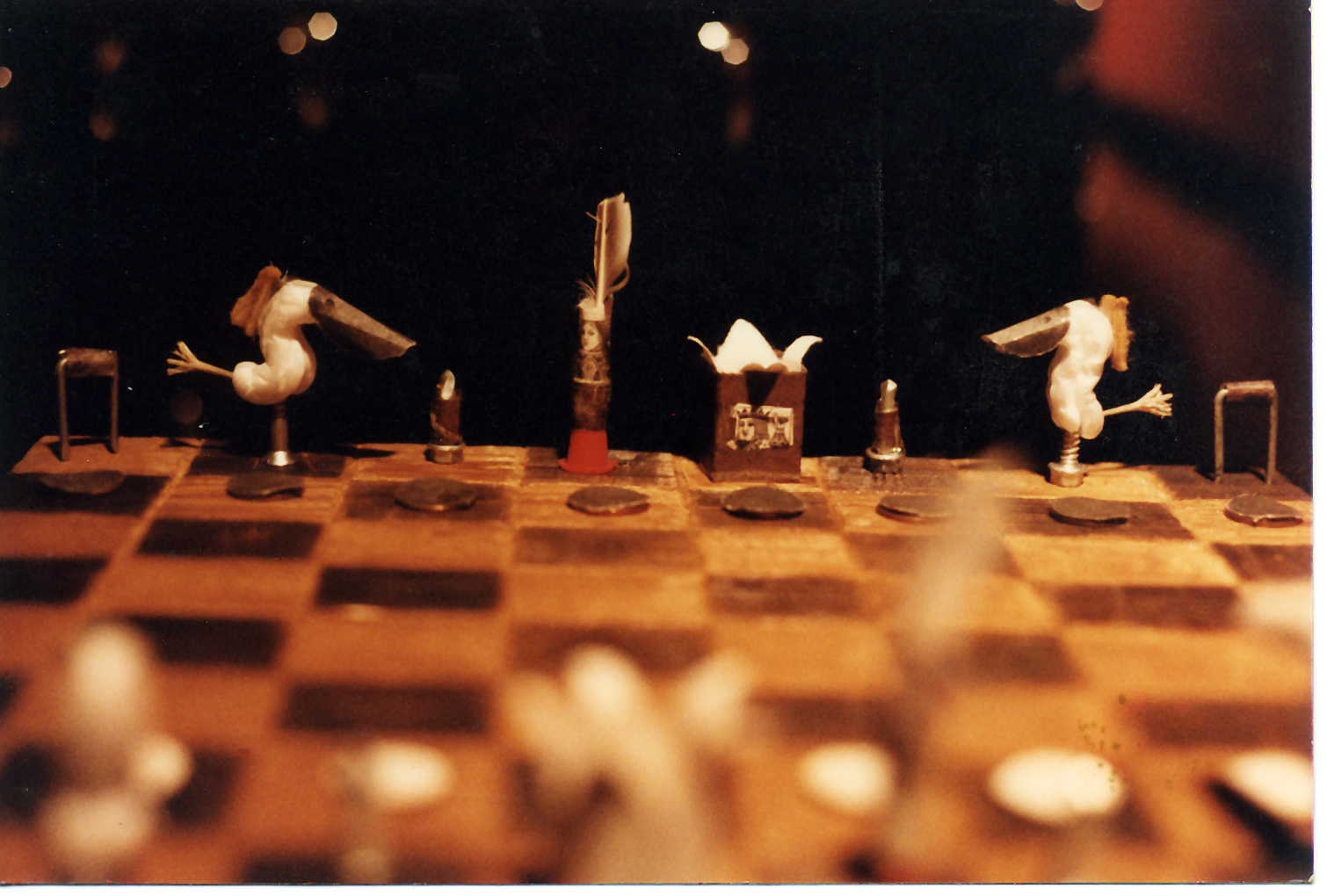
Here’s a picture of a chess board that Scott Woodman and I made late one night in the studio. We used whatever we could find around the place, actually burning the black squares with some books of matches we found. It was really fun, and we played one game that Scott won in the last moments when I clenched defeat from the jaws of victory.

Old Sonic from 2004 (RIPITBY)
Imagine Voyager landing on an inhabited planet far away. Look through all of the contents of the golden record that was sent along. Imagine two scenarios. One – a planet on which the inhabitants have just discovered radio waves. Two – a planet where the civilization has advanced farther than our own here on Earth. Imagine what those two scenarios would be like. I think there is a best selling book in there somewhere!
In the early 1970s, the National Aeronautics and Space Administration (NASA) developed a mission called Voyager to make a “grand tour” of Jupiter and Saturn — and possibly Uranus and Neptune if all went well. The agency planned to launch a pair of unmanned spacecraft on different trajectories to thoroughly study the planets from multiple angles. Voyager 1 and Voyager 2 are identical in construction. Each weighs around 1,500 pounds. Each is equipped to conduct 10 specific experiments, ranging from taking pictures to measuring atmospheric plasma concentrations. Each contains about 65,000 individual parts. (Some of those components represent technology that might seem laughable now but was cutting – edge at the time, such as a digital eight-track recorder.) When they were launched in 1977, the Voyagers were designed for a five-year lifespan, but both have outlived that projection by 30 years.
NASA launched Voyager 1 on September 5, 1977, 16 days after the launch of Voyager 2. Why this reversal in order? The Voyager mission was designed to take advantage of a rare configuration of the solar system’s giant planets, Jupiter, Saturn, Uranus and Neptune. In this arrangement, which occurs roughly once every 175 years, the giants lined up in a way that would allow the probes to harness each planet’s gravitational forces to “swing” from one to the next with minimal self-propulsion. To accomplish this feat, the probes were launched on different trajectories. Voyager 2?s so-called slow trajectory would enable it to potentially visit all four giant planets, while Voyager 1?s faster trajectory would get it to Jupiter and Saturn before it headed into deep space. Voyager 1?s course allowed it to overtake Voyager 2 in the Asteroid Belt and gain the lead position in the mission. So, while Voyager 1 launched second, NASA knew all along it would take first place in the race to deep space, and they named it accordingly.
Because of the complexity of using a “gravity assist” technique to propel Voyager 1 from Jupiter to Saturn and then on to interstellar space during its exploratory mission, NASA engineers considered thousands of potential trajectories for the probe. The engineers needed to chart a precise course that would take Voyager close to the planets but not so close that the next leg of the journey was compromised. Ultimately, NASA engineers chose a route for Voyager 1 that would ensure the completion of its primary mission to study the two giant planets before propelling it toward interstellar space. Thirty-five years later, it’s safe to say they chose well.
In order to offer a sense of Earth’s culture to any spacefarers encountered by Voyager 1, NASA included a 12-inch gold – plated audiovisual disc on the craft. Dubbed the Golden Record, this disc contains a variety of content that was chosen by a committee chaired by the late scientist Carl Sagan. The disc includes photos and drawings, spoken greetings in many languages, music and Earth sounds. For the convenience of any alien life forms that discover the Golden Disc, NASA included a cartridge and needle for playback. However, the extraterrestrials will first have to figure out how to build a record player and speaker. Including that technology aboard Voyager 1 would have added too much weight and bulk.
Not long after Voyager 1?s encounter with Saturn in 1980, NASA engineers turned off the craft’s cameras to conserve energy. For nearly a decade, the probe quietly flew toward deep space. But as it approached the edge of the solar system, NASA engineers on February 14, 1990, instructed Voyager to turn its cameras back on and take a last look over its shoulder at the planets. In a series of 60 images, Voyager 1 returned the only “family portrait” of our solar system, including the sun, Venus, Earth, Jupiter, Saturn and Uranus. The photo mosaic depicts Earth as a small, pale blue dot afloat in the vastness of space. The photos were the last Voyager 1 ever took; its cameras were again turned off to maintain maximal energy reserves as the craft prepared to become the first manmade object to reach interstellar space.
Contents of the golden record
http://voyager.jpl.nasa.gov/spacecraft/scenes.html
January 23 2015

| Distance from Earth |
19,573,745,704 KM
130.84240847 AU
|
| Distance from the Sun |
19,491,771,870 KM
130.29444724 AU
|
| Roundtrip Light Time from the Sun |
36:16:21
hh:mm:ss |

| Distance from Earth |
16,129,053,317 KM
107.81606210 AU
|
| Distance from the Sun |
16,011,636,748 KM
107.03118081 AU
|
| Roundtrip Light Time from the Sun |
29:53:21
hh:mm:ss |
The chart above is a real-time odometer of Voyager 2’s distance from the Earth and the Sun in astronomical units (AU) and kilometers (km). Note: Because Earth moves around the sun faster than Voyager 2 is traveling from Earth, the distance between Earth and the spacecraft actually decreases at certain times of the year.
http://voyager.jpl.nasa.gov/where/
Q: What did God do before he created the Universe?
A: He was busy preparing Hell for the people who ask such questions.
A major research institution has just announced the discovery of the densest element yet known to science. The new element has been named Pelosium. The chemical symbol of Pelosium is Pu. Pelosium has one neutron, 12 assistant neutrons, 75 deputy neutrons, and 224 assistant deputy neutrons, giving it an atomic mass of 311. These particles are held together by dark particles called morons, which are surrounded by vast quantities of lepton-like particles called peons.
Pelosium’s mass actually increases over time, as morons randomly interact with various elements in the atmosphere and become assistant deputy neutrons within the Pelosium molecule, leading to the formation of isodopes. This characteristic of moron-promotion leads some scientist to believe that Pelosium is formed whenever morons reach a certain quantity in concentration. This hypothetical quantity is referred to as Critical Morass.
When catalyzed with money, Pelosium activates MSNBCobnoxium and CNNadnausium, both elements that radiate orders of magnitude more energy, albeit as incoherent noise, since they have half as many peons but twice as many morons as Pelosium.
Since it has no electrons, Pelosium is inert. However, it can be detected chemically as it impedes every reaction it comes in contact with. According to the discoverers, a minute amount of Pelosium causes one reaction to take over four days to complete when it would have normally occurred in less than a second. In the presense of anti-morons, Pelosium can be extremely corrosive. Botox seems to distort and smooth it’s surface, without impeding it’s ongoing decay.
Pelosium has a normal half-life of approximately two years, at which time it does not decay, but instead undergoes a transmutation, appearing in a new location but displaying the same properties. In this process, assistant neutrons, vice neutrons and assistant vice neutrons exchange places. Some studies have shown that the atomic mass actually increases after each transmutation.
Research at other laboratories indicates that Pelosium occurs naturally in the atmosphere. It tends to concentrate at certain points such as government agencies, large corporations, universities, and anywhere there is news coverage occurring. It can usually be found in the newest, best appointed, and best maintained buildings.
Scientists point out that Pelosium is known to be toxic at any level of concentration and can easily destroy any productive reaction where it is allowed to accumulate. Attempts are being made to determine how Pelosium can be controlled to prevent irreversible damage, but results to date are not promising.
