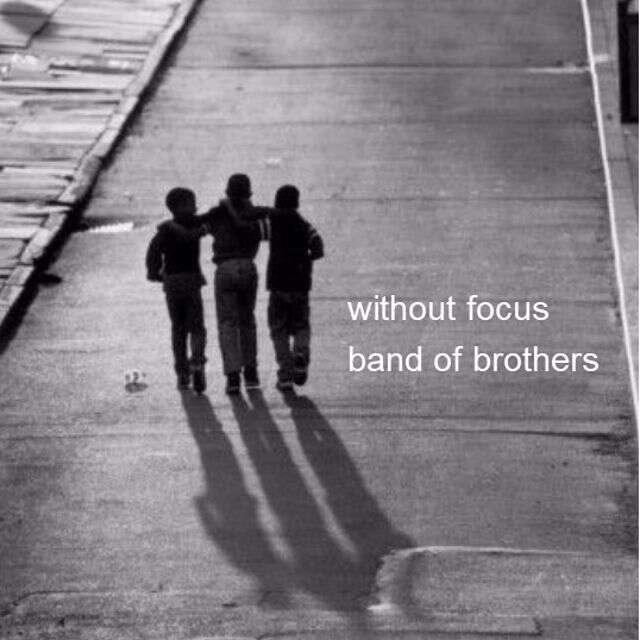
Because
This is my cover version of the great Beatles song from the Abbey Road album.
This is my cover version of the great Beatles song from the Abbey Road album.
Album will be released on December 1, 2024. Here is a playlist of all the videos for the album.

My Friend Dave Loehr helped me with the lyrics for this song. This will be the last song on my new album ‘Charm’ that will be out in December.

Well, I asked Gemini why I couldn’t see my Network computer, but could map drives and remote in. This fixed it.
On my windows 10 system, I cannot see a second computer that is on the network. I can map drives from it and I can remote into it, but it is not showing up in my Network places. How can I fix this? Show drafts

Here are several solutions to try to fix the issue:
1. Enable Network Discovery and File and Printer Sharing:
2. Set Network Location to Private:
3. Check Firewall Settings:
4. Verify Workgroup Settings:
5. Enable SMB 1.0/CIFS File Sharing Support:
6. Reset Network Settings:
7. Check IP Addresses:
8. Disable Antivirus Temporarily:
9. Check for Windows Updates:
10. Manually Map Network Drive:
If you’ve tried these solutions and still can’t see the other computer, please provide more information about your network setup, such as:
With more details, I can provide more tailored troubleshooting steps.
The eternal battle between good and bad is a real thing. If you are a normal non-sociopath, the borders are clear, but the temptation is also great. Be careful, the Devil will take your soul if he can.
Here is the video:
In Christianity, the Devil is the personification of evil. He is traditionally held to have rebelled against God in an attempt to become equal to God himself.[a] He is said to be a fallen angel, who was expelled from Heaven at the beginning of time, before God created the material world, and is in constant opposition to God.[2][3] The devil is conjectured to be several other figures in the Bible including the serpent in the Garden of Eden, Lucifer, Satan, the tempter of the Gospels, Leviathan, and the dragon in the Book of Revelation.
Early scholars discussed the role of the devil. Scholars influenced by neoplatonic cosmology, like Origen and Pseudo-Dionysius, portrayed the devil as representing deficiency and emptiness, the entity most remote from the divine. According to Augustine of Hippo, the realm of the devil is not nothingness, but an inferior realm standing in opposition to God. The standard Medieval depiction of the devil goes back to Gregory the Great. He integrated the devil, as the first creation of God, into the Christian angelic hierarchy as the highest of the angels (either a cherub or a seraph) who fell far, into the depths of hell, and became the leader of demons.[4]
Since the early Reformation period, the devil has been imagined as an increasingly powerful entity, with not only a lack of goodness but also a conscious will against God, his word, and his creation. Simultaneously, some reformists have interpreted the devil as a mere metaphor for humans’ inclination to sin — thereby downgrading his importance. While the devil has played no significant role for most scholars in the Modern Era, he has become important again in contemporary Christianity.
At various times in history, certain Gnostic sects such as the Cathars and the Bogomils, as well as theologians like Marcion and Valentinus, have believed that the devil was involved in creation. Today these views are not part of mainstream Christianity.

The Hebrew term śāṭān (Hebrew: שָּׂטָן) was originally a common noun meaning “accuser” or “adversary” that was applicable to both human and heavenly adversaries.[5][6] The term is derived from a verb meaning primarily “to obstruct, oppose”.[7] [8] Throughout the Hebrew Bible, it refers most frequently to ordinary human adversaries.[9][10][6] However, 1 Samuel 29:4; 2 Samuel 19:22; 1 Kings 5:4; 1 Kings 11:14, 23, 25; Psalms 109:6 and Numbers 22:22, 32 use the same term to refer to the angel of the Lord. This concept of a heavenly being as an adversary to humans evolved into the personified evil of “a being with agency” called the Satan 18 times in Job 1–2 and Zechariah 3.[9]
Both Hebrew and Greek have definite articles that are used to differentiate between common and proper nouns, but they are used in opposite ways: in Hebrew, the article designates a common noun, whereas in Greek, the article signals an individual’s name (a proper noun).[11] For example, in the Hebrew book of Job, one of the angels is referred to as a satan, “an adversary”, but in the Greek Septuagint, which was used by the early Christians, whenever “the Satan” (Ha-Satan) appears with a definite article, it specifically refers to the individual known as the heavenly accuser whose personal name is Satan.[10] In some cases it is unclear which is intended.[11]
Henry A. Kelly says that “almost all modern translators and interpreters” of 1 Chronicles 21:1 (in which satan occurs without the definite article) agree the verse contains “the proper name of a specific being appointed to the office of adversary”.[12][13] Thomas Farrar writes that “In all three cases, satan was translated in the Septuagint as diabolos, and in the case of Job and Zechariah, with ho diabolos (the accuser; the slanderer). In all three of these passages there is general agreement among Old Testament scholars that the referent of the word satan is an angelic being”.[10][6]
In the early rabbinic literature, Satan is never referred to as “the Evil one, the Enemy, belial, Mastema or Beelzebul”.[14] No Talmudic source depicts Satan as a rebel against God or as a fallen angel or predicts his end.[14] Ancient Jewish text depicts Satan as an agent of God, a spy, a stool-pigeon, a prosecutor of mankind and even a hangman. He descends to earth to test men’s virtue and lead them astray, then rises to Heaven to accuse them.[14]
In the Book of Job, Job is a righteous man favored by God.[15] Job 1:6–8[16] describes the “sons of God” (bənê hā’ĕlōhîm) presenting themselves before God:[15]
“Sons of God” is a description of ‘angels’ as supernatural heavenly beings, “ministers of Yahweh, able under His direction to intervene in the affairs of men, enjoying a closer union with Yahweh than is the lot of men. They appear in the earliest books of the Old Testament as well as in the later… They appear in prophetical and sapiential literature as well as in the historical books; they appear in the primitive history and in the most recent history… they usually appear in the Old Testament in the capacity of God’s agents to men; otherwise they appear as the heavenly court of Yahweh. They are sent to men to communicate God’s message, to destroy, to save, to help, to punish. …The angels are in complete submission to the will of God… Whenever they appear among men, it is to execute the will of Yahweh.”[17]
God asks one of them where he has been. Satan replies that he has been roaming around the earth.[15] God asks, “Have you considered My servant Job?”[15] Satan thinks Job only loves God because he has been blessed, so he requests that God test the sincerity of Job’s love for God through suffering, expecting Job to abandon his faith.[18] God consents; Satan destroys Job’s family, health, servants and flocks, yet Job refuses to condemn God.[18] At the end, God returned to Job twice what he had lost. This is one of the two Old Testament passages, along with Zechariah 3, where the Hebrew ha-Satan (the Adversary) becomes the Greek ho diabolos (the Slanderer) in the Greek Septuagint used by the early Christian church.[19]
A satan is involved in King David‘s census and Christian teachings about this satan varies, just as the pre-exilic account of 2 Samuel and the later account of 1 Chronicles present differing perspectives:
And again the anger of the LORD was kindled against Israel, and He moved David against them, saying: ‘Go, number Israel and Judah.’
— 2 Samuel 24:1[20]
However, Satan rose up against Israel, and moved David to number Israel.
— 1 Chronicles 21:1[21]
According to some teachings, this term refers to a human being, who bears the title satan while others argue that it indeed refers to a heavenly supernatural agent, an angel.[22] Since the satan is sent by the will of God, his function resembles less the devilish enemy of God. Even if it is accepted that this satan refers to a supernatural agent, it is not necessarily implied this is the Satan. However, since the role of the figure is identical to that of the devil, viz. leading David into sin, most commentators and translators agree that David’s satan is to be identified with Satan and the Devil.[23]
Zechariah‘s vision of recently deceased Joshua the High Priest depicts a dispute in the heavenly throne room between Satan and the Angel of the Lord (Zechariah 3:1–2).[24] The scene describes Joshua the High Priest dressed in filthy rags, representing the nation of Judah and its sins,[25] on trial with God as the judge and Satan standing as the prosecutor.[25] Yahweh rebukes Satan[25] and orders that Joshua be given clean clothes, representing God’s forgiveness of Judah’s sins.[25] Goulder (1998) views the vision as related to opposition from Sanballat the Horonite.[26] Again, Satan acts in accordance with God’s will. The text implies he functions both as God’s accuser and as his executioner.[27]
Some parts of the Bible, which do not originally refer to an evil spirit or Satan, have been retroactively interpreted as references to the devil.[28]

The Garden of Eden with the Fall of Man by Jan Brueghel the Elder and Pieter Paul Rubens, c. 1615, depicting Eve reaching for the forbidden fruit beside the Devil portrayed as a serpent
Genesis 3 mentions the serpent in the Garden of Eden, which tempts Adam and Eve into eating the forbidden fruit from the tree of the knowledge of good and evil, thus causing their expulsion from the Garden. God rebukes the serpent, stating: “I will put enmity between you and the woman, and between your offspring and hers; he will strike your head, and you will strike his heel” (Genesis 3:14–15).[29] Although the Book of Genesis never mentions Satan,[30] Christians have traditionally interpreted the serpent in the Garden of Eden as the devil due to Revelation 12:9,[31] which describes the devil as “that ancient serpent called the Devil, or Satan, the one deceiving the whole world; was thrown down to the earth with all his angels.”[32][6] This chapter is used not only to explain the fall of mankind but also to remind the reader of the enmity between Satan and humanity. It is further interpreted as a prophecy regarding Jesus’ victory over the devil, with reference to the child of a woman, striking the head of the serpent.[33]

The idea of fallen angels was familiar in pre-Christian Hebrew thought from the Book of the Watchers, according to which angels who impregnated human women were cast out of heaven. The Babylonian/Hebrew myth of a rising star, as the embodiment of a heavenly being who is thrown down for his attempt to ascend into the higher planes of the gods, is also found in the Bible, (Isaiah 14:12–15)[34] was accepted by early Christians, and interpreted as a fallen angel.[35]
Aquila of Sinope derives the word hêlêl, the Hebrew name for the morning star, from the verb yalal (to lament). This derivation was adopted as a proper name for an angel who laments the loss of his former beauty.[36] The Christian church fathers—for example Saint Jerome, in his Vulgate—translated this as Lucifer. The equation of Lucifer with the fallen angel probably occurred in 1st-century Palestinian Judaism.[37] The church fathers brought the fallen lightbringer Lucifer into connection with the devil on the basis of a saying of Jesus in the Gospel of Luke (10.18 EU): “I saw Satan fall from heaven like lightning.”[35]
In his work De principiis Proemium and in a homily on Book XII, the Christian scholar Origen compared the morning star Eosphorus-Lucifer with the devil. According to Origen, Helal-Eosphorus-Lucifer fell into the abyss as a heavenly spirit after he tried to equate himself with God. Cyprian c. 400, Jerome c. 345–420),[38] Ambrosius c. 340–397, and a few other church fathers essentially subscribed to this view. They viewed this earthly overthrow of a pagan king of Babylon as a clear indication of the heavenly overthrow of Satan.[39] In contrast, the church fathers Hieronymus, Cyrillus of Alexandria (412–444), and Eusebius c. 260–340 saw in Isaiah’s prophecy only the mystifying end of a Babylonian king.
Some scholars use Ezekiel’s cherub in Eden to support the Christian doctrine of the devil:[40]
You were in Eden, the garden of God; every precious stone adorned you: ruby, topaz, emerald, chrysolite, onyx, jasper, sapphire, turquoise, and beryl. Gold work of tambourines and of pipes was in you. In the day that you were created they were prepared. You were the anointed cherub who covers: and I set you, so that you were on the holy mountain of God; you have walked up and down in the midst of the stones of fire. You were perfect in your ways from the day that you were created, until unrighteousness was found in you.
— Ezekiel 28:13–15[41]
This description is used to establish major characteristics of the devil: that he was created good as a high ranking angel, that he lived in Eden, and that he turned evil on his own accord. The Church Fathers argued that, therefore, God is not to be blamed for evil but rather the devil’s abuse of free will.[42]
In the Old Testament, the term belial (Hebrew: בְלִיַּעַל, romanized: bĕli-yaal), with the broader meaning of worthlessness[43] denotes those who work against God or at least against God’s order.[44] In Deuteronomy 13:14 those who tempt people into worshiping something other than Yahweh are related to belial. In 1 Samuel 2:12, the sons of Eli are called belial for not recognizing Yahweh and violating sacrifice rituals.[45] In Psalm 18:4 and Psalm 41:8, belial appears in the context of death and disease. In the Old Testament, both Satan and belial make it difficult for men to live in harmony with God’s will.[46] Belial is thus another template for the later conception of the devil.[47] On the one hand, both Satan and belial cause hardship for humans, but while belial opposes God, represents chaos and death, and stands outside of God’s cosmos, Satan, on the other hand, accuses what opposes God. Satan punishes what belial stands for.[47] Unlike Satan, belial is not an independent entity, but an abstraction.[48]
Although not part of the canonical Bible, intertestamental writings shaped the early Christian worldview and influenced the interpretation of the Biblical texts. Until the third century, Christians still referred to these stories to explain the origin of evil in the world.[49] Accordingly, evil entered the world by apostate angels, who lusted after women and taught sin to mankind. The Book of Enoch and the Book of Jubilees are still accepted as canonical by the Ethiopian Church.[50] Many Church Fathers accepted their views about fallen angels, though they excluded Satan from these angels. Satan instead, fell after tempting Eve in the Garden of Eden.[51] Satan was being used as a proper name in the apocryphal Jewish writings such as the Book of Jubilees 10:11; 23:29; 50:5, the Testament of Job, and The Assumption of Moses which are contemporary to the writing of the New Testament.[52]
The Book of Enoch, estimated to date from about 300–200 BC, to 100 BC,[53] tells of a group of angels called the Watchers. The Watchers fell in love with human women and descended to earth to have intercourse with them, resulting in giant offspring.[54] On earth, these fallen angels further teach the secrets of heaven like warcraft, blacksmithing, and sorcery.[54] There is no specific devilish leader, as the fallen angels act independently after they descend to earth, but eminent among these angels are Shemyaza and Azazel.[44] Only Azazel is rebuked by the prophet Enoch himself for instructing illicit arts, as stated in 1 Enoch 13:1.[55] According to 1 Enoch 10:6, God sent the archangel Raphael to chain Azazel in the desert Dudael as punishment.
Satan, on the other hand, appears as a leader of a class of angels. Satan is not among the fallen angels but rather a tormentor for both sinful men and sinful angels. The fallen angels are described as “having followed the way of Satan”, implying that Satan led them into their sinful ways, but Satan and his angels are clearly in the service of God, akin to Satan in the Book of Job. Satan and his lesser satans act as God’s executioners: they tempt into sin, accuse sinners for their misdeeds, and finally execute divine judgment as angels of punishment.[56]
The Book of Jubilees also identifies the Bene Elohim (“sons of God”) in Genesis 6 with the offspring of fallen angels, adhering to the Watcher myth known from the Book of Enoch. Throughout the book, another wicked angel called Mastema is prominent. Mastema asks God to spare a tenth of the demons and assign them under his domain so that he might prove humanity to be sinful and unworthy. Mastema is the first figure who unites the concept Satan and Belial. Morally questionable actions ascribed to God in the Old Testament, like environmental disasters and tempting Abraham, are ascribed to Mastema instead, establishing a satanic character distant from the will of God in contrast to early Judaism. Still, the text implies that Mastema is a creature of God, although contravening his will. In the end times, he will be extinguished.[57]
“Father of Lies” redirects here. For other uses, see Father of Lies (disambiguation).
.jpg)
The devil figures much more prominently in the New Testament and in Christian theology than in the Old Testament and Judaism. Religion scholar William Caldwell writes that “In the Old Testament we have seen that the figure of Satan is vague. … In reaching the New Testament we are struck by the unitariness, clearness, and definiteness of the outline of Satan.”[58] The New Testament Greek word for the devil, satanas, which occurs 38 times in 36 verses, is not actually a Greek word: it is transliterated from Aramaic, but is ultimately derived from Hebrew.[52] Scholars agree that “Satan” is always a proper name in the New Testament.[52] In Mark 1:13 “ho Satanas” is a proper name that identifies a particular being with a distinct personality:[59]
The figure whom Mark designates as the perpetrator of Jesus’ Wilderness temptation, whether called Satan or one of a host of other names, was not an ‘unknown quantity’. On the contrary, in Mark’s time and in the thought world which Mark and his audience shared, Satan’s identity and the activities characteristic of him were both well-defined and widely known.[60]
Although in later Christian theology, the devil and his fellow fallen angels are often merged into one category of demonic spirits, the devil is a unique entity throughout the New Testament.[61] The devil is not only a tempter but perhaps rules over the kingdoms of earth.[62] In the temptation of Christ (Matthew 4:8–9 and Luke 4:6–7),[63] the devil offers all kingdoms of the earth to Jesus, implying they belong to him.[64] Since Jesus does not dispute this offer, it may indicate that the authors of those gospels believed this to be true.[64] This interpretation is, however, not shared by all, as Irenaeus argued that, since the devil was a liar since the beginning, he also lied here and that all kingdoms in fact belong to God, referring to Proverbs 21.[65][66] This event is described in all three synoptic gospels, (Matthew 4:1–11,[67] Mark 1:12–13[68] and Luke 4:1–13).[69]
Other adversaries of Jesus are ordinary humans although influence by the devil is suggested. John 8:40[70] speaks about the Pharisees as the “offspring of the devil”. John 13:2[71] states that the devil entered Judas Iscariot before Judas’ betrayal (Luke 22:3).[72][73] In all three synoptic gospels (Matthew 9:22–29,[74] Mark 3:22–30[75] and Luke 11:14–20),[76] Jesus’ critics accuse him of gaining his power to cast out demons from Beelzebub, the devil. In response, Jesus says that a house divided against itself will fall, and that there would be no reason for the devil to allow one to defeat the devil’s works with his own power.[77]
The Epistle of Jude makes reference to an incident where the Archangel Michael argued with the devil over the body of Moses (Jude 1:9).[78] According to the First Epistle of Peter, “Like a roaring lion your adversary the devil prowls around, looking for someone to devour” (1 Peter 5:8).[79] The authors of the Second Epistle of Peter and the Epistle of Jude believe that God prepares judgment for the devil and his fellow fallen angels, who are bound in darkness until the Divine retribution.[80]
In the Epistle to the Romans, the inspirer of sin is also implied to be the author of death.[80] The Epistle to the Hebrews speaks of the devil as the one who has the power of death but is defeated through the death of Jesus (Hebrews 2:14).[81][82] In the Second Epistle to the Corinthians, Paul the Apostle warns that Satan is often disguised as an angel of light.[80]


The Book of Revelation describes a battle in heaven (Revelation 12:7–10)[83] between a dragon/serpent “called the devil, or Satan” and the archangel Michael resulting in the dragon’s fall. Here, the devil is described with features similar to primordial chaos monsters, like the Leviathan in the Old Testament.[61] The identification of this serpent as Satan supports identification of the serpent in Genesis with the devil.[84] Thomas Aquinas, Rupert of Deutz and Gregory the Great (among others) interpreted this battle as occurring after the devil sinned by aspiring to be independent of God. In consequence, Satan and the evil angels are hurled down from heaven by the good angels under leadership of Michael.[85]
Before Satan was cast down from heaven, he was accusing humans for their sins (Revelation 12:10).[86][61] After 1,000 years, the devil would rise again, just to be defeated and cast into the Lake of Fire (Revelation 20:10).[87][88] An angel of the abyss called Abaddon, mentioned in Revelation 9:11,[89] is described as its ruler and is often thought of as the originator of sin and an instrument of punishment. For these reasons, Abaddon is also identified with the devil.[90]
The concept of fallen angels is of pre-Christian origin. Fallen angels appear in writings such as the Book of Enoch, the Book of Jubilees and arguably in Genesis 6:1–4. Christian tradition and theology interpreted the myth about a rising star, thrown into the underworld, originally told about a Babylonian king (Isaiah 14:12) as also referring to a fallen angel.[91] The devil is generally identified with Satan, the accuser in the Book of Job.[92] Only rarely are Satan and the devil depicted as separate entities.[93]
Much of the lore of the devil is not biblical. It stems from post-medieval Christian expansions on the scriptures influenced by medieval and pre-medieval popular mythology.[94] In the Middle Ages there was a great deal of adaptation of biblical material, in the vernacular languages, that often employed additional literary forms like drama to convey important ideas to an audience unable to read the Latin for themselves.[95] They sometimes expanded the biblical text with additions, explanatory developments or omissions.[96] The Bible has silences: questions it does not address. For example, in the Bible, the fruit Adam and Eve ate is not defined; the apple is part of folklore.[97] Medieval Europe was well equipped to explain the silences of the Bible.[98] In addition to the use of world history and the expansion of Biblical books, additional vehicles for the adornment of Biblical tales were popular sagas, legends, and fairy tales. These provided elaborate views of a dualistic creation where the Devil vies with God, and creates disagreeable imitations of God’s creatures like lice, apes, and women.[99] The Devil in certain Russian tales had to intrigue his way on board the Ark in order to keep from drowning.[100] The ability of the Devil, in folk-tale, to appear in any animal form, to change form, or to become invisible, all such powers while nowhere mentioned in the Bible itself, have been assigned to the devil by medieval ecclesiasticism without dispute.[101]
Maximus the Confessor argued that the purpose of the devil is to teach humans how to distinguish between virtue and sin. Since, according to Christian teachings, the devil was cast out of the heavenly presence (unlike the Jewish Satan, who still functions as an accuser angel at service of God), Maximus explained how the devil could still talk to God, as told in the Book of Job, despite being banished. He argues that, as God is omnipresent within the cosmos, Satan was in God’s presence when he uttered his accusation towards Job without being in the heavens. Only after the Day of Judgement, when the rest of the cosmos reunites with God, the devil, his demons, and all whose who cling to evil and unreality will exclude themselves eternally from God and suffer from this separation.[102]
Christians have understood the devil as the personification of evil, the author of lies and the promoter of evil, and as a metaphor of human evil. However, the devil can go no further than God, or human freedom, allows, resulting in the problem of evil. Christian scholars have offered three main theodicies of why a good God might need to allow evil in the world. These are based on the free will of humankind,[103] a self-limiting God,[104] and the observation that suffering has “soul-making” value.[105] Christian theologians do not blame evil solely on the devil, as this creates a kind of Manichean dualism that, nevertheless, still has popular support.[106]
Origen was probably the first author to use Lucifer as a proper name for the devil. In his work De principiis Proemium and in a homily on Book XII, he compared the morning star Eosphorus-Lucifer—probably based on the Life of Adam and Eve—with the devil or Satan. Origen took the view that Helal-Eosphorus-Lucifer, originally mistaken for Phaeton, fell into the abyss as a heavenly spirit after he tried to equate himself with God. Cyprian (around 400), Ambrosius (around 340–397) and a few other church fathers essentially subscribed to this view which was borrowed from a Hellenistic myth.[35]
According to Origen, God created rational creatures first then the material world. The rational creatures are divided into angels and humans, both endowed with free will,[107] and the material world is a result of their choices.[108][109] The world, also inhabited by the devil and his angels, manifests all kinds of destruction and suffering too. Origen opposed the Valentinian view that suffering in the world is beyond God’s grasp, and the devil is an independent actor. Therefore, the devil is only able to pursue evil as long as God allows. Evil has no ontological reality, but is defined by deficits or a lack of existence, in Origen’s cosmology. Therefore, the devil is considered most remote from the presence of God, and those who adhere to the devil’s will follow the devil’s removal from God’s presence.[110]
Origen has been accused by Christians of teaching salvation for the devil. However, in defense of Origen, scholars have argued apocatastasis for the devil is based on a misinterpretation of his universalism. Accordingly, it is not the devil, as the principle of evil, the personification of death and sin, but the angel, who introduced them in the first place, who will be restored after this angel abandons his evil will.[111]
Augustine of Hippo‘s work, Civitas Dei (5th century), and his subsequent work On Free Will became major influences in Western demonology into the Middle Ages and even into the Reformation era, influencing notable Reformation theologians such as John Calvin and Martin Luther.[112][113] For Augustine, the rebellion of Satan was the first and final cause of evil; thus, he rejected earlier teachings about Satan having fallen when the world was already created.[114][115] In his Civitas Dei, he describes two cities (Civitates) distinct from and opposed to each other like light and darkness.[116] The earthly city is influenced by the sin of the devil and is inhabited by wicked men and demons (fallen angels) who are led by the devil. On the other hand, the heavenly city is inhabited by righteous men and the angels led by God.[116] Although his ontological division into two different kingdoms shows a resemblance to Manichean dualism, Augustine differs in regard to the origin and power of evil. He argues that evil came first into existence by the free will of the devil[117] and has no independent ontological existence. Augustine always emphasized the sovereignty of God over the devil[118] who can only operate within his God-given framework.[115]
Augustine wrote that angels sinned under differing circumstances than humans did, resulting in different consequences for their actions. Human sins are the result of circumstances an individual may or may not be responsible for, such as original sin. The person is responsible for their decisions, but not the environment or conditions in which their decisions are made. The angels who became demons had lived in Heaven; their environment was grounded and surrounded by the divine; they should have loved God more than themselves, but they delighted in their own power, and loved themselves more, sinning “spontaneously”. Because they sinned “through their own initiative, without being tempted or persuaded by anyone else, they cannot repent and be saved through the intervention of another. Hence they are eternally fixed in their self-love (De lib. arb. 3.10.29–31)”.[119][120] Since the sin of the devil is intrinsic to his nature, Augustine argues that the devil must have turned evil immediately after his creation.[121] Thus the devil’s attempt to take God’s throne is not an assault on the gates of heaven, but a turn to solipsism in which the devil becomes God in his world.[122]
Further, Augustine rejects the idea that envy could have been the first sin (as some early Christians believed, evident from sources like Cave of Treasures in which Satan has fallen because he envies humans and refused to prostrate himself before Adam), since pride (“loving yourself more than others and God”) must precede envy (“hatred for the happiness of others”).[123] Such sins are described as removal from God’s presence. The devil’s sin does not give evil a positive value, since evil is, according to Augustinian theodicy, merely a byproduct of creation. The spirits have all been created in the love of God, but the devil valued himself more, thereby abandoning his position for a lower good. Less clear is Augustine about the reason for the devil’s choosing to abandon God’s love. In some works, he argued that it is God’s grace that gives the angels a deeper understanding of God’s nature and the order of the cosmos. Illuminated by God-given grace, they became incapable of feeling any desire for sin. The other angels, however, are not blessed with grace and act sinfully.[124]
Anselm of Canterbury describes the reason for the devil’s fall in his De Casu Diaboli (“On the Devil’s Fall”). Breaking with Augustine’s diabology, he absolved God from pre-determinism and causing the devil to sin. Like earlier theologians, Anselm explained evil as nothingness, or something people can merely ascribe to something to negate its existence that has no substance in itself. God gave the devil free will, but has not caused the devil to sin by creating the condition to abuse this gift. Anselm invokes the idea of grace, bestowed upon the angels.[125] According to Anselm, grace was also offered to Lucifer, but the devil willingly refused to receive the gift from God. Anselm argues further that all rational creatures strive for good, since it is the definition of good to be desired by rational creatures, so Lucifer’s wish to become equal to God is actually in accordance with God’s plan.[126][b] The devil deviates from God’s plans when he wishes to become equal to God by his own efforts without relying on God’s grace.[126]
Anselm also played an important role in shifting Christian theology further away from the ransom theory of atonement, the belief that Jesus’ crucifixion was a ransom paid to Satan, in favor of the satisfaction theory.[128] According to this view, humanity sinned by violating the cosmic harmony God created. To restore this harmony, humanity needed to pay something they did not owe to God. But since humans could not pay the price, God had to send Jesus, who is both God and human, to sacrifice himself.[129] The devil does not play an important role in this theory of atonement any longer. In Anselm’s theology, the devil features more as an example of the abuse of free will than as a significant actor in the cosmos.[130] He is not necessary to explain either the fall or the salvation of humanity.[131]

The notion of fallen angels already existed, but had no unified narrative in Pre-Christian times. In 1 Enoch, Azazel and his host of angels came to earth in human shape and taught forbidden arts resulting in sin. In the Apocalypse of Abraham, Azazel is described with his own Kavod (Magnificence), a term usually used for the Divine in apocalyptic literature, already indicating the devil as anti-thesis of God, with the devil’s kingdom on earth and God’s kingdom in heaven.[132] In the Life of Adam and Eve, Satan was cast out of heaven for his refusal to prostrate himself before man, likely the most common explanation for Satan’s fall in Proto-orthodox Christianity.[133]
Christianity, however, depicted the fall of angels as an event prior to the creation of humans. The devil becomes considered a rebel against God, by claiming divinity for himself; he is allowed to have temporary power over the world. Thus, in prior depictions of the fallen angels, the evil angel’s misdemeanor is directed downwards (to man on earth) while, with Christianity, the devil’s sin is directed upwards (to God).[35] Although the devil is considered to be inherently evil, influential Christian scholars, like Augustine and Anselm of Canterbury, agree that the devil had been created good but, at some point, had freely chosen evil, resulting in his fall.
In early Christianity, some movements postulated a distinction between the God of Law, creator of the world and the God of Jesus Christ. Such positions were held by Marcion, Valentinus, the Basilides and Ophites, who denied the Old Testamental deity to be the true God, arguing that the descriptions of the Jewish deity are blasphemous for God. They were opposed by those like Irenaeus, Tertullian and Origen who argued that the deity presented by Jesus and the God of Jews are the same, and who, in turn, accused such movements as blaspheming against God by asserting a power higher than the Creator. As evident from Origen’s On the First Principles, those who denied the Old Testamental deity to be the true God argued that God can only be good and cannot be subject to inferior emotions like anger and jealousy. Instead, they accused him of self-deification, thus identifying him with Lucifer (Hêlêl), the opponent of Jesus and ruler of the world.[134]
However, not all dualistic movements equated the Creator with the devil. In Valentinianism, the Creator is merely ignorant, but not evil, trying to fashion the world as good as he can, but lacking the proper power to maintain its goodness.[135] Irenaeus writes in Against Heresies that, according to the Valentinian cosmological system, Satan was the left-hand ruler,[136] but actually superior to the Creator, because he would consist of spirit, while the Creator of inferior matter.[137][135]

Byzantine understanding of the devil derived mostly from the church fathers of the first five centuries. Due to the focus on monasticism, mysticism and negative theology, which were more unifying than Western traditions, the devil played only a marginal role in Byzantine theology.[139] Within such monistic cosmology, evil was considered as a deficiency having no real ontological existence. Thus the devil became the entity most remote from God, as described by Pseudo-Dionysius the Areopagite.[140]
John Climacus detailed the traps of the devil in his monastic treatise The Ladder of Paradise. The first trap of the devil and his demons is to prevent people from performing good actions. In the second, one performs good but not in accordance with God’s will. In the third, one becomes proud of one’s good actions. Only by recognizing that all the good that one can perform comes from God can the last and most dangerous trap be avoided.[102]
John of Damascus, whose works also affected Western scholastic traditions, provided a rebuttal to Dualistic cosmology. Against dualistic religions like Manichaeism, he argued that, if the devil was a principle independent from God and there are two principles, they must be in complete opposition. But if they exist, according to John, they both share the trait of existence, resulting in only one principle (of existence) again.[141] Influenced by John the Evangelist, he further emphasized the metaphors of light for good and darkness for evil.[142] Like darkness, deprivation of good results in one’s becoming non-existent and darker.[141]
Byzantine theology does not consider the devil as redeemable. Since the devil is a spirit, the devil and his angels cannot have a change in their will, just as humans turned into spirits after death are not able to change their attitude either.[143]
.jpg)
Although the teachings of Augustine, who rejected the Enochian writings and associated the devil with pride instead of envy, are usually considered to be the most fundamental depictions of the devil in medieval Christianity, some concepts like regarding evil as the mere absence of good, were far too subtle to be embraced by most theologians during the Early Middle Ages. They sought a more concrete image of evil to represent spiritual struggle and pain, so the devil became more of a concrete entity. From the 4th through the 12th centuries, Christian ideas combined with European pagan beliefs, creating a vivid folklore about the devil and introducing new elements. Although theologians usually conflated demons, satans and the devil, medieval demonology fairly consistently distinguished between Lucifer, the fallen angel fixed in hell, and the mobile Satan executing his will.[144]
Teutonic gods were often considered demons or even the devil. In the Flateyjarbók, Odin is explicitly described as another form of the devil, whom the pagans worshiped and to whom they sacrificed.[145] Everything sacred to pagans or the foreign deities was usually perceived as sacred for the devil and feared by Christians.[146] Many pagan nature spirits like dwarfs and elves became seen as demons, although a difference remained between monsters and demons. The monsters, regarded as distorted humans, probably without souls, were created so that people might be grateful to God that they did not suffer in such a state; they ranked above demons in existence and still claimed a small degree of beauty and goodness as they had not turned away from God.[147]
It was widely accepted that people could make a deal with the devil[148] by which the devil would attempt to catch the soul of a human. Often, the human would have to renounce faith in Christ. But the devil could easily be tricked by courage and common sense and therefore often remained as a comic relief character in folkloric stories.[149] In many German folktales, the devil replaces the role of a deceived giant, known from pagan tales.[150] For example, the devil builds a bridge in exchange for the first passing being’s soul, then people let a dog pass the bridge first and the devil is cheated.[151]
Pope Gregory the Great‘s doctrines about the devil became widely accepted during the Medieval period and, combined with Augustine’s view, became the standard account of the devil. Gregory described the devil as the first creation of God. He was a cherub and leader of the angels (contrary to the Byzantine writer Pseudo-Dionysius, who did not place the devil among the angelic hierarchy).[152] Gregory and Augustine agreed with the idea that the devil fell because of his own will; nevertheless, God held ultimate control over the cosmos. To support his argument, Gregory paraphrases parts of the Old Testament according to which God sends an evil spirit. However, the devils’ will is indeed unjust; God merely diverts the evil deeds to justice.[153] For Gregory, the devil is thus also the tempter. The tempter incites, but it is the human will that consents to sin. The devil is only responsible for the first stage of sinning.[154]
,_f.1v_-_BL_Royal_MS_2_B_VII.jpg)
The revival of dualism in the 12th century by Catharism deeply influenced Christian perceptions on the devil.[155] What is known of the Cathars largely comes in what is preserved by the critics in the Catholic Church which later destroyed them in the Albigensian Crusade. Alain de Lille, c. 1195, accused the Cathars of believing in two gods, one of light and one of darkness.[156] Durand de Huesca, responding to a Cathar tract c. 1220 indicates that they regarded the physical world as the creation of Satan.[157] A former Italian Cathar turned Dominican, Sacchoni in 1250 testified to the Inquisition that his former co-religionists believed that the devil made the world and everything in it.[158]
Catharism probably roots in Bogomilism, founded by Theophilos in the 10th century, who in turn owed many ideas to the earlier Paulicians in Armenia and the Near East and had strong impact on the history of the Balkans. Their true origin probably lies within earlier sects such as Nestorianism, Marcionism and Borboritism, who all share the notion of a docetic Jesus. Like these earlier movements, Bogomilites agree upon a dualism between body and soul, matter and spirit, and a struggle between good and evil. Rejecting most of the Old Testament, they opposed the established Catholic Church whose deity they considered to be the devil. Among the Cathars, there have been both an absolute dualism (shared with Bogomilites and early Christian Gnosticism) and mitigated dualism as part of their own interpretation.[159]
Mitigated dualists are closer to Christianity, regarding Lucifer as an angel created (through emanation, since by rejecting the Old Testament, they rejected creation ex nihilo) by God, with Lucifer falling because of his own will. On the other hand, absolute dualists regard Lucifer as the eternal principle of evil, not part of God’s creation. Lucifer forced the good souls into bodily shape, and imprisoned them in his kingdom. Following the absolute dualism, neither the souls of the heavenly realm nor the devil and his demons have free will but merely follow their nature, thus rejecting the Christian notion of sin.[160]
The Catholic church reacted to spreading dualism in the Fourth Council of the Lateran (1215), by affirming that God created everything from nothing; that the devil and his demons were created good, but turned evil by their own will; that humans yielded to the devil’s temptations, thus falling into sin; and that, after Resurrection, the damned will suffer along with the devil, while the saved enjoy eternity with Christ.[161] Only a few theologians from the University of Paris, in 1241, proposed the contrary assertion, that God created the devil evil and without his own decision.[162]
After the collapse of the Ottoman Empire, parts of Bogomil Dualism remained in Balkan folklore concerning creation: before God created the world, he meets a goose on the eternal ocean. The name of the Goose is reportedly Satanael and it claims to be a god. When God asks Satanael who he is, the devil answers “the god of gods”. God requests that the devil then dive to the bottom of the sea to carry some mud, and from this mud, they fashioned the world. God created his angels, and the devil created his demons. Later, the devil tries to assault god but is thrown into the abyss. He remains lurking on the creation of God and planning another attack on heaven.[163] This myth shares some resemblance with Pre-Islamic Turkic creation myths as well as Bogomilite thoughts.[164]


From the beginning of the early modern period (around the 1400s), Christians started to imagine the devil as an increasingly powerful entity, constantly leading people into falsehood. Jews, witches, heretics and people affected by leprosy were often associated with the devil.[165] The Malleus Maleficarum, a popular and extensive work on witch-hunting, was written in 1486. Protestants and the Catholic Church began to accuse each other of teaching false doctrines and unwittingly falling for the traps of the devil. Both Catholics and Protestants reformed Christian society by shifting their major ethical concerns from avoiding the seven deadly sins to observing the Ten Commandments.[166] Thus disloyalty to God, which was seen as disloyalty to the church, and idolatry became the greatest sins, making the devil increasingly dangerous. Some reform movements and early humanists often rejected the concept of a personal devil. For example, Voltaire dismissed belief in the devil as superstition.[167]

Martin Luther taught that the devil was real, personal and powerful.[168] Evil was not a deficit of good, but the presumptuous will against God, his word and his creation.[169] He also affirmed the reality of witchcraft caused by the devil. However, he denied the reality of witches’ flight and metamorphoses, regarded as imagination instead.[c] The devil could also possess someone. He opined that the possessed might feel the devil in himself, as a believer feels the Holy Spirit in his body.[d] In his Theatrum Diabolorum, Luther lists several hosts of greater and lesser devils. Greater devils would incite to greater sins, like unbelief and heresy, while lesser devils to minor sins like greed and fornication. Among these devils also appears Asmodeus known from the Book of Tobit.[e] These anthropomorphic devils are used as stylistic devices for his audience, although Luther regards them as different manifestations of one spirit (i.e. the devil).[f]
Calvin taught the traditional view of the devil as a fallen angel. Calvin repeats the simile of Saint Augustine: “Man is like a horse, with either God or the Devil as rider.”[172] In interrogation of Servetus who had said that all creation was part of God, Calvin asked: “what of the Devil?” Servetus responded that “all things are a part and portion of God”.[173]
Protestants regarded the teachings of the Catholic Church as undermined by Satan’s agency, since they were seen as having replaced the teachings of the Bible with invented customs. Unlike heretics and witches, Protestants saw Catholics as following Satan unconsciously.[174] By abandoning the ceremonial rituals and intercession upheld by the Catholic Church, reformers emphasized individual resistance against the temptations of the devil.[174] Among Luther’s teachings to ward off the devil was a recommendation of music since “the Devil cannot stand gaiety.”[175]
David Joris was the first of the Anabaptists to suggest the devil was only an allegory (c. 1540); this view found a small but persistent following in the Netherlands.[165] The devil as a fallen angel symbolized Adam’s fall from God’s grace and Satan represented a power within man.[165]
Thomas Hobbes (1588–1679) used the devil as a metaphor. The devil, Satan and similar figures mentioned throughout the Bible, refer in his work Leviathan to offices or qualities but not individual beings.[176]
However, these views remained very much a minority view at this time. Daniel Defoe in his The Political History of the Devil (1726) describes such views as a form of “practical atheism“. Defoe wrote “those who believe there is a God, […] acknowledge the debt of homage which mankind owes […] to nature, and to believe the existence of the Devil is a like debt to reason”.[177]

With the increasing influence of positivism, scientism and nihilism in the modern era, both the concept of God and the devil have become less relevant for many.[178] However, Gallup has reported that “Regardless of political belief, religious inclination, education, or region, most Americans believe that the devil exists.”[179]
Many Christian theologians have interpreted the devil as being within its original cultural context a symbol of psychological forces. Many dropped the concept of the devil as an unnecessary assumption: they say that the devil does not add much to solving the problem of evil since, whether or not the angels sinned before men, the question remains how evil entered the world in the first place.[180]
Rudolf Bultmann taught that Christians need to reject belief in a literal devil as part of formulating an authentic faith in today’s world.[181]
In contrast, the works of writers like Jeffrey Burton Russell retain the belief in a literal personal fallen being of some kind.[182] Russell argues that theologians who reject a literal devil (like Bultmann) overlook the fact that the devil is part and parcel of the New Testament from its origins.[183]
Christian theologian Karl Barth describes the devil neither as a person nor as a merely psychological force but as nature opposing good. He includes the devil in his threefold cosmology: there is God, God’s creation, and nothingness. Nothingness is not absence of existence, but a plane of existence in which God withdraws his creative power. It is depicted as chaos opposing real being, distorting the structure of the cosmos and gaining influence over humanity. In contrast to dualism, Barth argued that opposition to reality entails reality, so that the existence of the devil depends on the existence of God and is not an independent principle.[184]
While the Catholic Church has not paid much attention to the devil in the modern period, some contemporary Catholic teachings have begun to re-emphasize the devil.[g]
Pope Paul VI expressed concern about the influence of the devil in 1972, stating that: “Satan’s smoke has made its way into the Temple of God through some crack”.[186] However, John Paul II viewed the defeat of Satan as inevitable.[187]
Pope Francis brought renewed focus on the devil in the early 2010s, stating, among many other pronouncements, that “The devil is intelligent, he knows more theology than all the theologians together.”[188] Journalist Cindy Wooden commented on the pervasiveness of the devil in Pope Francis’ teachings, noting that Francis believes that the devil is real.[189] During a morning homily in the chapel of the Domus Sanctae Marthae, in 2013, the pontiff said:
The Devil is not a myth, but a real person. One must react to the Devil, as did Jesus, who replied with the word of God. With the prince of this world one cannot dialogue. Dialogue is necessary among us, it is necessary for peace […] Dialogue is born from charity, from love. But with that prince one cannot dialogue; one can only respond with the word of God that defends us.[190]
In 2019, Arturo Sosa, superior general of the Society of Jesus, said that Satan is a symbol, the personification of evil, but not a person and not a “personal reality”; four months later, he said that the devil is real, and his power is a malevolent force.[191]
Liberal Christianity often views the devil metaphorically and figuratively. The devil is seen as representing human sin and temptation, and any human system in opposition to God.[192] Early Unitarians and Dissenters like Nathaniel Lardner, Richard Mead, Hugh Farmer, William Ashdowne and John Simpson, and John Epps taught that the miraculous healings of the Bible were real, but that the devil was an allegory, and demons just the medical language of the day. Such views are taught today by Christadelphians[193] and the Church of the Blessed Hope. Unitarians and Christadelphians who reject the Trinity, immortality of the soul and the divinity of Christ, also reject belief in a personified evil.[194]
Charismatic movements regard the devil as a personal and real character, rejecting the increasingly metaphorical and historical reinterpretation of the devil in the modern period as unbiblical and contrary to the life of Jesus. People who surrender to the kingdom of the devil are in danger of becoming possessed by his demons.[195]

The Catechism of the Catholic Church states that the Church regards the Devil as being created as a good angel by God, and by his and his fellow fallen angels’ free will, fell out of God’s grace.[196] Satan is not an infinitely powerful being. Although he is an angel, and thus pure spirit, he is considered a creature nonetheless. Satan’s actions are permitted by divine providence.[196] Catholicism rejects apocatastasis, the reconciliation with God suggested by the Church Father Origen.[197]
A number of prayers and practices against the Devil exist within Catholic Church tradition.[198][199] The Lord’s Prayer includes a petition for being delivered “from the evil one”, but a number of other specific prayers also exist.
The Prayer to Saint Michael specifically asks for Catholics to be defended “against the wickedness and snares of the Devil.” Given that some of the messages from Our Lady of Fatima have been linked by the Holy See to the “end times”,[200] some Catholic authors have concluded that the angel referred to within the Fatima messages is Michael the Archangel, who defeats the Devil in the War in Heaven.[201][202] Timothy Tindal-Robertson takes the position that the Consecration of Russia was a step in the eventual defeat of Satan by the Archangel Michael.[203]
The process of exorcism is used within the Catholic Church against the Devil and demonic possession. According to The Catechism of the Catholic Church, “Jesus performed exorcisms and from him the Church has received the power and office of exorcising”.[204] Gabriele Amorth, who was until his death in 2016 the chief exorcist of the Diocese of Rome, warned against ignoring Satan, saying, “Whoever denies Satan also denies sin and no longer understands the actions of Christ”.[205]
The Catholic Church views the battle against the Devil as ongoing. During a 24 May 1987 visit to the Sanctuary of Saint Michael the Archangel, Pope John Paul II said:[205]
The battle against the Devil, which is the principal task of Saint Michael the archangel, is still being fought today, because the Devil is still alive and active in the world. The evil that surrounds us today, the disorders that plague our society, man’s inconsistency and brokenness, are not only the results of original sin, but also the result of Satan’s pervasive and dark action.

In Eastern Orthodoxy, the devil is an integral part of Christian cosmology. The existence of the devil is taken seriously and is not subject to question.[206] According to Eastern Orthodox Christian tradition, there are three enemies of humanity: Death, sin and Satan.[207] In contrast to Western Christianity, sin is not viewed as a deliberate choice but as a universal and inescapable weakness.[207] Sin is turning from God towards oneself, a form of egoism and ungratefulness, leading away from God towards death and nothingness.[208] Lucifer invented sin, resulting in death, and introduced it first to the angels, who have been created before the material world, and then to humanity. Lucifer, considered a former radiant archangel, lost his light after his fall and became the dark Satan (the enemy).[209]
Eastern Orthodoxy maintains that God did not create death, but that it was forged by the devil through deviance from the righteous way (a love of God and gratitude).[210] In a sense, it was a place where God was not, for he could not die, yet it was an inescapable prison for all humanity until the Christ. Before Christ’s resurrection, it could be said that humanity had a reason to fear the devil, as he was a creature that could separate mankind from God and source of life — for God could not enter hell, and humanity could not escape it.
Once in Hades, the Orthodox hold that Christ — being good and just — granted life and resurrection to all who wanted to follow him. As a result, the devil has been overthrown and is no longer able to hold humanity. With the prison despoiled, the devil only has power over whose who freely choose him and sin.[211]
Evangelical Protestants agree that Satan is a real, created being entirely given over to evil and that evil is whatever opposes God or is not willed by God. Evangelicals emphasize the power and involvement of Satan in history in varying degrees; some virtually ignore Satan and others revel in speculation about spiritual warfare against that personal power of darkness.[212] According to Soergel, Martin Luther avoided “an extensive treatment of the angels’ place in heavenly hierarchy or in Christian theology.”[213] Modern Protestants continue in a similar way, since it is thought as neither useful nor necessary to know.[214]

See also: Jehovah’s Witnesses beliefs and Eschatology of Jehovah’s Witnesses
Jehovah’s Witnesses believe that Satan was originally a perfect angel who developed feelings of self-importance and craved worship that belonged to God. Satan persuaded Adam and Eve to obey him rather than God, raising the issue—often referred to as a “controversy”—of whether people, having been granted free will, would obey God under both temptation and persecution. The issue is said to be whether God can rightfully claim to be sovereign of the universe.[215][216] Instead of destroying Satan, God decided to test the loyalty of the rest of humankind and to prove to the rest of creation that Satan was a liar.[217][218] Jehovah’s Witnesses believe that Satan is God’s chief adversary[218] and the invisible ruler of the world.[215][216] They believe that demons were originally angels who rebelled against God and took Satan’s side in the controversy.[219]
Jehovah’s Witnesses do not believe that Satan lives in Hell or that he has been given responsibility to punish the wicked. Satan and his demons are said to have been cast down from Heaven to Earth in 1914, marking the beginning of the “last days“.[215][220] Witnesses believe that Satan and his demons influence individuals, organizations and nations, and that they are the cause of human suffering. At Armageddon, Satan is to be bound for 1,000 years, and then given a brief opportunity to mislead perfect humanity before being destroyed.[221]
See also: Latter Day Saint movement
In Mormonism, the devil is a real being, a literal spirit son of God who once had angelic authority, but rebelled and fell prior to the creation of the Earth in a pre-mortal life. At that time, he persuaded a third part of the spirit children of God to rebel with him. This was in opposition to the plan of salvation championed by Jehovah (Jesus Christ). Now the devil tries to persuade mankind into doing evil (Doctrine and Covenants 76:24–29). Mankind can overcome this through faith in Jesus Christ and obedience to the Gospel.[222]
Latter-Day Saints traditionally regard Lucifer as the pre-mortal name of the devil. Mormon theology teaches that in a heavenly council, Lucifer rebelled against the plan of God the Father and was subsequently cast out.[223] Mormon scripture reads:
And this we saw also, and bear record, that an angel of God who was in authority in the presence of God, who rebelled against the Only Begotten Son whom the Father loved and who was in the bosom of the Father, was thrust down from the presence of God and the Son, and was called Perdition, for the heavens wept over him—he was Lucifer, a son of the morning. And we beheld, and lo, he is fallen! is fallen, even a son of the morning! And while we were yet in the Spirit, the Lord commanded us that we should write the vision; for we beheld Satan, that Old Serpent, even the devil, who rebelled against God, and sought to take the kingdom of our God and his Christ—Wherefore, he maketh war with the saints of God, and encompasseth them round about (Doctrine and Covenants 76:25–29)
After becoming Satan by his fall, Lucifer “goeth up and down, to and fro in the earth, seeking to destroy the souls of men” (Doctrine and Covenants 10:27). Mormons consider Isaiah 14:12 to be referring to both the king of the Babylonians and the devil.[224][225]
See also: Hierarchy of angels § Christianity
The devil might either be a cherub or a seraph. Christian writers were often undecided from which order of the angels the devil fell. While the devil is identified with the cherub in Ezekiel 28:13–15,[226] this conflicts with the view that the devil was among the highest angels, who are, according to Pseudo-Dionysius, the seraphim.[227] Thomas Aquinas quotes Gregory the Great who stated that Satan “surpassed [the angels] all in glory”.[228] Arguing that the higher an angel stood the more likely he was to become guilty of pride,[229][227] the devil would be a seraph. But Aquinas held sin incompatible with the fiery love characteristic of a seraph, but possible for a cherub, whose primary characteristic is fallible knowledge. He concludes, in line with Ezekiel, that the devil was the most knowledgeable of the angels, a cherub.[227]

Christianity is undecided whether the devil fell immediately into hell or if he is given respite until the Day of Judgment.[230] Several Christian authors, among them Dante Alighieri and John Milton, have depicted the devil as resident in Hell. This is in contrast to parts of the Bible that describe the devil as traveling about the earth, like Job 1:6–7[231] and 1 Peter 5:8,[232] discussed above. On the other hand, 2 Peter 2:4[233] speaks of sinning angels chained in hell.[234] At least according to Revelation 20:10,[87] the devil is thrown into the Lake of Fire and Sulfur. Theologians disagree whether the devil roams the air of the earth or fell underground into hell,[235] yet both views agree that the devil will be in hell after Judgment Day.
If the devil is bound in hell, the question arises how he can still appear to people on earth. In some literature, the devil only sends his lesser demons or Satan to execute his will, while he remains chained in hell.[236][237] Others assert that the devil is chained but takes his chains with him when he rises to the surface of the earth.[230] Gregory the Great tried to resolve this conflict by stating that, no matter where the devil dwells spatially, separation from God itself is a state of hell.[238] Bede states in his Commentary on the Epistle of James (3.6), no matter where the devil and his angels move, they carry the tormenting flames of hell with them, like a person with fever.[239]
Some theologians believe that angels cannot sin because sin brings death and angels cannot die.[240]
Supporting the idea that an angel may sin, Thomas Aquinas, in his Summa Theologiae Question 63 article 1, wrote:
An angel or any other rational creature considered in his own nature, can sin; and to whatever creature it belongs not to sin, such creature has it as a gift of grace, and not from the condition of nature. The reason of this is, because sinning is nothing else than a deviation from that rectitude which an act ought to have; whether we speak of sin in nature, art, or morals. That act alone, the rule of which is the very virtue of the agent, can never fall short of rectitude. Were the craftsman’s hand the rule itself engraving, he could not engrave the wood otherwise than rightly; but if the rightness of engraving be judged by another rule, then the engraving may be right or faulty.
He further divides angelic orders, as distinguished by Pseudo-Dionysius, into fallible and infallible based whether the Bible mentions them in relation to the demonic or not. He concludes that because seraphim (the highest order) and thrones (the third-highest) are never mentioned as devils, they are unable to sin. On the contrary, the Bible speaks about cherubim (the second-highest order) and powers (the sixth-highest) in relation to the devil. He concludes that attributes represented by the infallible angels, like charity, can only be good, while attributes represented by cherubim and powers can be both good and bad.[241]
Aquinas concludes that while angels cannot succumb to bodily desires, as intellectual creatures they can sin as result of their mind-based will.[242] The sins attributed to the devil include pride, envy, and even lust, for Lucifer loved himself more than everything else. Initially, after the angels realized their existence, they decided for or against dependence on God, and the good and evil angels were separated from each other after a short delay following their creation.[243] Similarly, Peter Lombard writes in his Sentences, angels were all created as good spirits, had a short interval of free-decision and some choose love and have thus been rewarded with grace by God, while others choose sin (pride or envy) and became demons.[244]

The earliest representation of the devil might be a mosaic in Basilica of Sant’Apollinare Nuovo in Ravenna from the 6th century, in the form of a blue angel.[245] Blue and violet were common colors for the devil in the early Middle Ages, reflecting his body composed of the air below the heavens, considered to consist of thicker material than the ethereal fire of heavens the good angels are made from and thus colored red. The devil’s first appearance as black rather than blue was in the 9th century.[246][247] Only later did the devil became associated with the color red to reflect blood or the fires of hell.[247]
Before the 11th century, the devil was often shown in art as either a human or a black imp. The humanoid devil often wore white robes and feathered bird-like wings or appeared as an old man in a tunic.[248] The imps were depicted as tiny misshapen creatures. When humanoid features were combined with monstrous ones during the 11th century, the imp’s monstrosity gradually developed into the grotesque.[249] Horns became a common motif starting in the 11th century. The devil was often depicted as naked wearing only loincloths, symbolizing sexuality and wildness.[250]
Particularly in the medieval period, the devil was often shown as having horns and a goat’s hindquarters and with a tail. He was also depicted as carrying a pitchfork,[251] the implement used in Hell to torment the damned, which derives in part from the trident of Poseidon.[252] Goat-like images resemble the Ancient Greek Deity Pan.[252] Pan in particular looks very much like the European devil in the late Middle Ages. It is unknown if these features are directly taken from Pan or whether Christians coincidentally devised an image similar to Pan.[253] Depiction of the devil as a satyr-like creature is attested since the 11th century.[253]
Poets such as Geoffrey Chaucer associated the color green with the Devil, although in modern times the color is red.[254]

The portrayal of the devil in Dante Alighieri‘s Inferno reflects early Christian Neo-Platonic thought. Dante structures his cosmology morally; God is beyond heaven and the devil at the bottom of hell beneath the earth. Imprisoned in the middle of the earth, the devil becomes the center of the material and sinful world to which all sinfulness is drawn. In opposition to God, who is portrayed by Dante as a love and light, Lucifer is frozen and isolated in the last circle of hell. Almost motionless, more pathetic, foolish, and repulsive than terrifying, the devil represents evil[255] in the sense of lacking substance. In accordance with Platonic/Christian tradition, his gigantic appearance indicates a lack of power, as pure matter was considered the farthest from God and closest to non-being.[4]
The devil is described as a huge fiend, whose buttocks are frozen in ice. He has three faces, chewing on the three traitors Judas, Cassius and Brutus. Lucifer himself is also accused of treason for turning against his Creator. Below each of his faces, Lucifer has a pair of bat-wings, another symbol of darkness.[256]

In John Milton‘s Renaissance epic poem Paradise Lost, Satan is one of the main characters, perhaps an anti-hero.[257] In line with Christian theology, Satan rebelled against God and was subsequently banished from heaven along with his fellow angels. Milton breaks with previous authors who portray Satan as a grotesque figure;[257] instead, he becomes a persuasive and charismatic leader who, even in hell, convinced the other fallen angels to establish their own kingdom. It is unclear whether Satan is a hero turning against an unjust ruler (God) or a fool who leads himself and his followers into damnation in a futile attempt to become equal to God. Milton uses several pagan images to depict the demons, and Satan himself arguably resembles the ancient legendary hero Aeneas.[258] Satan is less the devil as known from Christian theology than a morally ambivalent character with strengths and weaknesses, inspired by the Christian devil.[
Written in late 2001. Updated for 2024 and will be included on my 3rd album ‘Charm’ to be released December 2024.
Here comes another day
You do the best you can
To keep it moving forward
And to lend a helping hand
Cause that’s the ticket in.
And when the practice game is over
Then the real game begins.
He called her Buttercup,
She giggled at the name
He hugged her one more time
And then he turned to board the plane.
He disappeared into the sky.
And you know what I mean.
With the power of a wave
as it crashes on the shore,
I feel your pain, cutting me
Turning me around.
Inside an empty hole
To dark to hold emotion
A little girl will live alone
and cling to her devotion
For the man who went away.
This was a jam put together by the Lone Wulf Project (RIP) – I added bass and tequila and tried to mix it together the best I could. It’s an old Nillsen song you probably remember.

“Coconut” is a novelty song written[3] and first recorded by American singer-songwriter Harry Nilsson, released as the third single from his 1971 album, Nilsson Schmilsson. It was on the U.S. Billboard charts for 14 weeks, reaching #8,[4] and was ranked by Billboard as the #66 song for 1972. It charted in a minor way in the UK, reaching #42.[5] “Coconut” did best in Canada, where it peaked at #5.[6]
The lyrics feature Nilsson singing three characters (a narrator, a woman, and a doctor), each in a different voice.[7] The woman drinks a mixture of lime juice and coconut milk, becomes sick, and calls the doctor. The doctor, annoyed at being woken up, tells her to drink the same thing again and call in the morning.
An arpeggiated C7 chord accompanies the song throughout.
According to the 1971 LP credits:[8]
I wrote some of this when I was but a young 20 year old, banging away on the piano. It laid dormant for years until I heard it on an old cassette a couple of years back. I started work on it, coming up with the acoustic guitar part that added a bunch of finger picking around the basic chords. I released it probably in 2016 time frame. After that, I kind of felt embarrassed a little bit, because I don’t write that kind of lyric very much, and it is the sentiment of a much younger man. I buried it, pulled it down off of Spotify and figured it would just languish on the garbage heap of my personal history.
A few months ago, I thought about it again and figured that I liked the chord structure, so I should probably write a new lyric. I pulled it into Cakewalk Sonar and started reworking some of the tracks. I quite liked a lot of what was going on, and I made it better by redoing a few things.
It got about time to rewrite the lyrics, and by that time I was thinking that I didn’t mind the current version that much and it was pretty cool as it was. So the Hell with it, I am going to release it again, and I am not going to be embarrassed by it, I think it is pretty cool for the genre that it is. And so what, I’m older now. So what! So WHAT!

This is a song I wrote for my next album, Charm. The song is called Dream a Life.
A dream is a succession of images, ideas, emotions, and sensations that usually occur involuntarily in the mind during certain stages of sleep.[1] Humans spend about two hours dreaming per night,[2] and each dream lasts around 5 to 20 minutes, although the dreamer may perceive the dream as being much longer than this.[3]
The content and function of dreams have been topics of scientific, philosophical and religious interest throughout recorded history. Dream interpretation, practiced by the Babylonians in the third millennium BCE[4] and even earlier by the ancient Sumerians,[5][6] figures prominently in religious texts in several traditions, and has played a lead role in psychotherapy.[7][8] The scientific study of dreams is called oneirology.[9] Most modern dream study focuses on the neurophysiology of dreams and on proposing and testing hypotheses regarding dream function. It is not known where in the brain dreams originate, if there is a single origin for dreams or if multiple regions of the brain are involved, or what the purpose of dreaming is for the body or mind.
The human dream experience and what to make of it has undergone sizable shifts over the course of history.[10][11] Long ago, according to writings from Mesopotamia and Ancient Egypt, dreams dictated post-dream behaviors to an extent that was sharply reduced in later millennia.[clarification needed] These ancient writings about dreams highlight visitation dreams, where a dream figure, usually a deity or a prominent forebear, commands the dreamer to take specific actions, and which may predict future events.[12][13][14] Framing the dream experience varies across cultures as well as through time.
Dreaming and sleep are intertwined. Dreams occur mainly in the rapid-eye movement (REM) stage of sleep—when brain activity is high and resembles that of being awake. Because REM sleep is detectable in many species, and because research suggests that all mammals experience REM,[15] linking dreams to REM sleep has led to conjectures that animals dream. However, humans dream during non-REM sleep, also, and not all REM awakenings elicit dream reports.[16] To be studied, a dream must first be reduced to a verbal report, which is an account of the subject’s memory of the dream, not the subject’s dream experience itself. So, dreaming by non-humans is currently unprovable, as is dreaming by human fetuses and pre-verbal infants.[17]
Further information: Oneiromancy
.jpg)
Preserved writings from early Mediterranean civilizations indicate a relatively abrupt change in subjective dream experience between Bronze Age antiquity and the beginnings of the classical era.[18]
In visitation dreams reported in ancient writings, dreamers were largely passive in their dreams, and visual content served primarily to frame authoritative auditory messaging.[19][10][20] Gudea, the king of the Sumerian city-state of Lagash (reigned c. 2144–2124 BCE), rebuilt the temple of Ningirsu as the result of a dream in which he was told to do so.[6] After antiquity, the passive hearing of visitation dreams largely gave way to visualized narratives in which the dreamer becomes a character who actively participates.
From the 1940s to 1985, Calvin S. Hall collected more than 50,000 dream reports at Western Reserve University. In 1966, Hall and Robert Van de Castle published The Content Analysis of Dreams, in which they outlined a coding system to study 1,000 dream reports from college students.[21] Results indicated that participants from varying parts of the world demonstrated similarity in their dream content. The only residue of antiquity’s authoritative dream figure in the Hall and Van de Castle listing of dream characters is the inclusion of God in the category of prominent persons.[22] Hall’s complete dream reports were made publicly available in the mid-1990s by his protégé William Domhoff. More recent studies of dream reports, while providing more detail, continue to cite the Hall study favorably.[23]

In the Hall study, the most common emotion experienced in dreams was anxiety. Other emotions included abandonment, anger, fear, joy, and happiness. Negative emotions were much more common than positive ones.[21] The Hall data analysis showed that sexual dreams occur no more than 10% of the time and are more prevalent in young to mid-teens.[21] Another study showed that 8% of both men’s and women’s dreams have sexual content.[24] In some cases, sexual dreams may result in orgasms or nocturnal emissions. These are colloquially known as “wet dreams”.[25]
The visual nature of dreams is generally highly phantasmagoric; that is, different locations and objects continuously blend into each other. The visuals (including locations, people, and objects) are generally reflective of a person’s memories and experiences, but conversation can take on highly exaggerated and bizarre forms. Some dreams may even tell elaborate stories wherein the dreamer enters entirely new, complex worlds and awakes with ideas, thoughts and feelings never experienced prior to the dream.
People who are blind from birth do not have visual dreams. Their dream contents are related to other senses, such as hearing, touch, smell, and taste, whichever are present since birth.[26]
Main article: Cognitive neuroscience of dreams
Further information: Neuroscience of sleep
Dream study is popular with scientists exploring the mind–brain problem. Some “propose to reduce aspects of dream phenomenology to neurobiology.”[27] But current science cannot specify dream physiology in detail. Protocols in most nations restrict human brain research to non-invasive procedures. In the United States, invasive brain procedures with a human subject are allowed only when these are deemed necessary in surgical treatment to address medical needs of the same human subject.[28] Non-invasive measures of brain activity like electroencephalogram (EEG) voltage averaging or cerebral blood flow cannot identify small but influential neuronal populations.[29] Also, fMRI signals are too slow to explain how brains compute in real time.[30]
Scientists researching some brain functions can work around current restrictions by examining animal subjects. As stated by the Society for Neuroscience, “Because no adequate alternatives exist, much of this research must [sic] be done on animal subjects.”[31] However, since animal dreaming can be only inferred, not confirmed, animal studies yield no hard facts to illuminate the neurophysiology of dreams. Examining human subjects with brain lesions can provide clues, but the lesion method cannot discriminate between the effects of destruction and disconnection and cannot target specific neuronal groups in heterogeneous regions like the brain stem.[29]

Denied precision tools and obliged to depend on imaging, much dream research has succumbed to the law of the instrument. Studies detect an increase of blood flow in a specific brain region and then credit that region with a role in generating dreams. But pooling study results has led to the newer conclusion that dreaming involves large numbers of regions and pathways, which likely are different for different dream events.[32]
Image creation in the brain involves significant neural activity downstream from eye intake, and it is theorized that “the visual imagery of dreams is produced by activation during sleep of the same structures that generate complex visual imagery in waking perception.”[33]
Dreams present a running narrative rather than exclusively visual imagery. Following their work with split-brain subjects, Gazzaniga and LeDoux postulated, without attempting to specify the neural mechanisms, a “left-brain interpreter” that seeks to create a plausible narrative from whatever electro-chemical signals reach the brain’s left hemisphere. Sleep research has determined that some brain regions fully active during waking are, during REM sleep, activated only in a partial or fragmentary way.[34] Drawing on this knowledge, textbook author James W. Kalat explains, “[A] dream represents the brain’s effort to make sense of sparse and distorted information…. The cortex combines this haphazard input with whatever other activity was already occurring and does its best to synthesize a story that makes sense of the information.”[35] Neuroscientist Indre Viskontas is even more blunt, calling often bizarre dream content “just the result of your interpreter trying to create a story out of random neural signaling.”[36]
Main article: Oneirology
Further information: Rapid eye movement sleep
For many humans across multiple eras and cultures, dreams are believed to have functioned as revealers of truths sourced during sleep from gods or other external entities.[37] Ancient Egyptians believed that dreams were the best way to receive divine revelation, and thus they would induce (or “incubate”) dreams. They went to sanctuaries and slept on special “dream beds” in hope of receiving advice, comfort, or healing from the gods.[14] From a Darwinian perspective dreams would have to fulfill some kind of biological requirement, provide some benefit for natural selection to take place, or at least have no negative impact on fitness. Robert (1886),[38] a physician from Hamburg, was the first who suggested that dreams are a need and that they have the function to erase (a) sensory impressions that were not fully worked up, and (b) ideas that were not fully developed during the day. In dreams, incomplete material is either removed (suppressed) or deepened and included into memory. Freud, whose dream studies focused on interpreting dreams, not explaining how or why humans dream, disputed Robert’s hypothesis[39] and proposed that dreams preserve sleep by representing as fulfilled those wishes that otherwise would awaken the dreamer.[40] Freud wrote that dreams “serve the purpose of prolonging sleep instead of waking up. Dreams are the GUARDIANS of sleep and not its disturbers.“[41]

A turning point in theorizing about dream function came in 1953, when Science published the Aserinsky and Kleitman paper[42] establishing REM sleep as a distinct phase of sleep and linking dreams to REM sleep.[43] Until and even after publication of the Solms 2000 paper that certified the separability of REM sleep and dream phenomena,[16] many studies purporting to uncover the function of dreams have in fact been studying not dreams but measurable REM sleep.
Theories of dream function since the identification of REM sleep include:
Hobson’s and McCarley’s 1977 activation-synthesis hypothesis, which proposed “a functional role for dreaming sleep in promoting some aspect of the learning process….”[44] In 2010 a Harvard study was published showing experimental evidence that dreams were correlated with improved learning.[45]
Crick’s and Mitchison’s 1983 “reverse learning” theory, which states that dreams are like the cleaning-up operations of computers when they are offline, removing (suppressing) parasitic nodes and other “junk” from the mind during sleep.[46][47]
Hartmann’s 1995 proposal that dreams serve a “quasi-therapeutic” function, enabling the dreamer to process trauma in a safe place.[48]
Revonsuo’s 2000 threat simulation hypothesis, whose premise is that during much of human evolution, physical and interpersonal threats were serious, giving reproductive advantage to those who survived them. Dreaming aided survival by replicating these threats and providing the dreamer with practice in dealing with them.[49] In 2015, Revonsuo proposed social simulation theory, which describes dreams as a simulation for training social skills and bonds.[50]
Eagleman’s and Vaughn’s 2021 defensive activation theory, which says that, given the brain’s neuroplasticity, dreams evolved as a visual hallucinatory activity during sleep’s extended periods of darkness, busying the occipital lobe and thereby protecting it from possible appropriation by other, non-vision, sense operations.[51]
Erik Hoel proposes, based on artificial neural networks, that dreams prevent overfitting to past experiences; that is, they enable the dreamer to learn from novel situations.[52][53]
Dreams figure prominently in major world religions. The dream experience for early humans, according to one interpretation, gave rise to the notion of a human “soul,”[54] a central element in much religious thought. J. W. Dunne wrote:
But there can be no reasonable doubt that the idea of a soul must have first arisen in the mind of primitive man as a result of observation of his dreams. Ignorant as he was, he could have come to no other conclusion but that, in dreams, he left his sleeping body in one universe and went wandering off into another. It is considered that, but for that savage, the idea of such a thing as a ‘soul’ would never have even occurred to mankind….[55]
In the Mandukya Upanishad, part of the Veda scriptures of Indian Hinduism, a dream is one of three states that the soul experiences during its lifetime, the other two states being the waking state and the sleep state.[56] The earliest Upanishads, written before 300 BCE, emphasize two meanings of dreams. The first says that dreams are merely expressions of inner desires. The second is the belief of the soul leaving the body and being guided until awakened.

In Judaism, dreams are considered part of the experience of the world that can be interpreted and from which lessons can be garnered. It is discussed in the Talmud, Tractate Berachot 55–60.
The ancient Hebrews connected their dreams heavily with their religion, though the Hebrews were monotheistic and believed that dreams were the voice of one God alone. Hebrews also differentiated between good dreams (from God) and bad dreams (from evil spirits). The Hebrews, like many other ancient cultures, incubated dreams in order to receive a divine revelation. For example, the Hebrew prophet Samuel would “lie down and sleep in the temple at Shiloh before the Ark and receive the word of the Lord”, and Joseph interpreted a Pharaoh’s dream of seven lean cows swallowing seven fat cows as meaning the subsequent seven years would be bountiful, followed by seven years of famine. Most of the dreams in the Bible are in the Book of Genesis.[57]
Christians mostly shared the beliefs of the Hebrews and thought that dreams were of a supernatural character because the Old Testament includes frequent stories of dreams with divine inspiration. The most famous of these dream stories was Jacob’s dream of a ladder that stretches from Earth to Heaven. Many Christians preach that God can speak to people through their dreams. The famous glossary, the Somniale Danielis, written in the name of Daniel, attempted to teach Christian populations to interpret their dreams.
Iain R. Edgar has researched the role of dreams in Islam.[58] He has argued that dreams play an important role in the history of Islam and the lives of Muslims, since dream interpretation is the only way that Muslims can receive revelations from God since the death of the last prophet, Muhammad.[59] According to Edgar, Islam classifies three types of dreams. Firstly, there is the true dream (al-ru’ya), then the false dream, which may come from the devil (shaytan), and finally, the meaningless everyday dream (hulm). This last dream could be brought forth by the dreamer’s ego or base appetite based on what they experienced in the real world. The true dream is often indicated by Islam’s hadith tradition.[59] In one narration by Aisha, the wife of the Prophet, it is said that the Prophet’s dreams would come true like the ocean’s waves.[59] Just as in its predecessors, the Quran also recounts the story of Joseph and his unique ability to interpret dreams.[59]
In both Christianity and Islam dreams feature in conversion stories.[citation needed] Constantine the Great started his conversion to Christianity because while on campaign he had a dream which prophecised that he would win a battle if he adopted the Chi-Rho as his battle standard.[citation needed]
In Buddhism, ideas about dreams are similar to the classical and folk traditions in South Asia. The same dream is sometimes experienced by multiple people, as in the case of the Buddha-to-be, before he is leaving his home. It is described in the Mahāvastu that several of the Buddha’s relatives had premonitory dreams preceding this. Some dreams are also seen to transcend time: the Buddha-to-be has certain dreams that are the same as those of previous Buddhas, the Lalitavistara states. In Buddhist literature, dreams often function as a “signpost” motif to mark certain stages in the life of the main character.[60]
Buddhist views about dreams are expressed in the Pāli Commentaries and the Milinda Pañhā.[60]

In Chinese history, people wrote of two vital aspects of the soul of which one is freed from the body during slumber to journey in a dream realm, while the other remained in the body.[61] This belief and dream interpretation had been questioned since early times, such as by the philosopher Wang Chong (27–97 CE).[61]
The Babylonians and Assyrians divided dreams into “good,” which were sent by the gods, and “bad,” sent by demons.[62] A surviving collection of dream omens entitled Iškar Zaqīqu records various dream scenarios as well as prognostications of what will happen to the person who experiences each dream, apparently based on previous cases.[6][63] Some list different possible outcomes, based on occasions in which people experienced similar dreams with different results.[6] The Greeks shared their beliefs with the Egyptians on how to interpret good and bad dreams, and the idea of incubating dreams. Morpheus, the Greek god of dreams, also sent warnings and prophecies to those who slept at shrines and temples. The earliest Greek beliefs about dreams were that their gods physically visited the dreamers, where they entered through a keyhole, exiting the same way after the divine message was given.
Antiphon wrote the first known Greek book on dreams in the 5th century BCE. In that century, other cultures influenced Greeks to develop the belief that souls left the sleeping body.[64] The father of modern medicine, Hippocrates (460–375 BCE), thought dreams could analyze illness and predict diseases. For instance, a dream of a dim star high in the night sky indicated problems in the head region, while low in the night sky indicated bowel issues.[65] Greek philosopher Plato (427-347) wrote that people harbor secret, repressed desires, such as incest, murder, adultery, and conquest, which build up during the day and run rampant during the night in dreams.[66] Plato’s student, Aristotle (384–322 BCE), believed dreams were caused by processing incomplete physiological activity during sleep, such as eyes trying to see while the sleeper’s eyelids were closed.[67] Marcus Tullius Cicero, for his part, believed that all dreams are produced by thoughts and conversations a dreamer had during the preceding days.[68] Cicero’s Somnium Scipionis described a lengthy dream vision, which in turn was commented on by Macrobius in his Commentarii in Somnium Scipionis.
Herodotus in his The Histories, writes “The visions that occur to us in dreams are, more often than not, the things we have been concerned about during the day.”[69]
The Dreaming is a common term within the animist creation narrative of indigenous Australians for a personal, or group, creation and for what may be understood as the “timeless time” of formative creation and perpetual creating.[70]
Some Indigenous American tribes and Mexican populations believe that dreams are a way of visiting and having contact with their ancestors.[71] Some Native American tribes have used vision quests as a rite of passage, fasting and praying until an anticipated guiding dream was received, to be shared with the rest of the tribe upon their return.[72][73]
Main article: Dream interpretation
Further information: Psychoanalysis and Precognition

Beginning in the late 19th century, Austrian neurologist Sigmund Freud, founder of psychoanalysis, theorized that dreams reflect the dreamer’s unconscious mind and specifically that dream content is shaped by unconscious wish fulfillment. He argued that important unconscious desires often relate to early childhood memories and experiences.[7] Carl Jung and others expanded on Freud’s idea that dream content reflects the dreamer’s unconscious desires.
Dream interpretation can be a result of subjective ideas and experiences. One study found that most people believe that “their dreams reveal meaningful hidden truths”.[74] The researchers surveyed students in the United States, South Korea, and India, and found that 74% of Indians, 65% of South Koreans and 56% of Americans believed their dream content provided them with meaningful insight into their unconscious beliefs and desires. This Freudian view of dreaming was believed significantly more than theories of dreaming that attribute dream content to memory consolidation, problem-solving, or as a byproduct of unrelated brain activity. The same study found that people attribute more importance to dream content than to similar thought content that occurs while they are awake. Americans were more likely to report that they would intentionally miss their flight if they dreamt of their plane crashing than if they thought of their plane crashing the night before flying (while awake), and that they would be as likely to miss their flight if they dreamt of their plane crashing the night before their flight as if there was an actual plane crash on the route they intended to take. Participants in the study were more likely to perceive dreams to be meaningful when the content of dreams was in accordance with their beliefs and desires while awake. They were more likely to view a positive dream about a friend to be meaningful than a positive dream about someone they disliked, for example, and were more likely to view a negative dream about a person they disliked as meaningful than a negative dream about a person they liked.
According to surveys, it is common for people to feel their dreams are predicting subsequent life events.[75] Psychologists have explained these experiences in terms of memory biases, namely a selective memory for accurate predictions and distorted memory so that dreams are retrospectively fitted onto life experiences.[75] The multi-faceted nature of dreams makes it easy to find connections between dream content and real events.[76] The term “veridical dream” has been used to indicate dreams that reveal or contain truths not yet known to the dreamer, whether future events or secrets.[77]
In one experiment, subjects were asked to write down their dreams in a diary. This prevented the selective memory effect, and the dreams no longer seemed accurate about the future.[78] Another experiment gave subjects a fake diary of a student with apparently precognitive dreams. This diary described events from the person’s life, as well as some predictive dreams and some non-predictive dreams. When subjects were asked to recall the dreams they had read, they remembered more of the successful predictions than unsuccessful ones.[79]
Main article: Dream art
Further information: Dream world (plot device)
Graphic artists, writers and filmmakers all have found dreams to offer a rich vein for creative expression. In the West, artists’ depictions of dreams in Renaissance and Baroque art often were related to Biblical narrative. Especially preferred by visual artists were the Jacob’s Ladder dream in Genesis and St. Joseph’s dreams in the Gospel according to Matthew.
Many later graphic artists have depicted dreams, including Japanese woodblock artist Hokusai (1760–1849) and Western European painters Rousseau (1844–1910), Picasso (1881–1973), and Dali (1904–1989).
In literature, dream frames were frequently used in medieval allegory to justify the narrative; The Book of the Duchess[80] and The Vision Concerning Piers Plowman[81] are two such dream visions. Even before them, in antiquity, the same device had been used by Cicero and Lucian of Samosata.

Dreams have also featured in fantasy and speculative fiction since the 19th century. One of the best-known dream worlds is Wonderland from Lewis Carroll‘s Alice’s Adventures in Wonderland, as well as Looking-Glass Land from its sequel, Through the Looking-Glass. Unlike many dream worlds, Carroll’s logic is like that of actual dreams, with transitions and flexible causality.
Other fictional dream worlds include the Dreamlands of H. P. Lovecraft‘s Dream Cycle[82] and The Neverending Story‘s[83] world of Fantastica, which includes places like the Desert of Lost Dreams, the Sea of Possibilities and the Swamps of Sadness. Dreamworlds, shared hallucinations and other alternate realities feature in a number of works by Philip K. Dick, such as The Three Stigmata of Palmer Eldritch and Ubik. Similar themes were explored by Jorge Luis Borges, for instance in The Circular Ruins.
Modern popular culture often conceives of dreams, as did Freud, as expressions of the dreamer’s deepest fears and desires.[84] In speculative fiction, the line between dreams and reality may be blurred even more in service to the story.[85] Dreams may be psychically invaded or manipulated (Dreamscape, 1984; the Nightmare on Elm Street films, 1984–2010; Inception, 2010) or even come literally true (as in The Lathe of Heaven, 1971).[84]
Main article: Lucid dream
Lucid dreaming is the conscious perception of one’s state while dreaming. In this state the dreamer may often have some degree of control over their own actions within the dream or even the characters and the environment of the dream. Dream control has been reported to improve with practiced deliberate lucid dreaming, but the ability to control aspects of the dream is not necessary for a dream to qualify as “lucid”—a lucid dream is any dream during which the dreamer knows they are dreaming.[86] The occurrence of lucid dreaming has been scientifically verified.[87]
“Oneironaut” is a term sometimes used for those who lucidly dream.
In 1975, psychologist Keith Hearne successfully recorded a communication from a dreamer experiencing a lucid dream. On April 12, 1975, after agreeing to move his eyes left and right upon becoming lucid, the subject and Hearne’s co-author on the resulting article, Alan Worsley, successfully carried out this task.[88] Years later, psychophysiologist Stephen LaBerge conducted similar work including:
Communication between two dreamers has also been documented. The processes involved included EEG monitoring, ocular signaling, incorporation of reality in the form of red light stimuli and a coordinating website. The website tracked when both dreamers were dreaming and sent the stimulus to one of the dreamers where it was incorporated into the dream. This dreamer, upon becoming lucid, signaled with eye movements; this was detected by the website whereupon the stimulus was sent to the second dreamer, invoking incorporation into that dreamer’s dream.[90]
Further information: Dream diary

The recollection of dreams is extremely unreliable, though it is a skill that can be trained. Dreams can usually be recalled if a person is awakened while dreaming.[91] Women tend to have more frequent dream recall than men.[91] Dreams that are difficult to recall may be characterized by relatively little affect, and factors such as salience, arousal, and interference play a role in dream recall. Often, a dream may be recalled upon viewing or hearing a random trigger or stimulus. The salience hypothesis proposes that dream content that is salient, that is, novel, intense, or unusual, is more easily remembered. There is considerable evidence that vivid, intense, or unusual dream content is more frequently recalled.[92] A dream journal can be used to assist dream recall, for personal interest or psychotherapy purposes.
Adults report remembering around two dreams per week, on average.[93][94] Unless a dream is particularly vivid and if one wakes during or immediately after it, the content of the dream is typically not remembered.[95]
In line with the salience hypothesis, there is considerable evidence that people who have more vivid, intense or unusual dreams show better recall. There is evidence that continuity of consciousness is related to recall. Specifically, people who have vivid and unusual experiences during the day tend to have more memorable dream content and hence better dream recall. People who score high on measures of personality traits associated with creativity, imagination, and fantasy, such as openness to experience, daydreaming, fantasy proneness, absorption, and hypnotic susceptibility, tend to show more frequent dream recall.[92] There is also evidence for continuity between the bizarre aspects of dreaming and waking experience. That is, people who report more bizarre experiences during the day, such as people high in schizotypy (psychosis proneness), have more frequent dream recall and also report more frequent nightmares.[92]
Recording or reconstructing dreams may one day assist with dream recall.[96][97] Using the permitted non-invasive technologies, functional magnetic resonance imaging (fMRI) and electromyography (EMG), researchers have been able to identify basic dream imagery,[98] dream speech activity[99] and dream motor behavior (such as walking and hand movements).[100][101]
Main article: Dream argument
Some philosophers have proposed that what we think of as the “real world” could be or is an illusion (an idea known as the skeptical hypothesis about ontology). The first recorded mention of the idea was in the 4th century BCE by Zhuangzi, and in Eastern philosophy, the problem has been named the “Zhuangzi Paradox.”
He who dreams of drinking wine may weep when morning comes; he who dreams of weeping may in the morning go off to hunt. While he is dreaming he does not know it is a dream, and in his dream he may even try to interpret a dream. Only after he wakes does he know it was a dream. And someday there will be a great awakening when we know that this is all a great dream. Yet the stupid believe they are awake, busily and brightly assuming they understand things, calling this man ruler, that one herdsman—how dense! Confucius and you are both dreaming! And when I say you are dreaming, I am dreaming, too. Words like these will be labeled the Supreme Swindle. Yet, after ten thousand generations, a great sage may appear who will know their meaning, and it will still be as though he appeared with astonishing speed.[102]
The idea also is discussed in Hindu and Buddhist writings.[103] It was formally introduced to Western philosophy by Descartes in the 17th century in his Meditations on First Philosophy.
Dreams of absent-minded transgression (DAMT) are dreams wherein the dreamer absent-mindedly performs an action that he or she has been trying to stop (one classic example is of a quitting smoker having dreams of lighting a cigarette). Subjects who have had DAMT have reported waking with intense feelings of guilt. One study found a positive association between having these dreams and successfully stopping the behavior.[104]
Hypnogogic and hypnopompic dreams, dreamlike states shortly after falling asleep and shortly before awakening, and dreams during stage 2 of NREM-sleep, also occur, but are shorter than REM-dreams.[105][106]
Main article: Daydream

A daydream is a visionary fantasy, especially one of happy, pleasant thoughts, hopes or ambitions, imagined as coming to pass, and experienced while awake.[107] There are many different types of daydreams, and there is no consistent definition amongst psychologists.[107] The general public also uses the term for a broad variety of experiences. Research by Harvard psychologist Deirdre Barrett has found that people who experience vivid dreamlike mental images reserve the word for these, whereas many other people refer to milder imagery, realistic future planning, review of memories or just “spacing out”—i.e. one’s mind going relatively blank—when they talk about “daydreaming”.[108][109]
While daydreaming has long been derided as a lazy, non-productive pastime, it is now commonly acknowledged that daydreaming can be constructive in some contexts.[110] There are numerous examples of people in creative or artistic careers, such as composers, novelists and filmmakers, developing new ideas through daydreaming. Similarly, research scientists, mathematicians and physicists have developed new ideas by daydreaming about their subject areas.
Main article: Hallucination
A hallucination, in the broadest sense of the word, is a perception in the absence of a stimulus. In a stricter sense, hallucinations are perceptions in a conscious and awake state, in the absence of external stimuli, and have qualities of real perception, in that they are vivid, substantial, and located in external objective space. The latter definition distinguishes hallucinations from the related phenomena of dreaming, which does not involve wakefulness.
Main article: Nightmare

A nightmare is an unpleasant dream that can cause a strong negative emotional response from the mind, typically fear or horror, but also despair, anxiety and great sadness. The dream may contain situations of danger, discomfort, psychological or physical terror. Sufferers usually awaken in a state of distress and may be unable to return to sleep for a prolonged period of time.[111]
Main article: Night terror
A night terror, also known as a sleep terror or pavor nocturnus, is a parasomnia disorder that predominantly affects children, causing feelings of terror or dread. Night terrors should not be confused with nightmares, which are bad dreams that cause the feeling of horror or fear.[112]
Main article: Déjà vu
One theory of déjà vu attributes the feeling of having previously seen or experienced something to having dreamed about a similar situation or place, and forgetting about it until one seems to be mysteriously reminded of the situation or the place while awake.[113]
Written, performed and produced by Steve Keith at Baselines Designs Studio.
The whole world was painted black and white.
Then a spark was struck, a brand new satellite.
The sixties roared in with a Paisley tie.
A sleek shining eye opened up the sky.
Elvis sings a million miles away
Electrons paint a cultural display
Across the oceans come signals uniting, dividing
Over the years it will continue providing
Milhous wipes his brow, J F K speaks For the world
Nickie bangs his shoe. Jackie smiles, not impressed
Our footsteps were etched for eternity
A new world will build a fraternity
We’ve thrived on those signals of dreams
We’ve strived to make sense of those beams
Derangement could always ignite
Our motives must always burn bright
Telstar is the name of various communications satellites. The first two Telstar satellites were experimental and nearly identical. Telstar 1 launched on top of a Thor-Delta rocket on July 10, 1962. It successfully relayed through space the first television pictures, telephone calls, and telegraph images, and provided the first live transatlantic television feed. Telstar 2 was launched May 7, 1963. Telstar 1 and 2—though no longer functional—still orbit the Earth.[1]
| External audio | |
|---|---|
 Felker Talking Telstar, 1962, Dr. Jean Felker’s speech starts at 4:20, WNYC[2] Felker Talking Telstar, 1962, Dr. Jean Felker’s speech starts at 4:20, WNYC[2] |
Belonging to AT&T, the original Telstar was part of a multi-national agreement among AT&T (USA), Bell Telephone Laboratories (USA), NASA (USA), GPO (United Kingdom) and the direction générale des Télécommunications (France) to develop experimental satellite communications over the Atlantic Ocean. Bell Labs held a contract with NASA, paying the agency for each launch, independent of success.[3]
Six ground stations were built to communicate with Telstar, one each in the US, France, the UK, Canada, West Germany and Italy. The American ground station—built by Bell Labs—was Andover Earth Station, in Andover, Maine. The main British ground station was at Goonhilly Downs, Cornwall. The BBC, as international coordinator, used this location. The standards 525/405 conversion equipment (filling a large room) was researched and developed by the BBC and located in the BBC Television Centre, London. The French ground station was at Pleumeur-Bodou [a]. The Canadian ground station was at Charleston, Nova Scotia. The German ground station was at Raisting in Bavaria. The Italian ground station (Fucino Space Centre) was at Fucino, near Avezzano, in Abruzzo.
The satellite was built by a team at Bell Telephone Laboratories that included John Robinson Pierce, who created the project;[4] Rudy Kompfner, who invented the traveling-wave tube transponder that the satellite used;[4][5] and James M. Early, who designed its transistors and solar panels.[6] The satellite is roughly spherical, measures 34.5 inches (880 mm) in length, and weighs about 170 lb (77 kg). Its dimensions were limited by what would fit on one of NASA’s Delta rockets. Telstar was spin-stabilized, and its outer surface was covered with solar cells capable of generating 14 watts of electrical power.
The original Telstar had a single innovative transponder that could relay data, a single television channel, or multiplexed telephone circuits. Since the spacecraft spun, it required an array of antennas around its “equator” for uninterrupted microwave communication with Earth. An omnidirectional array of small cavity antenna elements around the satellite’s “equator” received 6 GHz microwave signals to relay back to ground stations. The transponder converted the frequency to 4 GHz, amplified the signals in a traveling-wave tube, and retransmitted them omnidirectionally via the adjacent array of larger box-shaped cavities. The prominent helical antenna received telecommands from a ground station.
Launched by NASA aboard a Delta rocket from Cape Canaveral on July 10, 1962, Telstar 1 was the first privately sponsored space launch. A medium-altitude satellite, Telstar was placed into an elliptical orbit completed once every 2 hours and 37 minutes, inclined at an angle of approximately 45 degrees to the equator, with perigee about 952 km (592 mi) from Earth and apogee about 5,933 km (3,687 mi) from Earth[7]: 3-5 This is in contrast to the 1965 Early Bird Intelsat and subsequent satellites that travel in circular geostationary orbits.[7]: 3-5
Due to its non-geosynchronous orbit, similar to a Molniya orbit, availability of Telstar 1 for transatlantic signals was limited to the 30 minutes in each 2.5-hour orbit when the satellite passed over the Atlantic Ocean. Ground antennas had to track the satellite with a pointing error of less than 0.06 degrees as it moved across the sky at up to 1.5 degrees per second.[citation needed]

Since the transmitters and receivers on Telstar were not powerful, ground antennas had to be 90 ft (27 m) tall. Bell Laboratory engineers designed a large horizontal conical horn antenna with a parabolic reflector at its mouth that re-directed the beam. This particular design had very low sidelobes, and thus made very low receiving system noise temperatures possible. The aperture of the antennas was 3,600 sq ft (330 m2). The antennas were 177 ft (54 m) long and weighed 380 short tons (340,000 kg). Morimi Iwama and Jan Norton of Bell Laboratories were in charge of designing and building the electrical portions of the azimuth-elevation system that steered the antennas. The antennas were housed in radomes the size of a 14-story office building. Two of these antennas were used, one in Andover, Maine, and the other in France at Pleumeur-Bodou. The GPO antenna at Goonhilly Downs in Great Britain was a conventional 26-meter-diameter paraboloid.
Telstar 1 relayed its first, and non-public, television pictures—a flag outside Andover Earth Station—to Pleumeur-Bodou on July 11, 1962.[8] Almost two weeks later, on July 23, at 3:00 p.m. EDT, it relayed the first publicly available live transatlantic television signal.[9] The broadcast was shown in Europe by Eurovision and in North America by NBC, CBS, ABC, and the CBC.[9] The first public broadcast featured CBS’s Walter Cronkite and NBC’s Chet Huntley in New York, and the BBC’s Richard Dimbleby in Brussels.[9] The first pictures were the Statue of Liberty in New York and the Eiffel Tower in Paris.[9] The first broadcast was to have included remarks by President John F. Kennedy, but the signal was acquired before the president was ready, so engineers filled the lead-in time with a short segment of a televised game between the Philadelphia Phillies and the Chicago Cubs at Wrigley Field.[9][10][11] The Phillies’ second baseman Tony Taylor was seen hitting a ball pitched by the Cubs’ Cal Koonce to deep right field, caught by fielder George Altman for the out. From there, the video switched first to Washington, DC; then to Cape Canaveral, Florida; to the Seattle World’s Fair; then to Quebec and finally to Stratford, Ontario.[9] The Washington segment included remarks by President Kennedy,[10] talking about the price of the American dollar, which was causing concern in Europe. When Kennedy denied that the United States would devalue the dollar it immediately strengthened on world markets; Cronkite later said that “we all glimpsed something of the true power of the instrument we had wrought.”[9][12]
That evening, Telstar 1 also relayed the first satellite telephone call, between U.S. vice-president Lyndon Johnson and the chairman of AT&T, Frederick Kappel. It successfully transmitted faxes, data, and both live and taped television, including the first live transmission of television across an ocean from Andover, Maine, US, to Goonhilly Downs, England, and Pleumeur-Bodou, France.[13][clarification needed] (An experimental passive satellite, Echo 1, had been used to reflect and redirect communications signals two years earlier, in 1960.) In August 1962, Telstar 1 became the first satellite used to synchronize time between two continents, bringing the United Kingdom and the United States to within 1 microsecond of each other (previous efforts were accurate to only 2,000 microseconds).[14]
The Telstar 1 satellite also relayed computer data between two IBM 1401 computers. The test, performed on October 25, 1962, sent a message from a transmitting computer in Endicott, New York, to the earth station in Andover, Maine. The message was relayed to the earth station in France, where it was decoded by a second IBM 1401 in La Gaude, France.[15]
Telstar 1, which had ushered in a new age of the commercial use of technology, became a victim of the military technology of the Cold War era. The day before Telstar 1 launched, a U.S. high-altitude nuclear bomb (called Starfish Prime) had energized the Earth’s Van Allen Belt where Telstar 1 went into orbit. This vast increase in a radiation belt, combined with subsequent high-altitude blasts, including a Soviet test in October, overwhelmed Telstar’s fragile transistors.[16][17][18] It went out of service in November 1962, after handling over 400 telephone, telegraph, facsimile, and television transmissions.[10] It was restarted by a workaround in early January 1963.[19] The additional radiation associated with its return to full sunlight[clarification needed] once again caused a transistor failure, this time irreparably, and Telstar 1 went back out of service on February 21, 1963.
Experiments continued, and by 1964, two Telstars, two Relay units (from RCA), and two Syncom units (from the Hughes Aircraft Company) had operated successfully in space. Syncom 2 was the first geosynchronous satellite and its successor, Syncom 3, broadcast pictures from the 1964 Summer Olympics in Tokyo. The first commercial geosynchronous satellite was Intelsat I (“Early Bird”) launched in 1965.
Telstar was considered a technical success. According to a US. Information Agency (USIA) poll, Telstar was better known in Great Britain than Sputnik had been in 1957.[20]
Subsequent Telstar satellites were advanced commercial geosynchronous spacecraft that share only their name with Telstar 1 and 2.
The second wave of Telstar satellites launched with Telstar 301 in 1983, followed by Telstar 302 in 1984 (which was renamed Telstar 3C after it was carried into space by Shuttle mission STS-41-D),[21] and by Telstar 303 in 1985.
The next wave, starting with Telstar 401, came in 1993; which was lost in 1997 due to a magnetic storm, and then Telstar 402 was destroyed shortly after launch in 1994.[22] It was replaced in 1995 by Telstar 402R, eventually renamed Telstar 4.
Telstar 10 was launched in China in 1997 by APT Satellite Company, Ltd.
In 2003, Telstars 4–8 and 13—Loral Skynet‘s North American fleet—were sold to Intelsat. Telstar 4 suffered complete failure prior to the handover. The others were renamed the Intelsat Americas 5, 6, etc. At the time of the sale, Telstar 8 was still under construction by Space Systems/Loral, and it was finally launched on June 23, 2005, by Sea Launch.
Telstar 18 was launched in June 2004 by sea launch. The upper stage of the rocket underperformed, but the satellite used its significant stationkeeping fuel margin to achieve its operational geostationary orbit. It has enough on-board fuel remaining to allow it to exceed its specified 13-year design life.
Telesat launched Telstar 12 Vantage in November 2015 on a H2A204 variant of the H-IIA rocket,[23] and it commenced service in December 2015.[24]
Telstar 19V was launched on 22 July 2018.
Telstar 18V was launched on 10 September 2018, on a SpaceX Falcon 9.[25][26]
This will be released on Spotify and all other streaming platforms in July 2024.
Originally intended as a political rant, I thought better and decided to redefine for the rest of the animal kingdom. Included below are both the audio by itself and the video that better defines the topic. Audio written, recorded and produced by Steve Keith at Baselines Designs Studio in Boston.
This is an instrumental, written, performed and recorded at Baselines Designs Studio in Boston.
Several new parts have been added to the vocals and an update mix/master was completed.

If I try, I can get my ass in gear and make a list
Of all of the things that I should never have done in my life.
Hindsight is a bitch when she pulls the bait and switch.
It leaves you in a coma on the floor.
I’ve got to get back in the game
I’m hoping that luck fine tunes her aim
But I know, yes I know
I’ve got those fall apart blues
I’ve got those filthy blues again
She never asks me where I’ve been all night.
My Guitar, she never asks me where I’ve been all night
Whenever I slide my hand around her neck she always complies
Major chords are fine when the game is on the line
A minor 7th doesn’t blow her mind
I’ve got to get back in the game
I’m hoping that luck fine tunes her aim
But I know, yes I know
I’ve got those fall apart blues
I’ve got those filthy blues again
When I die, there’ll be broken hearted girls who start to cry
There are those who will close their eyes and heave a sigh of relief.
Karma is a witch and they’ll throw me in a ditch.
They’ll say some words and then it’s time to eat.
I’ve … got to get back in the game
I’m hoping that luck fine tunes her aim
But I know, yes I know
I’ve got those fall apart blues.
I’ve got those filthy blues again.
Here’s a new mix/master with several updates. I removed one section that seemed superfluous. This song tries to put into words the feelings that we feel when a loved one leaves us.
If there are words
You’ve never said before
Tell them to me,
And I’ll tell you.
Precious time is running out
As I’m watching.
While I’m Watching.
Before you go.
It’s been a while since we
Held each other’s hand.
I’ll hold it now,
As your eyes are asking why …
Why this has to end.
It breaks my heart.
There’s a doctor in the house
Who wears compassion on his sleeve
Telling everyone
God is make believe
And ever silence takes my breath
Till the breathing starts again.
When you open up your eyes
Do you recognize my face?
Seconds ticking slowly
In the dark of night.
Flowers scent the air,
A reminder
Of this world’s friends.
Tethers almost broken,
Pretty soon you’ll go.
If there are words
You’ve never said before
Tell them to me,
And I’ll tell you.
Precious time is running out
As I’m watching.
While I’m Watching.
Before you go.
Newly updated for 2024, this is a song about a sick and twisted TV series from 2006. I found it in 2010 and became thoroughly addicted, binge watching until I fell off the couch.
If you would prefer just to listen to the audio, here it is:
But if you want the video, here it is:
Waking up this morning
And I’m lacing up my shoes
Gonna take the boat on
A midnight cruise
Gotta get supplies
set it up like I should
Got a feeling Angel
There’s gonna be blood
Rita’s got the baby and
She’s packing up the kids
Gonna take a breather
Down in South Madrid
Dad is riding shotgun
and going thru the code
Me, I’ve got my needle
And my eyes are on the road.
Rudy’s got a problem
He’d been taking folks apart
Now he’s got my sister
And he’s going to break her heart
He’s been incognito
He’s been doing it so well
But now he’s on my table
and I’m sending him to Hell.
Dexter is an American crime drama television series that aired on Showtime from October 1, 2006, to September 22, 2013.[1] Set in Miami, the series centers on Dexter Morgan (Michael C. Hall), a forensic technician specializing in bloodstain pattern analysis for the fictional Miami Metro Police Department, who leads a secret parallel life as a vigilante serial killer, hunting down murderers who have not been adequately punished by the justice system due to corruption or legal technicalities. The show’s first season was derived from the novel Darkly Dreaming Dexter (2004), the first in a series of novels by Jeff Lindsay. It was adapted for television by James Manos Jr., who wrote the first episode.[2] Subsequent seasons evolved independently of Lindsay’s works while using many of the same characters and concepts.
The series enjoyed mostly positive reviews throughout its run. The first four seasons were widely praised, but reception dropped considerably as the series progressed. The show has received myriad awards, including two Golden Globes won by Hall and John Lithgow for their roles as Dexter Morgan and Arthur Mitchell, respectively. Season four aired its season finale on December 13, 2009, to a record-breaking audience of 2.6 million viewers, making it the most-watched original series episode ever on Showtime at that time.[3][4]
In April 2013, Showtime announced that season eight would be the final season of Dexter.[5] The season eight premiere was the most watched Dexter episode, with more than 3 million viewers total.[6] The original broadcast of the series finale on September 22, 2013, drew 2.8 million viewers, the largest audience in Showtime’s history.[7]
In October 2020, it was announced that Dexter would return with a ten-episode limited series titled Dexter: New Blood, with Hall reprising the title role and Clyde Phillips as showrunner, a position he occupied during the original series’ first four seasons. The first season premiered on November 7, 2021, and concluded on January 9, 2022. A continuation of New Blood is in development.[8][9][10] In January 2023, a prequel series titled Dexter: Original Sin, was announced as being in development, with Clyde Phillips once again returning as showrunner. This series will follow a younger Dexter as he begins his career with the Miami Metro police department.[11][12][13]
See also: List of Dexter episodes
Orphaned at age three, when he witnessed his mother’s brutal murder with a chainsaw, Dexter (Michael C. Hall) was adopted by Miami police officer Harry Morgan (James Remar). Recognizing the boy’s trauma and the subsequent development of his sociopathic tendencies, Harry trained Dexter to channel his gruesome bloodlust into vigilantism, killing only heinous criminals who slip through the criminal justice system. To cover his prolific trail of homicides, Dexter gains employment as a forensic analyst, specializing in blood spatter pattern analysis, with the Miami Metro Police Department. Dexter is extremely cautious and circumspect; he wears gloves and uses plastic-wrapped “kill rooms”, carves up the corpses, and disposes of them in the Atlantic Ocean’s Gulf Stream to reduce his chances of detection. Dexter juggles his two personas, recognizing each as a distinct part of himself that must cohesively work as one. He depends on their interaction, as a means of survival and normality. Although his homicidal tendencies are deeply unyielding, as he originally claims (via narration), throughout the series he strives to feel (and in some cases does feel) normal emotions and maintains his appearance as a socially responsible human being.
See also: List of Dexter characters

Besides Hall playing the title character, the show’s supporting cast includes Jennifer Carpenter as Dexter’s adoptive sister and co-worker (and later boss) Debra, and James Remar as Dexter’s adoptive father, Harry Morgan. Dexter’s co-workers include Lauren Vélez as Lieutenant (later Captain) María LaGuerta, Dexter and Debra’s supervisor, David Zayas as Detective Sergeant (later Lieutenant) Angel Batista, and C. S. Lee as lab tech Vince Masuka (promoted to title credits in season two).
Erik King portrayed the troubled Sgt James Doakes for the first two seasons of the show. Desmond Harrington joined the cast in season three as Joey Quinn; his name was promoted to the title credits as of season four. Geoff Pierson plays Captain Tom Matthews of Miami Metro Homicide. Julie Benz starred as Dexter’s girlfriend, then wife, Rita in seasons one to four, with a guest appearance in season five. Rita’s children, Astor and Cody, are played by Christina Robinson and Preston Bailey (who replaced Daniel Goldman after the first season). Dexter’s infant son Harrison is played by twins, Evan and Luke Kruntchev, through season seven; in season eight, Harrison was played by Jadon Wells. Aimee Garcia plays Batista’s younger sister, Jamie.[14]
Notable appearances in season one are Christian Camargo as Rudy and Mark Pellegrino as Rita’s abusive ex-husband Paul. Jaime Murray portrayed Lila Tournay in season two, a physically attractive but unhinged British artist who becomes obsessed with Dexter. Keith Carradine, as Special FBI Agent Frank Lundy, and Jimmy Smits, as ADA Miguel Prado, each appeared in season-long character arcs in seasons two and three, respectively. David Ramsey, who plays confidential informant Anton Briggs in season three, returned in season four, becoming romantically involved with Debra Morgan. John Lithgow joined the cast in season four as the “Trinity Killer“. Carradine returned in season four, reprising his role as newly retired FBI Special Agent Frank Lundy, who was hunting the Trinity Killer. Courtney Ford was featured in season four as an ambitious reporter who mixes business with pleasure, getting romantically involved with Quinn while simultaneously fishing for sources and stories. Julia Stiles joined the cast in season five as Lumen Pierce, a woman who gets involved in a complex relationship with Dexter after the tragedy that culminated the previous season. Season five also had Jonny Lee Miller cast as the motivational speaker Jordan Chase, Peter Weller cast as Stan Liddy, a corrupt narcotics cop, and Maria Doyle Kennedy cast as Sonya, Harrison’s nanny. In season six, Mos Def was cast as Brother Sam, a convicted murderer turned born-again Christian, and Edward James Olmos and Colin Hanks guest-starred as Professor James Gellar and Travis Marshall, members of a murderous apocalyptic cult. Seasons seven and eight featured multiple guest stars, including Ray Stevenson as Ukrainian mob boss Isaak Sirko, a man with a personal vendetta against Dexter; Yvonne Strahovski as Hannah McKay, the former accomplice of a spree killer; Jason Gedrick as strip club owner George Novikov, also part of the mob; and Charlotte Rampling as Dr. Evelyn Vogel, a neuropsychiatrist who takes an interest in Dexter; Ronny Cox as the Tooth Fairy killer; Sean Patrick Flanery as Jacob Elway, a private investigator who Debra works for.
Margo Martindale had a recurring role as Camilla Figg, a records office worker who was close friends with Dexter’s adoptive parents. JoBeth Williams portrayed Rita’s suspicious mother, Gail Brandon, in four episodes of season two. Anne Ramsay portrayed defense attorney Ellen Wolf, Miguel’s nemesis. Valerie Cruz played a recurring role as Miguel’s wife, Sylvia. In season six, Billy Brown was cast as transferred-in Detective Mike Anderson to replace Debra after her promotion to lieutenant. Josh Cooke played Louis Greene, a lab tech and Masuka’s intern, in seasons six and seven, and Darri Ingolfsson played Oliver Saxon in season eight.
The main creative forces behind the series were executive producers Daniel Cerone, Clyde Phillips, and Melissa Rosenberg. Cerone left the show after its second season. Executive producer and showrunner Phillips departed the series, after a record-setting season-four finale, to spend more time with his family; 24 co-executive producer Chip Johannessen took over Phillips’ post.[15] Head writer Melissa Rosenberg left after season four, as well.
After the conclusion of season five, Chip Johannessen was revealed to be leaving the show after a single run,[16] and Scott Buck would take over as showrunner from season six onward.
Although the series is set in Miami, Florida, many of the exterior scenes are filmed in Los Angeles and Long Beach, California. Many landmark buildings and locations in Long Beach are featured throughout the series.[17] The finale episode’s airport scene takes place at Ontario International Airport in Ontario, California.[18]
In preparation for the United Kingdom launch of the series, Fox UK experimented with an SMS-based viral marketing campaign. Mobile phone owners received the following unsolicited SMS messages addressed to them by name with no identifying information other than being from “Dexter”: “Hello (name). I’m heading to the UK sooner than you might think. Dexter.” The SMS message was followed by an email directing the user to an online video “news report” about a recent spree of killings. Using on-the-fly video manipulation, the user’s name and a personalized message were worked into the report—the former written in blood on a wall near the crime scene, the latter added to a note in an evidence bag carried past the camera. While the marketing campaign succeeded in raising the profile of the show, it proved unpopular with many mobile owners, who saw this as spam advertising aimed at mobile phones. In response to complaints about the SMS element of the campaign, Fox issued the following statement:
The text message you received was part of an internet viral campaign for our newest show Dexter. However, it was not us who sent you the text, but one of your friends. We do not have a database of viewer phone numbers. The text message went along with a piece on the net that you can then send on to other people you know. If you go to [the website] you will see the page that one of your friends has filled in to send you that message. Therefore I suggest you have a word with anyone who knows your mobile number and see who sent you this message. For the record, we did not make a record of any phone numbers used in this campaign.[19]
Although reception to individual seasons has varied, the overall response to Dexter has been positive. The first, second, fourth, and seventh seasons received critical acclaim, the third and fifth seasons received generally positive reviews, while the sixth and eighth seasons received mixed to negative reviews. While remarking on some of the show’s more formulaic elements (quirky detective, hero with dense workmates, convenient plot contrivances), Tad Friend of The New Yorker magazine remarked that when Dexter is struggling to connect with Rita or soliciting advice from his victims, “the show finds its voice.”[20]
The review aggregator website Metacritic calculated a score of 77 from a possible 100 for season one, based on 27 reviews, making it the third-best reviewed show of the 2006 fall season. This score includes four 100 percent scores (from the New York Daily News, San Francisco Chronicle, Chicago Sun-Times and People Weekly magazine).[21] Brian Lowry, who had written one of the three poor reviews Metacritic tallied for the show,[22] recanted his negative review in a year-end column for the trade magazine Variety, after watching the full season.[23] On Metacritic, season two has a score of 85 with all eleven reviews positive;[24] season three scored 78 with 13 reviews;[25] season four scored 77 with 14 reviews;[26] season five scored 76 with eleven reviews;[27] season six scored 62 with 10 reviews;[28] season seven scored 81 with seven reviews;[29] and season eight scored 71 with ten reviews.[30]
On Rotten Tomatoes, season one has an 81 percent approval rating with a score of 8.18 out of 10, and the consensus: “Its dark but novel premise may be too grotesque for some, but Dexter is a compelling, elegantly crafted horror-drama.”;[31] season two has a 96 percent approval rating with a score of 7.6 out of 10 and the consensus: “The Bay Harbor Butcher secures his nefarious spot among the great television anti-heroes in a taut second season that is both painfully suspenseful and darkly hilarious”;[32] season three has a 71 percent approval rating with a score of 8.3 out of 10 and the consensus: “America’s most amiable serial killer has lost some of his dramatic edge, but this third outing continues Dexter‘s streak of delivering deliriously twisted entertainment”;[33] season four has an 88 percent approval rating with a score of 8.4 out of 10 and the consensus: “The inherent comedy of Miami’s favorite psychopath contending with domestic bliss and the unspeakable horror of John Lithgow’s Trinity killer coalesce into one of Dexter‘s most sensational seasons”;[34] season five has an 88 percent approval rating with a score of 7.5 out of 10 and the consensus: “Michael C. Hall’s remarkable performance invites viewers into Dexter’s heart of darkness in a sorrowful fifth season that explores whether a hollow man can become a real boy”;[35] season six has a 38 percent approval rating with a score of 6.1 out of 10 and the consensus: “Heavy-handed symbolism, an unimpressive villain, and a redundant arc for America’s favorite serial killer all conspire to make Dexter‘s sixth season its worst yet”;[36] season seven has an 82 percent approval rating with a score of 7.6 out of 10 and the consensus: “Season seven represents a return to form for Dexter, characterized by a riveting storyline and a willingness to take some risks”;[37] and season eight has a 35 percent approval rating, a score of 5.4 out of 10, and the final consensus: “The darkly dreaming Dexter lays to rest once and for all in a bitterly disappointing final season that is so hesitant to punish its anti-hero for his misdeeds, it opts to punish its audience instead.”[38]
The season-three finale, on December 14, 2008, was watched by 1.51 million viewers, giving Showtime its highest ratings for any of its original series since 2004,[39] when Nielsen started including original shows on premium channels in its ratings.[40] The season-four finale aired on December 13, 2009, and was watched by 2.6 million viewers. It broke records for all of Showtime’s original series and was their highest-rated telecast in over a decade.[41] The season-five finale was watched by a slightly smaller number of people—2.5 million. The show was declared the ninth-highest rated show for the first ten years of IMDb.com Pro (2002–2012).[42] The seventh season as a whole was the highest rated season of Dexter, watched by 6.1 million total weekly viewers across all platforms.[43]
Main article: List of awards and nominations received by Dexter (TV series)

Dexter was nominated for 24 Primetime Emmy Awards, including in the category of Outstanding Drama Series four times in a row, from 2008 to 2011, and Outstanding Lead Actor in a Drama Series (for Hall) five times in a row, from 2008 to 2012. It has also been nominated for ten Golden Globe Awards (winning two), seven Screen Actors Guild Awards and received a Peabody Award in 2007.[44]
On December 14, 2006, Hall was nominated for a Golden Globe Award at the 64th Golden Globe Awards. In 2008, the show was nominated for a Primetime Emmy Award for Outstanding Drama Series for its second season (Showtime’s first-ever drama to be nominated for the award), and its star for Outstanding Lead Actor in a Drama Series. It won neither, losing to Breaking Bad actor Bryan Cranston.[45] In 2010, Hall and Lithgow, in their respective categories, each won a Golden Globe for their performances in season four.
In December 2007, when CBS publicly announced that it was considering Dexter for broadcast reruns in the wake of the shortage of original programming ensuing from the 2007–08 Writers Guild of America strike, the Parents Television Council (“PTC”) protested the decision.[46][47] When the network began posting promotional videos of the rebroadcast on YouTube on January 29, 2008, PTC president Timothy F. Winter, in a formal press release, again called for CBS not to air the show on broadcast television, saying that it “should remain on a premium subscription cable network” because “the series compels viewers to empathize with a serial killer, to root for him to prevail, to hope he doesn’t get discovered”.[48] Winter called on the public to demand that local affiliates pre-empt Dexter and warned advertisers that the PTC would take action against any affiliates that sponsored the show.[49]
Following Winter’s press release, CBS added parental advisory notices to its broadcast promotions and ultimately rated Dexter TV-14 for broadcast.[50] On February 17, 2008, the show premiered edited primarily for “language” and scenes containing sex or the dismemberment of live victims.[51] The PTC later objected to CBS’ broadcasting of the final two episodes of season one in a two-hour block, and to the episodes’ starting times, which were as early as 8 pm in some time zones.[52]
Several comparisons and connections between the TV show and its protagonist have been drawn during criminal prosecutions. In 2009, 17-year-old Andrew Conley said the show inspired him to strangle his ten-year-old brother.[53] In an affidavit filed in Ohio County court, in Indiana, police said Conley confessed that he “watches a show called Dexter on Showtime, about a serial killer, and he stated, ‘I feel just like him.'”[54]
In Spain, on July 25, 2009, a man and his girlfriend killed his brother and pregnant partner. The man owned the complete Dexter series DVD collection and the methods used to avoid leaving blood traces were inspired by the show.[55]
On November 4, 2010, in Sweden, a 21-year-old woman known as Dexter-mördaren (“The Dexter killer”) or Dexter-kvinnan (“The Dexter woman”) killed her 49-year-old father by stabbing him in the heart.[56] During questioning, the woman compared herself to Dexter Morgan, and a picture of the character would appear on her phone when her father called her. In July 2011, she was sentenced to seven years in prison.[57]
In Norway, Shamrez Khan hired Håvard Nyfløt to kill Faiza Ashraf. Nyfløt claimed that Dexter inspired him, and he wanted to kill Khan in front of Faiza, similar to the television series, to “stop evil”.[58]
Association was established between Mark Twitchell, of Edmonton, Alberta, Canada, during his first-degree murder trial, and the character of Dexter Morgan. After weeks of testimony and gruesome evidence presented in court, Twitchell was found guilty of the planned and deliberate murder of 38-year-old Johnny Altinger on April 12, 2011.[59]
British teenager Steven Miles, 17, was sentenced to 25 years in prison on October 2, 2014, for stabbing and dismembering his girlfriend Elizabeth Rose Thomas, 17, in Oxted, Surrey. Police discovered Thomas’ body on January 24, 2014, and determined the cause of death to be a stab wound to the back. Miles was arrested on suspicion of murder. Miles pled guilty to the crime on September 9. According to Surrey Police, Miles had dismembered Thomas’ body following her death, wrapping up limbs in plastic wrap, and had attempted to clean up the crime scene before he was found by a family member. Miles had been reported to be obsessed with the television series Dexter. Miles reportedly had an alter ego named Ed, whom Miles claims made him carry out the murder.[60][61][62]
On January 11, 2022, in New Orleans, Louisiana, 34-year-old Benjamin Beale was arrested after police discovered a decapitated body inside a freezer in a painted bus.[63] The body was confirmed, over a week later, to be that of Julia Dardar, a missing mother of two children.[64] They even discovered a grim Dexter profile painting with guns and knives, as this murder was inspired by the “Ice Truck Killer” from the show’s first season.[65]
On May 18, 2022, in Delhi, India, 28-year-old Aaftab Ameen Poonawala strangled his live-in partner Shraddha Walkar after a heated argument, killing her. He chopped her body into 35 pieces and stored it in a large refrigerator, disposing of the pieces in a nearby forest over the next 18 days. The murder was inspired by the show.[66]
The opening title theme for Dexter was written by Rolfe Kent and scored by American composer Daniel Licht. The series music for each episode was overseen by Gary Calamar of Go Music and coordinated by Alyson Vidoli.
Dexter: Early Cuts is an animated web series that premiered on October 25, 2009.[68] Hall reprises his role as the voice of Dexter.[69]
KTV Media International Bullseye Art produced and animated the webisodes, working closely with Showtime for sound editing, Interspectacular for direction, and illustrators Kyle Baker, Ty Templeton, Andrés Vera Martínez, and Devin Lawson for creating distinctive illustrations. The webisodes are animated in 2.5D style, where flat two-dimensional illustrations are brought to life in three-dimensional space. The first season was created and written by Dexter producer/writer Lauren Gussis. She was nominated for a Webby for her writing in the first season.
The first web series precedes the narrative of the show and revolves around Dexter hunting down the three victims that he mentions in the sixth episode of season one, “Return to Sender“. Each victim’s story is split into four two-minute chapters.
A second season of the web series titled Dexter: Early Cuts: Dark Echo, one story in six chapters, premiered on October 25, 2010. It was written by Tim Schlattmann and illustrated by Bill Sienkiewicz and David Mack. The story begins immediately following Dexter’s adoptive father Harry’s death.[70][71]
Season 3 centers around Dexter’s first encounter with a pair of killers. Each story is told in several two to three-minute chapters.
In August 2007, the album soundtrack entitled Dexter: Music from the Showtime Original Series was released featuring music from the television series. The album was produced by Showtime and distributed by Milan Records. The digital download version offers five additional bonus tracks from the show’s first two seasons.
Marvel Comics released a Dexter limited series in July 2013. The comic books are written by creator Jeff Lindsay and drawn by Dalihbor Talajic.[72][73] Another limited series, called Dexter: Down Under, was published in 2014.
On September 13, 2009, Icarus Studios released a video game based on the events of season one, for the iPhone platform, via the iTunes app store. The game was released for the iPad on October 15, 2010, and for PCs on February 15, 2011. The cast and crew of Dexter were very supportive, with some of the cast providing full voice work for the game, including Hall. The game has received many positive reviews, including an 8/10 from IGN.[citation needed] No additional content for the game has been released or announced as planned; plans to release the game on the PlayStation 3 and Xbox 360 seem to have been canceled, as no recent information regarding the expansion of the game onto these platforms has been given and both consoles have been discontinued.
In July 2010, Showtime launched Dexter Game On during Comic-Con. The promotion relied on community involvement, part of which required participants to use the SCVNGR applications available for the Android, iPad, iPhone, and iPod Touch platforms to complete treks around the five cities where the game was available. The final trek led to a kill room, where the Infinity Killer had recently claimed a victim. A link was found in the room to a (fake) company called Sleep Superbly, which began an extensive Showtime-maintained alternate reality game that continued until Dexter‘s season-five premiere.[82] The alternate reality game involves players working cooperatively to help catch the Infinity Killer and identify his victims; several other characters help. During the game, players communicate with the Infinity Killer, among many others. The game spans Craigslist, Facebook, Twitter, and countless unique sites created for the game. Players can even call phone numbers. The characters and companies are controlled by real people, adding an extra layer of realism and the ability for intelligent conversation. To maintain a realistic feeling in the game, Showtime does not put its name or advertisements on most sites or pages created for the game.[citation needed]
In September 2010, the Toronto-based company, GDC-GameDevCo Ltd., released a Dexter board game.[83]
On August 13, 2015, the hidden object mobile game Dexter: Hidden Darkness[84] was released for all iOS devices, with the announcement that Android support would be available soon. Players, acting as Dexter Morgan, solve crimes and hunt down killers to “feed” the dark passenger.
In February 2010, EMCE Toys announced plans to release action figures based on the series.[85]
In March 2010, Dark Horse Comics released a seven-inch bust of Dexter Morgan, as part of its Last Toys on the Left series.[86] In April 2010, it released a bobblehead doll based on the show character, the Trinity Killer.[87]
A variety of merchandise items is available from Showtime including an apron, bin bags, blood slide beverage coasters and key rings, drinking glasses, mugs, pens made to look like syringes of blood, posters, and T-shirts.[88]
In June 2021 Flashback announced a highly detailed 1⁄6th scale figure of Dexter Morgan.
In January 2014, in partnership with Hollywood Props, Dexter Corner created an auction site and sold hundreds of original props used in the series; part of the auction’s proceeds were donated to the Leukemia & Lymphoma Society.[89][90][91] Showtime has also offered a limited selection of props for sale.[92]
Main article: Dexter: New Blood
In October 2020, Showtime announced that Dexter would return with a 10-episode limited series, starring Michael C. Hall in his original role, with Clyde Phillips returning as showrunner.[8] On November 17, 2020, it was announced Marcos Siega is set to direct six episodes of the limited series as well as executive produce alongside Hall, John Goldwyn, Sara Colleton, Bill Carraro, and Scott Reynolds.[93] Production began in February 2021, with a fall 2021 premiere date.[94] In January 2021, Clancy Brown was cast as Kurt Caldwell, Dexter’s main antagonist and David Magidoff was cast as Teddy.[95][96] In February 2021, Jamie Chung and Oscar Wahlberg were cast in recurring roles.[97][98] In June 2021, it was announced that John Lithgow would reprise his role as Arthur Mitchell.[99] In July 2021, it was revealed that Jennifer Carpenter would return as well, with both Lithgow and Carpenter appearing in their characters during flashback scenes.[100] It premiered on November 7, 2021, on Showtime.[101]
In February 2023, it was announced that Dexter: New Blood will continue with a story centered around Dexter’s son, Harrison Morgan. In the new season, a continuation of the series, the character struggles with his own violent nature and whether he will follow in his father’s footsteps.[9][10]
A prequel series titled Dexter: Original Sin is also in development with a straight-to-series order. Depicting the earlier years of Dexter’s life, the show will follow his years after college graduation, and his first introduction to various characters from the original series. Members of his family will feature as main characters.[9][10]
Additional spin-off series, depicting the origins of various other characters from the original show including the Trinity Killer are also in development. The new franchise is being overseen by Clyde Phillips, creator of Dexter. The multiple television shows will be developed through Showtime’s merger with Paramount+.[9][10]
Newly mixed and mastered with some updated tracks. This is a song from the Horse Latitudes album about a magical trip through a crummy subway station on a lousy Monday after a horrible weekend. Enjoy!!!
Listen here – or watch the video below!
UPDATE: There is now a new video for this song!
It was feeling like a throw back Monday
The whole human race was on my back
And coming off a dreadful weekend
I was looking for a four leaf clover Jack
Given half the chance I’d roll up
In a little ball and go right back to sleep
Flip the safety off a Nyquil bottle
Take a hit and then I’d backstroke Neptune deep
Bought a coffee and a Charlie ticket
I took a little risk and blew off work
At the far end of the subway platform
Saw a crazy old codger who was going berserk
I watched him crab-walk toward me
Pretty soon I felt him pulling on my sleeve
Heard the screech of a braking trolley
Jumping on I heard him tell me to believe
Without the pain there is no gain
You’ve got to keep on looking through
Enchanted Glasses
Getting slammed into a balance hand pole
I felt a sudden sharpness against my chest
In the pocket of my leather jacket
I found a pair of multi-colored tricked out specs
Just for a laugh I tried them
When I looked around I thought that I had died
Everybody had a golden aura
The subway car looked like a Magic Kingdom ride
Without the pain there is no gain
You’ve got to keep on looking through
Enchanted Glasses
This is lyrically one of my personal favorites. I strive to write songs like this one. Hope you all like it.
This has been through several iterations over the years. This one eliminates the beginning 30 seconds and goes right into a verse. It has brand new vocals, and a new mix/master. I’ve always liked these lyrics and how they fit the song.

Here’s my latest release on all the major music sites. I would dearly appreciate it if you would play the song on Spotify. I’m working with companies to get true streamers via playlist adds – every play helps.

Lyrics:
I see the future in all its glory
My droid has green eyes his name is Henry
If I had a buffalo Nickel for every time
My dreams collided with stark reality
I’d buy a super yacht and sail it
Around the seven seas then right back home
I’d take a breath and try to calculate my fate
And hope I don’t end up like Sharon Tate
Shine when others tell you
That the world we know
Is a ball of confusion
Shine
Maybe I will ponder calculate and scheme
I’ll find a way to capture joy
Synthesize it in a jar
And maybe I’ll get Henry to do all the work
In case of failure or despair
Take a generous spoonful from my jar
And keep on dancing
With great abandon
Don’t let them see you
Just keep on tapping
(Mommas little baby will never cry
Mommas little baby would rather die)
Just keep on shining
There’s a silver lining
I’ve finally put lyrics together – it took me forever (as it usually does) – Thanks for stopping by and I hope you like the video. Recorded and produced at Baselines Designs Studio in Boston.
You know there is only so much music related stuff you can do before you go crazy, so here is a little break. I’m going to post here some pictures of my latest hydroponics setup. I have been concentrating on lettuce, spinach and chard because it is so freaking forgiving. Still, I had problems related to the learning curve, at least for the spinach. I’ll save it for a later post regarding how I germinated the damn things, but for now, here are some pictures.
I started these seeds around the middle of March 2024, and now it is May 8th. I’ve already had a couple of harvests, and now I am bugging my wife to schedule some spinach and chard dishes, because it is picking time again.
First, here is an update (available in another post) regarding levels of nutrients.
Now that we are caught up. Here are the pictures you have all been waiting for.
This is the chard and some spinach.


Here’s another tank of Chard.

This is the bottom shelf, chard and some recently added carrots (a test) and more spinach.

Here’s the upper shelf. Lettuce, spinach and more chard.

An update to this video. Audio written, performed and produced by Steve Keith at Baselines Designs Studio in Boston.
UPDATE: May 5th 2024 Update – The results for Week 3 have been posted in a reply at the bottom of this post. Kindly check the link provided for more information.
Hi – this is off topic for my music production, but it is also a hobby of mine.
I have pretty good luck now with Spinach, Chard, Lettuce in my indoor hydroponics setup. I had a lot of help along the way, so I want to give back a little. Honestly I don’t know how useful this will be in general, but it is an experiment to test the readings on my old meter vs my new meter and the measurements are in line with what Advanced Nutrients says to use for their Micro, Grow, Bloom products.
On May 5, I emptied out the mixed tank. I will use this to test out growing carrots hydroponically – should be a gas!
I’m going to share all my measurements from week one and week two of my current grow.
Here are the two meters I use – the gray one is the old meter and the yellow is the new.

I have 8 tanks I am using and these measurements show the values for each meter function for each tank. This is followed by an averaging of all 8 tanks.
Here is week one measurements – I used advanced nutrients measurement of 1 ml per liter of water for each of the three liquids (Micro, Grow, Bloom) – My go to measurement was the old EC MS reading of 2.7 for this mixture. The PH was maintained pretty well without having to add any PH UP or DOWN.
The average of all 8 tanks at the bottom indicated that the new meter reads approx 17% lower than the old meter. If my old meter dies, I have a good idea of what to set the new one at.

The following is the table for week 2 – Advanced nutrients suggests 2 ml per liter for each of the three liquids.

You can see from the averages that the meters are still different, this time by approx 15%. That’s close enough for me.
I hope these measurements help you out. They are working very well for me. I’ve been at this for about 3 years and finally feel that I am getting good results.
Feel free to leave a comment and I can provide more information.
A great song from 1972, King Harvest. Everybody knows this one. My version recorded at Baselines Designs Studio in Boston.

“Dancing in the Moonlight” is a song written by Sherman Kelly, originally recorded in 1970 by Kelly’s band Boffalongo, and then a hit single by King Harvest in 1972, reaching number 5 in Canada and number 13 on the Billboard Hot 100. In 2000, a cover by English band Toploader became a worldwide hit and achieved multi-platinum status in the United Kingdom. A version by Swedish EDM duo Jubël, released in 2018, was a hit in Europe.
Sherman Kelly wrote the song in 1969.[1] While recovering from a vicious assault by a gang, he “envisioned an alternate reality, the dream of a peaceful and joyful celebration of life.”[2] Kelly wrote:
On a trip to St. Croix in 1969, I was the first victim of a vicious St. Croix gang who eventually murdered 8 American tourists. At that time, I suffered multiple facial fractures and wounds and was left for dead. While I was recovering, I wrote “Dancin in the Moonlight” in which I envisioned an alternate reality, the dream of a peaceful and joyful celebration of life. The song became a huge hit and was recorded by many musicians worldwide. “Dancin In The Moonlight” continues to be popular to this day.[3]
He recorded it singing lead with his band Boffalongo, who were active from 1968 to 1971; they included it on their album Beyond Your Head and it was their final single. The song was also recorded by High Broom and released in 1970 on Island Records. It failed to reach the UK Singles Chart.
| “Dancing in the Moonlight” | |
|---|---|
| Single by King Harvest | |
| from the album Dancing in the Moonlight | |
| B-side | “Lady, Come On Home” |
| Released | 1972 |
| Genre | Pop[4] |
| Length | 2:57 |
| Label | PerceptionA&M (1974 re-issue) |
| Songwriter(s) | Sherman Kelly |
| Producer(s) | Jack Robinson |
| King Harvest singles chronology | |
| “You and I” (1971)”Dancing in the Moonlight“ (1972)”A Little Bit Like Magic” (1972) | |
Sherman Kelly’s brother Wells Kelly introduced the song to the Paris-based band King Harvest in which he was drummer and former Boffalongo member Dave “Doc” Robinson was lead vocalist, bassist, and keyboardist. King Harvest recorded and released “Dancing in the Moonlight,” featuring a prominent keyboard countermelody, as a single with “Lady, Come On Home” on the B-side in 1972. Steve Cutler, a jazz drummer from New York City (standing on the base of the pole in the cover picture), played drums on the tracks and toured France and the UK with the band. The group disbanded after six months and the single languished for a year until it was bought and released worldwide by Perception Records. In Canada, the song reached number 5 on the weekly charts and number 71 on the year-end chart for 1973. It peaked at number 13 on the Billboard Hot 100 in the United States during the weeks of February 24 and March 3, 1973.[5][6]
| Chart (1972–1973) | Peak position |
|---|---|
| Canada RPM Top Singles[7] | 5 |
| Canada RPM Top AC[8] | 69 |
| US Billboard Hot 100[9] | 13 |
| US Billboard Easy Listening chart [10] | 22 |
| US Cash Box Top 100[11] | 10 |
| “Dancing in the Moonlight” | |
|---|---|
| Single by Toploader | |
| from the album Onka’s Big Moka | |
| B-side | “Lucy””Jack””Man with a Plan””Times Like These” |
| Released | February 21, 2000 |
| Length | 3:523:30 (Stargate radio mix) |
| Label | Sony Soho Square |
| Songwriter(s) | Sherman Kelly |
| Producer(s) | George Drakoulias |
| Toploader singles chronology | |
| “Let the People Know” (1999)”Dancing in the Moonlight“ (2000)”Achilles Heel” (2000) | |
| Music video | |
| “Dancing in the Moonlight” on YouTube | |
In 2000, English band Toploader released a cover of “Dancing in the Moonlight”. It was originally released on February 21, 2000, as the third single from their debut studio album, Onka’s Big Moka (1999), and peaked at number 19 on the UK Singles Chart. It was then re-released in November of the same year with new production from Stargate and reached number seven on the same chart. The song has been certified 4× Platinum by the British Phonographic Industry (BPI) for sales and streams of over 2,400,000 units. Worldwide, the song reached the top 20 in Australia, Germany, Ireland, the Netherlands, Norway, and Spain. At the Danish Music Awards of 2001, the song was nominated for Foreign Hit of the Year.[14]
Here’s an update on my song Hey St. Peter with more info than you ever wanted to know about the man. Written, recorded and produced by Steve Keith at Baselines Designs Studio in Boston.
Saint Peter[note 1] (Imperial Aramaic: 𐡔𐡌𐡏𐡅𐡍 𐡁𐡓 𐡉𐡅𐡍𐡄, romanized: Shimoun Bar Younah; died AD 64–68),[1] also known as Peter the Apostle, Simon Peter, Simeon, Simon, or Cephas (Imperial Aramaic: 𐡊𐡉𐡐𐡀, romanized: Kipa, lit. ‘Rock’),[6] was one of the Twelve Apostles of Jesus Christ and one of the first leaders of the early Christian Church. He appears repeatedly and prominently in all four New Testament gospels as well as the Acts of the Apostles. Catholic tradition accredits Peter as the first bishop of Rome—or pope—and also as the first bishop of Antioch.
According to Christian tradition, Peter was crucified in Rome under Emperor Nero. The ancient Christian churches all venerate Peter as a major saint and as the founder of the Church of Antioch and the Church of Rome,[1] but they differ in their attitudes regarding the authority of his successors. According to Catholic teaching, Jesus promised Peter a special position in the Church.[7] In the New Testament, the name “Simon Peter” is found 19 times. He is the brother of Saint Andrew, and they both were fishermen. The Gospel of Mark in particular was traditionally thought to show the influence of Peter’s preaching and eyewitness memories. He is also mentioned, under either the name Peter or Cephas, in Paul‘s First Letter to the Corinthians and the Epistle to the Galatians. The New Testament also includes two general epistles, First Peter and Second Peter, that are traditionally attributed to him, but modern scholarship generally rejects the Petrine authorship of both.[8] Nevertheless, Evangelicals and Catholics have always affirmed Peter’s authorship, and recently, evangelical scholars have revived the claim of Petrine authorship of these epistles.[9]
Based on contemporary historical data, Peter’s papacy is estimated to have spanned from AD 30 to his death, which would make him the longest-reigning pope, at anywhere from 34 to 38 years; however, this has never been verified.[1]
Saint Irenaeus (c. 130 – c. 202 AD) explains the Apostle Peter, his See, and his successors in book III of Adversus Haereses (Against Heresies).[10] In the book, Irenaeus wrote that Peter and Paul founded and organised the Church in Rome.[11]
Sources suggest that at first, the terms episcopos and presbyteros were used interchangeably,[12] with the consensus among scholars being that by the turn of the 1st and 2nd centuries, local congregations were led by bishops and presbyters, whose duties of office overlapped or were indistinguishable from one another.[13] Protestant and secular historians generally agree that there was probably “no single ‘monarchical’ bishop in Rome before the middle of the 2nd century…and likely later.”[14] Outside of the New Testament, several apocryphal books were later attributed to him, in particular the Acts of Peter, Gospel of Peter, Preaching of Peter, Apocalypse of Peter, and Judgment of Peter, although scholars believe these works to be pseudepigrapha.[15][16][17]

_-_The_Calling_of_Saints_Peter_and_Andrew_-_RCIN_402824_-_Hampton_Court_Palace.jpg)
The New Testament presents Peter’s original name as Simon (/ˈsaɪmən/ ⓘ; Σίμων, Simōn in Greek). In only two passages,[18] his name is instead spelled “Simeon” (Συμεών in Greek). The variation possibly reflects “the well-known custom among Jews at the time of giving the name of a famous patriarch or personage of the Hebrew Bible to a male child [i.e., Simeon] along with a similar sounding Greek/Roman name [in this case, Simon]”.[19]
He was later given by Jesus the name Cephas (/ˈsiːfəs/[20]), from the Aramaic 𐡊𐡉𐡐𐡀, Kipa, ‘rock/stone’. In translations of the Bible from the original Greek, his name is maintained as Cephas in nine occurrences in the New Testament,[21] whereas in the vast majority of mentions (156 occurrences in the New Testament) he is called Πέτρος, Petros, from the Greek and Latin word for a rock or stone (petra)[22] to which the masculine ending was added, rendered into English as Peter.[23]
The precise meaning of the Aramaic word is disputed, some saying that its usual meaning is “rock” or “crag”, others saying that it means rather “stone” and, particularly in its application by Jesus to Simon, like a “jewel”, but most scholars agree that as a proper name, it denotes a rough or tough character…[24] Both meanings, “stone” (jewel or hewn stone) and “rock”, are indicated in dictionaries of Aramaic[25] and Syriac.[26]
Catholic theologian Rudolf Pesch argues that the Aramaic word would mean “precious stone” to designate a distinguishing person.[27][28] This cannot be sufficiently proven from Aramaic, however, since the use of the Aramaic root kp as a personal name has not been proven and there are hardly any known examples of the word being used to mean “precious stone”.[29]
The combined name Σίμων Πέτρος (Símon Pétros, Simon Peter) appears 19 times in the New Testament. In some Syriac documents he is called, in English translation, Simon Cephas.[30]

The sources used to reconstruct the life of Peter can be divided in three groups:
In the New Testament, he is among the first[note 2] of the disciples called during Jesus’ ministry. Peter became the first listed apostle ordained by Jesus in the early Church.[36]
Peter was a Jewish fisherman in Bethsaida (John 1:44).[37] He was named Simon, the son of a man named Jonah or John.[note 3] The three Synoptic Gospels recount how Peter’s mother-in-law was healed by Jesus at their home in Capernaum (Matthew 8:14–17,[40] Mark 1:29–31,[41] Luke 4:38);[42] this passage clearly depicts Peter as being married or widowed. 1 Corinthians 9:5[43] has also been taken to imply that he was married.[44]

In the Synoptic Gospels, Peter (then Simon) was a fisherman along with his brother, Andrew, and the sons of Zebedee, James and John. The Gospel of John also depicts Peter fishing, even after the resurrection of Jesus, in the story of the Catch of 153 fish. In Matthew and Mark, Jesus called Simon and his brother Andrew to be “fishers of men” (Matthew 4:18–19,[45] Mark 1:16–17).[46]
In the Confession of Peter he proclaims Jesus to be the Christ (Jewish Messiah), as described in the three Synoptic Gospels: Matthew 16:13–20,[47] Mark 8:27–30[48] and Luke 9:18–21.[49] It is there, in the area of Caesarea Philippi, that he receives from Jesus the name Cephas (Aramaic Kepha), or Peter (Greek Petros).
In Luke, Simon Peter owns the boat that Jesus uses to preach to the multitudes who were pressing on him at the shore of Lake Gennesaret (Luke 5:3).[50] Jesus then amazes Simon and his companions James and John (Andrew is not mentioned) by telling them to lower their nets, whereupon they catch a huge number of fish. Immediately after this, they follow Him (Luke 5:4–11).[51] The Gospel of John gives a comparable account of “The First Disciples” (John 1:35–42).[52] In John, the readers are told that it was two disciples of John the Baptist (Andrew and an unnamed disciple) who heard John the Baptist announce Jesus as the “Lamb of God” and then followed Jesus. Andrew then went to his brother Simon, saying, “We have found the Messiah“, and then brought Simon to Jesus, who immediately, at the first sight of him, named him as “Cephas”. (John 1:42).[38]

Three of the four gospels—Matthew, Mark and John—recount the story of Jesus walking on water. Matthew additionally describes Peter walking on water for a moment but beginning to sink when his faith wavers (Matthew 14:28–31).[53]
At the beginning of the Last Supper, Jesus washed His disciples’ feet. Peter initially refused to let Jesus wash his feet, but when Jesus told him: “If I wash thee not, thou hast no part with me”, Peter replied: “Lord, not my feet only, but also my hands and my head” (John 13:2–11).[54] The washing of feet is often repeated in the service of worship on Maundy Thursday by some Christian denominations.
The three Synoptic Gospels all mention that, when Jesus was arrested, one of his companions cut off the ear of a servant of the High Priest of Israel (Matthew 26:51,[55] Mark 14:47,[56] Luke 22:50).[57] The Gospel of John also includes this event and names Peter as the swordsman and Malchus as the victim (John 18:10).[58] Luke adds that Jesus touched the ear and miraculously healed it (Luke 22:49–51).[59] This healing of the servant’s ear is the last of the 37 miracles attributed to Jesus in the Bible.
Simon Peter was twice arraigned, with John, before the Sanhedrin and directly defied them (Acts 4:7–22,[60] Acts 5:18–42).[61] After receiving a vision from God that allowed for the eating of previously unclean animals, Peter takes a missionary journey to Lydda, Joppa and Caesarea (Acts 9:32–Acts 10:2),[62] becoming instrumental in the decision to evangelise the Gentiles (Acts 10).[63] Simon Peter applied the message of the vision on clean animals to the gentiles and follows his meeting with Cornelius the Centurion by claiming that “God shows no partiality”.
According to the Acts of the Apostles, Peter and John were sent from Jerusalem to Samaria (Acts 8:14).[64] Peter/Cephas is mentioned briefly in the opening chapter of one of the Pauline epistles, Epistle to the Galatians, which mentions a trip by Paul the Apostle to Jerusalem where he meets Peter (Galatians 1:18).[65] Peter features again in Galatians, fourteen years later, when Paul (now with Barnabas and Titus) returned to Jerusalem (Galatians 2:7–9).[66] When Peter came to Antioch, Paul opposed Peter to his face “because he [Peter] was in the wrong” (Galatians 2:11).[67][note 4]
.jpg)
Acts 12 narrates how Peter, who was in Jerusalem, was put into prison by Agrippa I (AD 42–44) but was rescued by an angel. After his liberation Peter left Jerusalem to go to “another place” (Acts 12:1–18).[68] Concerning Peter’s subsequent activity there is no further connected information from the extant sources, although there are short notices of certain individual episodes of his later life.[1]
Synoptic Gospels mention that Peter had a mother-in-law at the time he joined Jesus, and this mother-in-law was healed by Him.[69] However, the Gospels give no information about his wife. Clement of Alexandria claimed his wife was executed for her faith by the Roman authorities but does not specify any date or location.[70] Another opinion states that Peter’s wife was no longer alive at the time he met Jesus, so he was a widower.[71]
Main articles: Jewish Christian and Early Christianity
The Gospels and Acts portray Peter as the most prominent apostle, though he denied Jesus three times during the events of the crucifixion. According to the Christian tradition, Peter was the first disciple to whom Jesus appeared, balancing Peter’s denial and restoring his position. Peter is regarded as the first leader of the early Church,[72][73] though he was soon eclipsed in this leadership by James the Just, “the brother of the Lord”.[74][75] Because Peter was the first to whom Jesus appeared, the leadership of Peter forms the basis of the Apostolic succession and the institutional power of orthodoxy, as the heirs of Peter,[76] and he is described as “the rock” on which the church will be built.[72]

Peter is always listed first among the Twelve Apostles in the Gospels[77] and in the Book of Acts.[78] Along with James the Elder and John he formed an informal triumvirate within the Twelve Apostles. Jesus allowed them to be the only apostles present at three particular occasions during his public ministry, the Raising of Jairus’ daughter,[79] Transfiguration of Jesus[80] and Agony in the Garden of Gethsemane.[81] Peter often confesses his faith in Jesus as the Messiah.
Peter is often depicted in the gospels as spokesman of all the Apostles.[82] John Vidmar, a Catholic scholar, writes: “Catholic scholars agree that Peter had an authority that superseded that of the other apostles. Peter is their spokesman at several events, he conducts the election of Matthias, his opinion in the debate over converting Gentiles was crucial, etc.”[83]
The author of the Acts of the Apostles portrays Peter as the central figure within the early Christian community.[note 5]

Main article: Denial of Peter
.jpg)
All four canonical gospels recount that, during the Last Supper, Jesus foretold that Peter would deny him three times before the following cockcrow (“before the cock crows twice” in Mark’s account). The three Synoptics and John describe the three denials as follows:
In the Gospel of Luke is a record of Christ telling Peter: “Simon, Simon, behold, Satan hath desired to have you, that he may sift you as wheat: but I have prayed for thee, that thy faith fail not: and when thou art converted, strengthen thy brethren.” In a reminiscent[89] scene in John’s epilogue, Peter affirms three times that he loves Jesus.

Paul’s First Epistle to the Corinthians[90] contains a list of resurrection appearances of Jesus, the first of which is an appearance to Peter.[91] Here, Paul apparently follows an early tradition that Peter was the first to see the risen Christ,[36] which, however, did not seem to have survived to the time when the gospels were written.[92]
In John’s gospel, Peter is the first person to enter the empty tomb, although the women and the beloved disciple see it before him.[93] In Luke’s account, the women’s report of the empty tomb is dismissed by the apostles, and Peter is the only one who goes to check for himself, running to the tomb. After seeing the graveclothes, he goes home, apparently without informing the other disciples.[94]
In the final chapter of the Gospel of John, Peter, in one of the resurrection appearances of Jesus, three times affirmed his love for Jesus, balancing his threefold denial, and Jesus reconfirmed Peter’s position. The Church of the Primacy of St. Peter on the Sea of Galilee is seen as the traditional site where Jesus Christ appeared to his disciples after his resurrection and, according to Catholic tradition, established Peter’s supreme jurisdiction over the Christian church.

Peter was considered along with James the Just and John the Apostle as the three Pillars of the Church.[95] Legitimised by Jesus’ appearance, Peter assumed leadership of the group of early followers, forming the Jerusalem ekklēsia mentioned by Paul.[72][73] He was soon eclipsed in this leadership by James the Just, “the Brother of the Lord.”[74][75] According to Lüdemann, this was due to the discussions about the strictness of adherence to the Jewish Law, when the more conservative faction of James the Just[96] took the overhand over the more liberal position of Peter, who soon lost influence.[75][note 6] According to Methodist historian James D. G. Dunn, this was not a “usurpation of power”, but a consequence of Peter’s involvement in missionary activities.[98] The early Church historian Eusebius (c. AD 325) records Clement of Alexandria (c. AD 190) as saying:
For they say that Peter and James (the Greater) and John after the ascension of our Saviour, as if also preferred by our Lord, strove not after honor, but chose James the Just bishop of Jerusalem.[99]
Dunn proposes that Peter was a “bridge-man” between the opposing views of Paul and James the Just [italics original]:
For Peter was probably in fact and effect the bridge-man (pontifex maximus!) who did more than any other to hold together the diversity of first-century Christianity. James the brother of Jesus and Paul, the two other most prominent leading figures in first-century Christianity, were too much identified with their respective “brands” of Christianity, at least in the eyes of Christians at the opposite ends of this particular spectrum.
— Dunn 2001, p. 577, Ch. 32
Paul affirms that Peter had the special charge of being apostle to the Jews, just as he, Paul, was apostle to the Gentiles. Some argue James the Just was bishop of Jerusalem whilst Peter was bishop of Rome and that this position at times gave James privilege in some (but not all) situations.
In a dialogue between Jesus and his disciples (Matthew 16:13–19), Jesus asks, “Who do people say that the Son of Man is?” The disciples give various answers. When he asks, “Who do you say that I am?”, Simon Peter answers, “You are the Messiah, the Son of the living God.” Jesus then declares:
Blessed are you, Simon son of Jonah, for this was not revealed to you by flesh and blood, but by my Father in heaven. And I tell you that you are Cephas (Peter) (Petros), and on this rock (petra) I will build my church, and the gates of Hades will not overcome it. I will give you the keys of the kingdom of heaven; whatever you bind on earth will be bound in heaven, and whatever you loose on earth will be loosed in heaven.
A common view of Peter is provided by Jesuit Father Daniel J. Harrington, who suggests that Peter was an unlikely symbol of stability. While he was one of the first disciples called and was the spokesman for the group, Peter is also the exemplar of “little faith”. In Matthew 14, Peter will soon have Jesus say to him, “O you of little faith, why did you doubt?”, and he will eventually deny Jesus three times. Thus, in light of the Easter event, Peter became an exemplar of the forgiven sinner.[100] Outside the Catholic Church, opinions vary as to the interpretation of this passage with respect to what authority and responsibility, if any, Jesus was giving to Peter.[101]
In the Eastern Orthodox Church this passage is interpreted as not implying a special prominence to the person of Peter, but to Peter’s position as representative of the Apostles. The word used for “rock” (petra) grammatically refers to “a small detachment of the massive ledge”,[102] not to a massive boulder. Thus, Orthodox Sacred Tradition understands Jesus’ words as referring to the apostolic faith.

Petros had not previously been used as a name, but in the Greek-speaking world it became a popular Christian name, after the tradition of Peter’s prominence in the early Christian church had been established.
Main article: Apostolic succession
The leadership of Peter forms the basis of the Apostolic succession and the institutional power of orthodoxy, as the heirs of Peter,[76] and is described as “the rock” on which the church will be built.[72] Catholics refer to him as chief of the Apostles,[103] as do the Eastern Orthodox[104] and the Oriental Orthodox.[105][106] In Coptic Orthodox Church liturgy, he is once referred to as “prominent” or “head” among the Apostles, a title shared with Paul in the text (The Fraction of Fast and Feast of the Apostles Peter and Paul in the Coptic Orthodox Church of Alexandria). Some, including the Orthodox Churches, believe this is not the same as saying that the other Apostles were under Peter’s orders.
Main article: Incident at Antioch
According to the Epistle to the Galatians (2:11), Peter went to Antioch where Paul rebuked him for following the conservative line regarding the conversion of Gentiles, having meals separate from Gentiles.[note 7] Subsequent tradition held that Peter had been the first Patriarch of Antioch. According to the writings of Origen[108] and Eusebius in his Church History (III, 36) Peter had founded the church of Antioch.[109]
Later accounts expand on the brief biblical mention of his visit to Antioch. The Liber Pontificalis (9th century) mentions Peter as having served as bishop of Antioch for seven years, and having potentially left his family in the Greek city before his journey to Rome.[110] Claims of direct blood lineage from Simon Peter among the old population of Antioch existed in the 1st century and continue to exist today, notably by certain Semaan families of modern-day Syria and Lebanon. Historians have furnished other evidence of Peter’s sojourn in Antioch.[note 8]
The Clementine literature, a group of related works written in the fourth century but believed to contain materials from earlier centuries, relates information about Peter that may come from earlier traditions. One is that Peter had a group of 12 to 16 followers, whom the Clementine writings name.[111] Another is that it provides an itinerary of Peter’s route from Caesarea Maritima to Antioch, where he debated his adversary Simon Magus; during this journey he ordained Zacchaeus as the first bishop of Caesarea and Maro as the first bishop of Tripolis. Historian Fred Lapham suggests the route recorded in the Clementine writings may have been taken from an earlier document mentioned by Epiphanius of Salamis in his Panarion called “The Itinerary of Peter”.[112]
Peter may have visited Corinth, and maybe there existed a party of “Cephas”.[36] First Corinthians suggests that perhaps Peter visited the city of Corinth, located in Greece, during their missions.[113]
Dionysius, bishop of Corinth, in his Epistle to the Roman Church under Pope Soter (A.D. 165–174), declares that Peter and Paul founded the Church of Rome and the Church of Corinth, and they have lived in Corinth for some time, and finally in Italy where they found death:
You have thus by such an admonition bound together the planting of Peter and of Paul at Rome and Corinth. For both of them planted and likewise taught us in our Corinth. And they taught together in like manner in Italy, and suffered martyrdom at the same time.[114]

Main article: Primacy of Peter

The Catholic Church speaks of the pope, the bishop of Rome, as the successor of Saint Peter. This is often interpreted to imply that Peter was the first Bishop of Rome. However, it is also said that the institution of the papacy is not dependent on the idea that Peter was Bishop of Rome or even on his ever having been in Rome.[115]
According to book III, chapter 3 of Against Heresies (180 AD) by Irenaeus of Lyons, Linus was named as Peter’s successor and is recognised by the Catholic church as the second Bishop of Rome (pope), followed by Anacletus, Clement of Rome, Evaristus, Alexander, Sixtus, Telesphorus, Hyginus, Pius, Anicetus, Soter and Eleutherius.[116]
In his book Church History, Eusebius notes that Linus succeeded Peter as the bishop of the Church in Rome.[117]
As to the rest of his followers, Paul testifies that Crescens was sent to Gaul; but Linus, whom he mentions in the Second Epistle to Timothy as his companion at Rome, was Peter’s successor in the episcopate of the church there, as has already been shown.
— Eusebius of Caesarea, Church History, Book III, Chapter 4
According to Tertullian‘s book Prescription against Heretics, it is stated that Clement was ordained by Peter as the bishop of Rome.[118]
…as also the church of Rome, which makes Clement to have been ordained in like manner by Peter.
— Tertullian, Prescription against Heretics, Chapter 32
St. Clement of Rome identifies Peter and Paul as the outstanding heroes of the faith.[36]
There is no obvious biblical evidence that Peter was ever in Rome, but the first epistle of Peter does mention that “The church that is at Babylon, elected together with you, saluteth you; and so doth Marcus my son.”[119] It is not certain whether this refers to the actual Babylon or to Rome, for which Babylon was a common nickname at the time, or to the Jewish diaspora in general, as a recent theory has proposed.[120][121]
Paul’s Epistle to the Romans, written about AD 57,[122] greets some fifty people in Rome by name,[123] but not Peter whom he knew. There is also no mention of Peter in Rome later during Paul’s two-year stay there in Acts 28, about AD 60–62. With regards to the latter, Acts 28 does not specifically mention any of Paul’s visitors.
The writings of the 1st century Church Father Ignatius of Antioch (c. 35 – c. 107), whose authenticity is disputed,[124] refer to Peter and Paul giving admonitions to the Romans, indicating Peter’s presence in Rome.[125]
Irenaeus of Lyons (c. 130 – c. 202) wrote in the 2nd century that Peter and Paul had been the founders of the Church in Rome and had appointed Linus as succeeding bishop.[126][127]
Clement of Alexandria (c. 150 – c. 215) states that “Peter had preached the Word publicly at Rome (A.D. 190).“[128]
According to Origen (184–253)[108] and Eusebius,[109] Peter “after having first founded the church at Antioch, went away to Rome preaching the Gospel, and he also, after [presiding over] the church in Antioch, presided over that of Rome until his death”.[129] After presiding over the church in Antioch for a while, Peter would have been succeeded by Evodius[130] and thereafter by Ignatius, who was a disciple of John the Apostle.[131]
Lactantius, in his book called Of the Manner in Which the Persecutors Died, written around 318, noted that “and while Nero reigned, the Apostle Peter came to Rome, and, through the power of God committed unto him, wrought certain miracles, and, by turning many to the true religion, built up a faithful and stedfast temple unto the Lord.”[132]
Eusebius of Caesarea (260/265–339/340) relates that when Peter confronts Simon Magus at Judea (mentioned in Acts 8), Simon Magus flees to Rome, where the Romans began to regard him as a god. According to Eusebius, his luck did not last long, since God sent Peter to Rome, and Simon was quenched and immediately destroyed.[133]
According to Jerome (327–420): “Peter went to Rome in the second year of Claudius to overthrow Simon Magus, and held the sacerdotal chair there for twenty-five years until the last, that is the fourteenth, year of Nero.”[134]
An apocryphal work, the Actus Vercellenses (7th century), a Latin text preserved in only one manuscript copy published widely in translation under the title Acts of Peter, sets Peter’s confrontation with Simon Magus in Rome.[135][136]

In the epilogue[137] of the Gospel of John, Jesus hints at the death by which Peter would glorify God, saying: “when you are old you will stretch out your hands, and another will dress you and carry you where you do not want to go.”[138] This is interpreted by some as a reference to Peter’s crucifixion.[89] Unitarian theologian Donald Fay Robinson has suggested that the incident in Acts 12:1–17,[139] where Peter is “released by an angel” and goes to “another place”, really represents an idealised account of his death, which may have occurred in a Jerusalem prison as early as AD 44.[140]
Early Church tradition says that Peter died by crucifixion (with arms outstretched) at the time of the Great Fire of Rome in the year 64. This probably took place three months after the disastrous fire that destroyed Rome for which the emperor (Nero) wished to blame the Christians. This “dies imperii” (regnal day anniversary) was an important one, exactly ten years after Nero ascended to the throne, and it was “as usual” accompanied by much bloodshed. Traditionally, Roman authorities sentenced him to death by crucifixion at Vatican Hill.[1] In accordance with the apocryphal Acts of Peter, he was crucified head down.[141] Tradition also locates his burial place where the Basilica of Saint Peter was later built, directly beneath the Basilica’s high altar.
.jpg)
Pope Clement I (d. 99), in his Letter to the Corinthians (Chapter 5), written c. 80–98, speaks of Peter’s martyrdom in the following terms: “Let us take the noble examples of our own generation. Through jealousy and envy the greatest and most just pillars of the Church were persecuted, and came even unto death. …Peter, through unjust envy, endured not one or two but many labours, and at last, having delivered his testimony, departed unto the place of glory due to him.”[142]
The apocryphal Acts of Peter (2nd cent.) (Vercelli Acts XXXV)[143] is the source for the tradition about the famous Latin phrase “Quo vadis, Domine?” (in Greek: Κύριε, ποῦ ὑπάγεις “Kyrie, pou hypageis?”), which means “Where are you going, Lord?”. According to the story, Peter, fleeing Rome to avoid execution meets the risen Jesus. In the Latin translation, Peter asks Jesus, “Quo vadis?” He replies, “Romam eo iterum crucifigi” (“I am going to Rome to be crucified again”). Peter then gains the courage to continue his ministry and returns to the city, where he is martyred. This story is commemorated in an Annibale Carracci painting. The Church of Quo Vadis, near the Catacombs of Saint Callistus, contains a stone in which Jesus’ footprints from this event are supposedly preserved, though this was apparently an ex-voto from a pilgrim, and indeed a copy of the original housed in the Basilica of St Sebastian.
The death of Peter is attested to by Tertullian (c. 155 – c. 240) at the end of the 2nd century in his Prescription Against Heretics, noting that Peter endured a passion like his Lord’s: “How happy is that church . . . where Peter endured a passion like that of the Lord, where Paul was crowned in a death like John’s”.[144] The statement implies that Peter was killed like Jesus (by crucifixion) and Paul was killed like John (by beheading). It gives the impression that Peter also died in Rome since Paul also died there.[145] In his work Scorpiace 15, he also speaks of Peter’s crucifixion: “The budding faith Nero first made bloody in Rome. There Peter was girded by another, since he was bound to the cross.”[146]
Origen (184–253) in his Commentary on the Book of Genesis III, quoted by Eusebius of Caesaria in his Ecclesiastical History (III, 1), said: “Peter was crucified at Rome with his head downwards, as he himself had desired to suffer.”[147] The Cross of St. Peter inverts the Latin cross based on this refusal, and on his claim of being unworthy to die the same way as his Saviour.[148]
Peter of Alexandria (d. 311), who was bishop of Alexandria and died around AD 311, wrote an epistle on Penance, in which he says: “Peter, the first of the apostles, having been often apprehended and thrown into prison, and treated with ignominy, was last of all crucified at Rome.”[149]
Jerome (327–420) wrote that “at Nero’s hands Peter received the crown of martyrdom being nailed to the cross with his head towards the ground and his feet raised on high, asserting that he was unworthy to be crucified in the same manner as his Lord.”[134]

Catholic tradition holds that Peter’s inverted crucifixion occurred in the gardens of Nero, with the burial in Saint Peter’s tomb nearby.[150]
Caius in his Disputation Against Proclus (A.D. 198), preserved in part by Eusebius, relates this of the places in which the remains of the apostles Peter and Paul were deposited: “I can point out the trophies of the apostles. For if you are willing to go to the Vatican or to the Ostian Way, you will find the trophies of those who founded this Church.”[151]
According to Jerome, in his work De Viris Illustribus (A.D. 392), “Peter was buried at Rome in the Vatican near the triumphal way where he is venerated by the whole world.”[134]
In the early 4th century, the Emperor Constantine I decided to honour Peter with a large basilica.[152][153] Because the precise location of Peter’s burial was so firmly fixed in the belief of the Christians of Rome, the church to house the basilica had to be erected on a site that was not convenient to construction. The slope of the Vatican Hill had to be excavated, even though the church could much more easily have been built on level ground only slightly to the south.[154] There were also moral and legal issues, such as demolishing a cemetery to make room for the building. The focal point of the Basilica, both in its original form and in its later complete reconstruction, is the altar located over what is said to be the point of Peter’s burial.[155]

According to a letter quoted by Bede, Pope Vitalian sent a cross containing filings said to be from Peter’s chains to the queen of Oswy, Anglo-Saxon King of Northumbria in 665, as well as unspecified relics of the saint to the king.[156] The skull of Saint Peter is claimed to reside in the Archbasilica of Saint John Lateran since at least the ninth century, alongside the skull of Saint Paul.[157]
In 1950, human bones were found buried underneath the altar of St. Peter’s Basilica. The bones have been claimed by many to have been those of Peter.[158] An attempt to contradict these claims was made in 1953 by the excavation of what some believe to be Saint Peter’s tomb in Jerusalem.[159] However along with this supposed tomb in Jerusalem bearing his previous name Simon (but not Peter), tombs bearing the names of Jesus, Mary, James, John, and the rest of the apostles were also found at the same excavation—though all these names were very common among Jews at the time.
In the 1960s, items from the excavations beneath St Peter’s Basilica were re-examined, and the bones of a male person were identified. A forensic examination found them to be a male of about 61 years of age from the 1st century. This caused Pope Paul VI in 1968 to announce them most likely to be the relics of Apostle Peter.[160] On 24 November 2013, Pope Francis presented part of the relics, consisting of bone fragments, for the first time in public during a Mass celebrated in St. Peter’s Square.[161] On 2 July 2019, it was announced that Pope Francis had transferred nine of these bone fragments within a bronze reliquary to Orthodox Ecumenical Patriarch Bartholomew of Constantinople.[162] Bartholomew, who serves as head of the Eastern Orthodox Christian church, described the gesture as “brave and bold.”[162] Pope Francis has said his decision was born “out of prayer” and intended as a sign of the ongoing work towards communion between the Orthodox and Catholic Churches.[163] The majority of Saint Peter’s remains, however, are still preserved in Rome, under the high altar of St. Peter’s Basilica.[164]
Some church historians consider Peter and Paul to have been martyred under the reign of Nero,[165][166] around AD 65 after the Great Fire of Rome.[note 9][167][168] Currently, most Catholic scholars,[169] and many scholars in general,[170] hold the view that Peter was martyred in Rome under Nero.[note 10]
While accepting that Peter came to Rome and was martyred there, there is no historical evidence that he held episcopal office there.[172][173][174][175][176] According to two studies published by the German philologist Otto Zwierlein [de] in 2009[177] and 2013 respectively,[178] “there is not a single piece of reliable literary evidence (and no archaeological evidence either) that Peter ever was in Rome.”[120][179][note 11] Timothy Barnes has criticised Zwierlein’s views as “a nadir in historical criticism”.[184]
Clement of Rome’s First Letter, a document that has been dated from the 90s to the 120s, is one of the earliest sources adduced in support of Peter’s stay in Rome, but Zwierlein questions the text’s authenticity and whether it has any knowledge about Peter’s life beyond what is contained in the New Testament Acts of the Apostles.[120] The letter also does not mention any particular place, only saying: “Peter, through unrighteous envy, endured not one or two, but numerous labours and when he had at length suffered martyrdom, departed to the place of glory due to him” (ch. 5).[185]
A letter to the Romans attributed to Ignatius of Antioch might imply that Peter and Paul had special authority over the Roman church,[36] telling the Roman Christians: “I do not command you, as Peter and Paul did” (ch. 4), although Zwierlein says he could be simply referring to the Epistles of the Apostles, or their mission work in the city, not a special authority given or bestowed. Zwierlein questions the authenticity of this document and its traditional dating to c. 105–10, saying it may date from the final decades of the 2nd century instead of from the beginning.[120]
The ancient historian Josephus describes how Roman soldiers would amuse themselves by crucifying criminals in different positions,[186] and it is likely that this would have been known to the author of the Acts of Peter. The position attributed to Peter’s crucifixion is thus plausible, either as having happened historically or as being an invention by the author of the Acts of Peter. Death, after crucifixion head down, is unlikely to be caused by suffocation, the usual “cause of death in ordinary crucifixion”.[187]

Church tradition ascribes the epistles First and Second Peter to the Apostle Peter, as does the text of Second Peter itself, an attribution rejected by scholarship. First Peter[119] says the author is in “Babylon”, which has been held to be a coded reference to Rome.[188][189][190] Early Church tradition reports that Peter wrote from Rome. Eusebius of Caesarea states:
Clement of Alexandria in the sixth [book] of the Hypotyposeis cites the story, and the bishop of Hierapolis named Papias joins him in testifying that Peter mentions Mark in the first epistle, which they say he composed in Rome herself, and that he indicates this, calling the city more figuratively Babylon by these: “She who is in Babylon, chosen together with you, sends you greetings and so does my son Mark. (1 Pet 5:13)”[191]
If the reference is to Rome, it is the only biblical reference to Peter being there. Many scholars regard both First and Second Peter as not having been authored by him, partly because other parts of the Acts of the Apostles seem to describe Peter as an illiterate fisherman.[8][192]
Most Biblical scholars[193][194] believe that “Babylon” is a metaphor for the pagan Roman Empire at the time it persecuted Christians, before the Edict of Milan in 313: perhaps specifically referencing some aspect of Rome’s rule (brutality, greed, paganism). Although some scholars recognise that Babylon is a metaphor for Rome, they also claim that Babylon represents more than the Roman city of the first century. According to Lutheran scholar on Revelation Craig R. Koester “the whore [of Babylon] is Rome, yet more than Rome”.[195] It “is the Roman imperial world, which in turn represents the world alienated from God”.[196]
At that time in history, the ancient city of Babylon was no longer of any importance. E.g., Strabo wrote, “The greater part of Babylon is so deserted that one would not hesitate to say … the Great City is a great desert.”[197]
Another theory is that “Babylon” refers to the Babylon in Egypt that was an important fortress city in Egypt, just north of today’s Cairo and this, combined with the “greetings from Mark” (1 Peter 5:13), who may be Mark the Evangelist, regarded as the founder of the Church of Alexandria (Egypt), has led some scholars to regard the First Peter epistle as having been written in Egypt.[198]
Main article: Feast of Saints Peter and Paul
See also: St Peter’s Eve

The Roman Martyrology assigns 29 June as the feast day of both Peter and Paul, without thereby declaring that to be the day of their deaths. Augustine of Hippo says in his Sermon 295: “One day is assigned for the celebration of the martyrdom of the two apostles. But those two were one. Although their martyrdom occurred on different days, they were one.”
This is also the feast of both Apostles in the calendar of the Eastern Orthodox Church.
In the Roman Rite, the feast of the Chair of Saint Peter is celebrated on 22 February, and the anniversary of the dedication of the two Papal Basilicas of Saint Peter’s and Saint Paul outside the Walls is held on 18 November.
Before Pope John XXIII‘s revision in 1960, the Roman Calendar also included on 18 January another feast of the Chair of Saint Peter (denominated the Chair of Saint Peter in Rome, while the February feast was then called that of the Chair of Saint Peter at Antioch), and on 1 August the feast of Saint Peter in Chains.
In the Orthodox Daily Office every Thursday throughout the year is dedicated to the Holy Apostles, including St. Peter. There are also three feast days in the year which are dedicated to him:
Peter is remembered (with Paul) in the Church of England with a Festival on 29 June, Peter the Apostle may be celebrated alone, without Paul, on 29 June.[202]
Main article: Primacy of Peter
Christians of different theological backgrounds are in disagreement as to the exact significance of Peter’s ministry. For instance:
Similarly, historians of various backgrounds also offer differing interpretations of the Apostle’s presence in Rome.
Main articles: Primacy of Simon Peter and Papal primacy

According to Catholic belief, Simon Peter was distinguished by Jesus to hold the first place of honor and authority. Also in Catholic belief, Peter was, as the first Bishop of Rome, the first Pope. Furthermore, they consider every Pope to be Peter’s successor and the rightful superior of all other bishops.[203] However, Peter never bore the title of “Pope” or “Vicar of Christ” in the sense the Catholic Church considers Peter the first Pope.[204]
The Catholic Church’s recognition of Peter as head of its church on earth (with Christ being its heavenly head) is based on its interpretation of passages from the canonical gospels of the New Testament, as well as sacred tradition.
The first passage is John 21:15–17 which is: “Feed my lambs… Tend my sheep… feed my sheep”[205] (within the Greek it is Ποίμαινε i.e., to feed and rule [as a Shepherd] v. 16, while Βόσκε i.e., to feed for v.15 & v. 17)[206]—which is seen by Catholics as Christ promising the spiritual supremacy to Peter. The Catholic Encyclopedia of 1913 sees in this passage Jesus “charging [Peter] with the superintendency of all his sheep, without exception; and consequently of his whole flock, that is, of his own church”.[203]
In this passage, the evangelist writes, “first, Simon called Peter…” The Greek word for “first” (protos), derived from the ancient Greek πρῶτος, can mean primacy in foundation, not just in a numerical sense.[207]
Another passage is Matthew 16:18:
I tell you that you are Peter, and on this rock I will build my church, and the gates of Hell will not overcome it. I will give you the keys of the kingdom of heaven; whatever you bind on earth will be bound in heaven, and whatever you loose on earth will be loosed in heaven.
— Matthew 16:18–19 (NIV)[208]
In the story of the calling of the disciples, Jesus addresses Simon Peter with the Greek term Κηφᾶς (Cephas), a Hellenised form of Aramaic ܟ݁ܺܐܦ݂ܳܐ (keepa), which means “rock”,[209] a term that before was not used as a proper name:
:ἐμβλέψας αὐτῷ ὁ Ἰησοῦς εἶπεν Σὺ εἶ Σίμων ὁ υἱὸς Ἰωάννου, σὺ κληθήσῃ Κηφᾶς ὃ ἑρμηνεύεται Πέτρος.[210]Having looked at him, Jesus said, “You are Simon the son of John; you will be called Cephas,” which means Petros (“rock”).
— John 1:42
Jesus later alludes to this nickname after Peter declares Jesus to be the Messiah:
:κἀγὼ δέ σοι λέγω ὅτι σὺ εἶ Πέτρος [Petros] καὶ ἐπὶ ταύτῃ τῇ πέτρᾳ [petra] οἰκοδομήσω μου τὴν ἐκκλησίαν, καὶ πύλαι ᾅδου οὐ κατισχύσουσιν αὐτῆς.[note 12]I also say to you now that you are Peter, and on this rock I will build my Church, and the gates of Hades will not prevail against it.
— Matthew 16:18[214]
The Peshitta Syriac version renders Jesus’ words into Aramaic[215] as follows:
:ܐܳܦ݂ ܐܶܢܳܐ ܐܳܡܰܪ ܐ݈ܢܳܐ ܠܳܟ݂ ܕ݁ܰܐܢ݈ܬ݁ ܗ݈ܽܘ ܟ݁ܺܐܦ݂ܳܐ ܘܥܰܠ ܗܳܕ݂ܶܐ ܟ݁ܺܐܦ݂ܳܐ ܐܶܒ݂ܢܶܝܗ ܠܥܺܕ݈݁ܬ݁ܝ ܘܬ݂ܰܪܥܶܐ ܕ݁ܰܫܝܽܘܠ ܠܳܐ ܢܶܚܣܢܽܘܢܳܗ܂Also I say to you that you are Keepa, and on this keepa I will build my Church, and the gates of Sheol not will subdue it.
— Matthew 16:18[216]
Paul of Tarsus later uses the appellation Cephas in reference to Peter.[217]

To better understand what Christ meant, St. Basil elaborates:[218]
Though Peter be a rock, yet he is not a rock as Christ is. For Christ is the true unmoveable rock of himself, Peter is unmoveable by Christ the rock. For Jesus doth communicate and impart his dignities, not voiding himself of them, but holding them to himself, bestoweth them also upon others. He is the light, and yet you are the light: he is the Priest, and yet he maketh Priests: he is the rock, and he made a rock.
— Basil li. De poenit. cƒ. Matt. v. 14; Luke 22:19
In reference to Peter’s occupation before becoming an Apostle, the popes wear the Fisherman’s Ring, which bears an image of the saint casting his nets from a fishing boat. The keys used as a symbol of the pope’s authority refer to the “keys of the kingdom of Heaven” promised to Peter.[219] The terminology of this “commission” of Peter is unmistakably parallel to the commissioning of Eliakim ben Hilkiah in Isaiah 22:15–23.[220] Peter is often depicted in both Western and Eastern Christian art holding a key or a set of keys.
In the original Greek the word translated as “Peter” is Πέτρος (Petros) and that translated as “rock” is πέτρα (petra), two words that, while not identical, give an impression of one of many times when Jesus used a play on words. Furthermore, since Jesus presumably spoke to Peter in their native Aramaic language, he would have used kepha in both instances.[221] The Peshitta Text and the Old Syriac texts use the word “kepha” for both “Peter” and “rock” in Matthew 16:18.[208][222] John 1:42 says Jesus called Simon “Cephas”, as Paul calls him in some letters.[223] He was instructed by Christ to strengthen his brethren, i.e., the apostles.[224] Peter also had a leadership role in the early Christian church at Jerusalem according to The Acts of the Apostles chapters 1–2, 10–11, and 15.
Early Catholic Latin and Greek writers (such as St. John Chrysostom) considered the “foundation rock” as applying to both Peter personally and his confession of faith (or the faith of his confession) symbolically, as well as seeing Christ’s promise to apply more generally to his twelve apostles and the Church at large.[225] This “double meaning” interpretation is present in the current Catechism of the Catholic Church.[226]
Protestant arguments against the Catholic interpretation are largely based on the difference between the Greek words translated “Rock” in the Matthean passage. They often claim that in classical Attic Greek petros (masculine) generally meant “pebble”, while petra (feminine) meant “boulder” or “cliff”, and accordingly, taking Peter’s name to mean “pebble”, they argue that the “rock” in question cannot have been Peter, but something else, either Jesus himself, or the faith in Jesus that Peter had just professed.[227][228] These popular-level writings are disputed in similar popular-level Catholic writings.[229]
The New Testament was written in Koiné Greek, not Attic Greek, and some authorities say no significant difference existed between the meanings of petros and petra. So far from meaning a pebble was the word petros that Apollonius Rhodius, a writer of Koiné Greek of the third century B.C., used it to refer to “a huge round boulder, a terrible quoit of Ares Enyalius; four stalwart youths could not have raised it from the ground even a little”.[230]

The feminine noun petra (πέτρα in Greek), translated as rock in the phrase “on this rock I will build my church”, is also used at 1 Cor. 10:4 in describing Jesus Christ, which reads: “They all ate the same spiritual food and drank the same spiritual drink; for they drank from the spiritual rock that accompanied them, and that rock was Christ.”[231]
Although Matthew 16 is used as a primary proof-text for the Catholic doctrine of Papal supremacy, some Protestant scholars say that prior to the Reformation of the 16th century, Matthew 16 was very rarely used to support papal claims, despite it being well documented as being used in the 3rd century by Stephen of Rome against Cyprian of Carriage in a “passionate disagreement” about baptism and in the 4th century by Pope Damasus as a claim to primacy as a lesson of the Arian Controversy for stricter discipline and centralised control.[232] Their position is that most of the early and medieval Church interpreted the “rock” as being a reference either to Christ or to Peter’s faith, not Peter himself. They understand Jesus’ remark to have been his affirmation of Peter’s testimony that Jesus was the Son of God.[233]
Despite this claim, many Fathers saw a connection between Matthew 16:18 and the primacy of Peter and his office, such as Tertullian, writing: “The Lord said to Peter, ‘On this rock I will build my Church, I have given you the keys of the kingdom of heaven [and] whatever you shall have bound or loosed on earth will be bound or loosed in heaven’ [Matt. 16:18–19]. …Upon you, he says, I will build my Church; and I will give to you the keys, not to the Church.”[234]
Paul’s Epistle to the Romans, written about AD 57.[122] greets some fifty people in Rome by name,[123] but not Peter whom he knew. There is also no mention of Peter in Rome later during Paul’s two-year stay there in Acts 28, about AD 60–62. Some Church historians consider Peter and Paul to have been martyred under the reign of Nero,[165][235][citation not found][166] around AD 64 or 68.[note 9][167][168]
Other theologically conservative Christians, including Confessional Lutherans, also rebut comments made by Karl Keating and D.A. Carson who claim that there is no distinction between the words petros and petra in Koine Greek. The Lutheran theologians state that the dictionaries of Koine/NT Greek, including the authoritative[236] Bauer-Danker-Arndt-Gingrich Lexicon, indeed list both words and the passages that give different meanings for each. The Lutheran theologians further note that:
We honor Peter and in fact some of our churches are named after him, but he was not the first pope, nor was he Roman Catholic. If you read his first letter, you will see that he did not teach a Roman hierarchy, but that all Christians are royal priests. The same keys given to Peter in Matthew 16 are given to the whole church of believers in Matthew 18.[237]

Oscar Cullmann, a Lutheran theologian and distinguished Church historian, disagrees with Luther and the Protestant reformers who held that by “rock” Christ did not mean Peter, but meant either himself or the faith of His followers. He believes the meaning of the original Aramaic is very clear: that “Kepha” was the Aramaic word for “rock”, and that it was also the name by which Christ called Peter.[238]
Yet, Cullmann sharply rejects the Catholic claim that Peter began the papal succession. He writes: “In the life of Peter there is no starting point for a chain of succession to the leadership of the church at large.” While he believes the Matthew text is entirely valid and is in no way spurious, he says it cannot be used as “warrant of the papal succession.”[238] Cullmann concludes that while Peter was the original head of the apostles, Peter was not the founder of any visible church succession.[238]
There are other Protestant scholars who also partially defend the historical Catholic position about “Rock.”[239] Taking a somewhat different approach from Cullman, they point out that the Gospel of Matthew was not written in the classical Attic form of Greek, but in the Hellenistic Koine dialect in which there is no distinction in meaning between petros and petra. Moreover, even in Attic Greek, in which the regular meaning of petros was a smallish “stone”, there are instances of its use to refer to larger rocks, as in Sophocles, Oedipus at Colonus v. 1595, where petros refers to a boulder used as a landmark, obviously something more than a pebble. In any case, a petros/petra distinction is irrelevant considering the Aramaic language in which the phrase might well have been spoken. In Greek, of any period, the feminine noun petra could not be used as the given name of a male, which may explain the use of Petros as the Greek word with which to translate Aramaic Kepha.[221]
Yet, still other Protestant scholars believe that Jesus in fact did mean to single out Peter as the very rock which he will build upon, but that the passage does nothing to indicate a continued succession of Peter’s implied position. They assert that Matthew uses the demonstrative pronoun taute, which allegedly means “this very” or “this same”, when he refers to the rock on which Jesus’ church will be built. He also uses the Greek word for “and”, kai. It is alleged that when a demonstrative pronoun is used with kai, the pronoun refers back to the preceding noun. The second rock Jesus refers to must then be the same rock as the first one; and if Peter is the first rock, he must also be the second.[240]
Unlike Oscar Cullmann, Confessional Lutherans and many other Protestant apologists agree that it’s meaningless to elaborate the meaning of “Rock” by looking at the Aramaic language. While the Jews spoke mostly Aramaic at home, in public they usually spoke Greek. The few Aramaic words spoken by Jesus in public were unusual, which is why they are noted as such. And most importantly the New Testament was revealed in Koine Greek, not Aramaic.[241][242][243]
Lutheran historians even report that the Catholic church itself did not, at least unanimously, regard Peter as the rock until the 1870s:
Rome’s rule for explaining the Scriptures and determining doctrine is the Creed of Pius IV. This Creed binds Rome to explain the Scriptures only according to the unanimous consent of the Fathers. In the year 1870 when the Fathers gathered and the pope declared his infallibility, the cardinals were not in agreement on Matthew 16, 18. They had five different interpretations. Seventeen insisted, Peter is the rock. Sixteen held that Christ is the rock. Eight were emphatic that the whole apostolic college is the rock. Forty-four said, Peter’s faith is the rock, The remainder looked upon the whole body of believers as the rock. – And yet Rome taught and still teaches that Peter is the rock.[244]

The Eastern Orthodox Church regards Apostle Peter, together with Apostle Paul, as “Preeminent Apostles”. Another title used for Peter is Coryphaeus, which could be translated as “Choir-director”, or lead singer.[245] The church recognises Apostle Peter’s leadership role in the early church, especially in the very early days at Jerusalem, but does not consider him to have had any “princely” role over his fellow Apostles.
The New Testament is not seen by the Orthodox as supporting any extraordinary authority for Peter with regard to faith or morals. The Orthodox also hold that Peter did not act as leader at the Council of Jerusalem, but as merely one of a number who spoke. The final decision regarding the non-necessity of circumcision (and certain prohibitions) was spelled out by James, brother of Jesus (though Catholics hold James merely reiterated and fleshed out what Peter had said, regarding the latter’s earlier divine revelation regarding the inclusion of Gentiles).
Eastern and Oriental Orthodox do not recognise the Bishop of Rome as the successor of St. Peter but the Ecumenical Patriarch of Constantinople sends a delegation each year to Rome to participate in the celebration of the feast of Sts. Peter and Paul. In the Ravenna Document of 13 October 2007, the representatives of the Eastern Orthodox Church agreed that “Rome, as the Church that ‘presides in love’ according to the phrase of St. Ignatius of Antioch (“To the Romans”, Prologue), occupied the first place in the taxis, and that the bishop of Rome was therefore the protos among the patriarchs, if the Papacy unites with the Orthodox Church. They disagree, however, on the interpretation of the historical evidence from this era regarding the prerogatives of the bishop of Rome as protos, a matter that was already understood in different ways in the first millennium.”
With regard to Jesus’ words to Peter, “Thou art Peter and upon this rock I will build my church”, the Orthodox hold Christ is referring to the confession of faith, not the person of Peter as that upon which he will build the church. This is allegedly shown by the fact that the original Septuagint uses the feminine demonstrative pronoun when he says, “upon this rock” (ταύτῃ τῇ πέτρᾳ); whereas, grammatically, if he had been referring to Peter, he would allegedly have used the masculine.[246]

The Fathers of the Syriac Orthodox Church tried to give a theological interpretation to the primacy of Apostle Peter. They were fully convinced of the unique office of Peter in the primitive Christian community. Ephrem, Aphrahat and Maruthas who were supposed to have been the best exponents of the early Syriac tradition unequivocally acknowledge the office of Peter.
The Syriac Fathers, following the rabbinic tradition, call Jesus “Kepha” for they see “rock” in the Old Testament as a messianic Symbol (yet the Old Maronite Syriacs of Lebanon still refer to Saint Peter as “Saint Simon the Generous” or Simon Karam”). When Christ gave his own name “Kepha” to Simon he was giving him participation in the person and office of Christ. Christ who is the Kepha and shepherd made Simon the chief shepherd in his place and gave him the very name Kepha and said that on Kepha he would build the Church. Aphrahat shared the common Syriac tradition. For him Kepha is in fact another name of Jesus, and Simon was given the right to share the name. The person who receives somebody else’s name also obtains the rights of the person who bestows the name. Aphrahat makes the stone taken from Jordan a type of Peter. He wrote: “Jesus [Joshua] son of Nun set up the stones for a witness in Israel; Jesus our Saviour called Simon Kepha Sarirto and set him as the faithful witness among nations.”
Again, he wrote in his commentary on Deuteronomy that Moses brought forth water from “rock” (Kepha) for the people and Jesus sent Simon Kepha to carry his teachings among nations. God accepted him and made him the foundation of the Church and called him Kepha. When he speaks about the transfiguration of Christ he calls him Simon Peter, the foundation of the Church. Ephrem also shared the same view. The Armenian version of De Virginitate records that Peter the rock shunned honour. A mimro of Efrem found in Holy Week Liturgy points to the importance of Peter.
Both Aphrahat and Ephrem represent the authentic tradition of the Syrian Church. The different orders of liturgies used for sanctification of Church buildings, marriage, ordination, et cetera, reveal that the primacy of Peter is a part of living faith of the Church.[247]
The New Apostolic Church, which believes in the re-established Apostle ministry, sees Peter as the first Chief Apostle.[248]
_-_Gr%C3%A3o_Vasco_(Museu_Nacional_Gr%C3%A3o_Vasco).png)
The Church of Jesus Christ of Latter-day Saints teaches that Peter was the first leader of the early Christian church after the death and resurrection of Jesus Christ. While the Church accepts apostolic succession from Peter, it rejects papal successors as illegitimate. Joseph Smith, the founder of Mormonism, recorded in multiple revelations that the resurrected Peter appeared to him and Oliver Cowdery in 1829, near Harmony Township, Susquehanna County, Pennsylvania, in order to bestow the apostleship and keys of the kingdom as part of a restoration of priesthood authority.[249][250]
In interpreting Matthew 16:13–19, Latter-day Saint leader Bruce R. McConkie stated, “The things of God are known only by the power of his Spirit,”[251] and “that which the world calls Mormonism is based upon the rock of revelation.”[252] In his April 1981 general conference address, McConkie identified the rock of which Jesus spoke as the rock of revelation: “There is no other foundation upon which the Lord could build His Church and kingdom. …Revelation: Pure, perfect, personal revelation—this is the rock!”[253]
Main article: Saint Peter and Judaism
According to an old Jewish tradition, Simon Peter joined the early Christians at the decision of the rabbis. Worried that early Christianity’s similarity to Judaism would lead people to mistake it for a branch of Judaism, he was chosen to join them. As he moved up in rank, he would be able to lead them into forming their own, distinct belief system. Despite this, he was said to remain a practicing Jew, and is ascribed with the authorship of the Nishmas prayer.[254]
Main article: Peter in Islam
Muslims consider Jesus a prophet of God. The Qur’an also speaks of Jesus’s disciples but does not mention their names, instead referring to them as “helpers to the prophet of God“.[255] Muslim exegesis and Qur’an commentary, however, names them and includes Peter among the disciples.[256] An old tradition, which involves the legend of Habib the Carpenter, mentions that Peter was one of the three disciples sent to Antioch to preach to the people there.[257]
Twelver Shia Muslims see a parallel in the figure of Peter to Ali at Muhammad‘s time. They look upon Ali as being the vicegerent, with Muhammad being the prophet; likewise, they see Peter as the vicegerent, behind Jesus the prophet and Masih. Peter’s role as the first proper leader of the church is also seen by Shias to be a parallel to their belief in Ali as the first caliph after Muhammad.[258]
In the Bahá’í Faith “the primacy of Peter, the Prince of the Apostles, is upheld and defended.”[259] Bahá’ís understand Peter’s station as The Rock upon which the church of God would be founded to mean that Peter’s belief in Christ as the Son of the living God would serve as the foundation for Christianity, and that upon this belief would the foundation of the church of God, understood as the Law of God, be established.[260] Peter appears in the writings of Bahá’u’lláh, the Prophet-Founder of the Bahá’í Faith, often referred to as The Rock:
O followers of all religions! We behold you wandering distraught in the wilderness of error. Ye are the fish of this Ocean; wherefore do ye withhold yourselves from that which sustaineth you? Lo, it surgeth before your faces. Hasten unto it from every clime. This is the day whereon the Rock (Peter) crieth out and shouteth, and celebrateth the praise of its Lord, the All-Possessing, the Most High, saying: “Lo! The Father is come, and that which ye were promised in the Kingdom is fulfilled!”
— Bahá’u’lláh, The Summons of the Lord of Hosts[260]
His name with a prefix dan (related to river names) was applied to Donbettyr, the Osettian god of waters, patron of fish and fishermen.[261]
San Pedro cactus (Echinopsis pachanoi) has a long history of being used in Andean traditional medicine.[262] The common name “San Pedro cactus” – Saint Peter cactus, is attributed to the belief that as St Peter holds the keys to heaven, the effects of the cactus allow users “to reach heaven while still on earth.” In 2022, the Peruvian Ministry of Culture declared the traditional use of San Pedro cactus in northern Peru as cultural heritage.[263]
Traditionally, two canonical epistles (1 and 2 Peter) and several apocryphal works have been attributed to Peter.

Main article: Authorship of the Petrine epistles
The New Testament includes two letters (epistles) ascribed to Peter. Both demonstrate a high quality of cultured and urban Greek, at odds with the linguistic skill that would ordinarily be expected of an Aramaic-speaking fisherman, who would have learned Greek as a second or third language. The textual features of these two epistles are such that a majority of scholars doubt that they were written by the same hand. Some scholars argue that theological differences imply different sources and point to the lack of references to 2 Peter among the early Church Fathers.
Daniel B. Wallace (who maintains that Peter was the author) writes that, for many scholars, “the issue of authorship is already settled, at least negatively: the apostle Peter did not write this letter” and that “the vast bulk of NT scholars adopts this perspective without much discussion”. However, he later states, “Although a very strong case has been made against Petrine authorship of 2 Peter, we believe it is deficient. …Taken together, these external and internal arguments strongly suggest the traditional view, viz., that Peter was indeed the author of the second epistle which bears his name.”[264]
Of the two epistles, the first epistle is considered the earlier. A number of scholars have argued that the textual discrepancies with what would be expected of the biblical Peter are due to it having been written with the help of a secretary or as an amanuensis.[265]
Jerome explains:
The two Epistles attributed to St. Peter differ in style, character, and the construction of the words, which proves that according to the exigencies of the moment St. Peter made use of different interpreters. (Epistle 120 – To Hedibia)[266]
Some have seen a reference to the use of a secretary in the sentence: “By Silvanus, a faithful brother unto you, as I suppose, I have written briefly, exhorting, and testifying that this is the true grace of God wherein ye stand”.[267] However New Testament scholar Bart D. Ehrman in his 2011 book Forged states that “scholars now widely recognise that when the author indicates that he wrote the book ‘through Silvanus’, he is indicating not the name of his secretary, but the person who was carrying his letter to the recipients.”[268] The letter refers to Roman persecution of Christians, apparently of an official nature. The Roman historian Tacitus and the biographer Suetonius do both record that Nero persecuted Christians, and Tacitus dates this to immediately after the fire that burned Rome in 64. Christian tradition, for example Eusebius of Caesarea (History book 2, 24.1), has maintained that Peter was killed in Nero’s persecution, and thus had to assume that the Roman persecution alluded to in First Peter must be this Neronian persecution.[265] On the other hand, many modern scholars argue that First Peter refers to the persecution of Christians in Asia Minor during the reign of the emperor Domitian (81–96), as the letter is explicitly addressed to Jewish Christians from that region:
Peter, an apostle of Jesus Christ, to God’s elect, strangers in the world, scattered throughout Pontus, Galatia, Cappadocia, Asia and Bithynia, who have been chosen according to the foreknowledge of God the Father, through the sanctifying work of the Spirit, for obedience to Jesus Christ and sprinkling by his blood: Grace and peace be yours in abundance.[269]
Those scholars who believe that the epistle dates from the time of Domitian argue that Nero’s persecution of Christians was confined to the city of Rome itself and did not extend to the Asian provinces mentioned in 1 Pet 1:1–2.
The Second Epistle of Peter, on the other hand, appears to have been copied, in part, from the Epistle of Jude, and some modern scholars date its composition as late as c. 150. Some scholars argue the opposite, that the Epistle of Jude copied Second Peter, while others contend an early date for Jude and thus observe that an early date is not incompatible with the text.[265] Many scholars have noted the similarities between the apocryphal Second Epistle of Clement (2nd century) and Second Peter. Second Peter may be earlier than 150; there are a few possible references to it that date back to the 1st century or early 2nd century, e.g., 1 Clement written in c. AD 96, and the later church historian Eusebius wrote that Origen had made reference to the epistle before 250.[265][270]
Jerome says that Peter “wrote two epistles which are called Catholic, the second of which, on account of its difference from the first in style, is considered by many not to be by him” (De Viris Illustribus 1).[134] But he himself received the epistle, and explained the difference in style, character, and structure of words by the assumption that Peter used different interpreters in the composition of the two epistles;[266] and from his time onward the epistle was generally regarded as a part of the New Testament.
Even in early times there was controversy over its authorship, and Second Peter was often not included in the biblical canon; it was only in the 4th century that it gained a firm foothold in the New Testament, in a series of synods. In the East the Syriac Orthodox Church still did not admit it into the canon until the 6th century.[265]
Traditionally, the Gospel of Mark was said to have been written by a person named John Mark, and that this person was an assistant to Peter; hence its content was traditionally seen as the closest to Peter’s viewpoint. According to Eusebius’ Ecclesiastical History, Papias recorded this belief from John the Presbyter:
Mark having become the interpreter of Peter, wrote down accurately whatsoever he remembered. It was not, however, in exact order that he related the sayings or deeds of Christ. For he neither heard the Lord nor accompanied Him. But afterwards, as I said, he accompanied Peter, who accommodated his instructions to the necessities [of his hearers], but with no intention of giving a normal or chronological narrative of the Lord’s sayings. Wherefore Mark made no mistake in thus writing some things as he remembered them. For of one thing he took especial care, not to omit anything he had heard, and not to put anything fictional into the statements.[271]
Clement of Alexandria in the fragments of his work Hypotyposes (A.D. 190) preserved and cited by the historian Eusebius in his Church History (VI, 14: 6) writes that:
As Peter had preached the Word publicly at Rome, and declared the Gospel by the Spirit, many who were present requested that Mark, who had followed him for a long time and remembered his sayings, should write them out. And having composed the Gospel he gave it to those who had requested it.[128]
Also, Irenaeus wrote about this tradition:
After their (Peter and Paul’s) passing, Mark also, the disciple and interpreter of Peter, transmitted to us in writing the things preached by Peter.[272]
Based on these quotes, and on the Christian tradition, the information in Mark’s gospel about Peter would be based on eyewitness material.[265] The gospel itself is anonymous, and the above passages are the oldest surviving written testimony to its authorship.[265]

There are also a number of other apocryphal writings which have been either attributed to or written about Peter. These include:

Two sayings are attributed to Peter in the Gnostic Gospel of Thomas. In the first, Peter compares Jesus to a “just messenger”.[274] In the second, Peter asks Jesus to “make Mary leave us, for females don’t deserve life.”[275] In the Apocalypse of Peter, Peter holds a dialogue with Jesus about the parable of the fig tree and the fate of sinners.[276] In the Gospel of Mary, whose text is largely fragmented, Peter appears to be jealous of “Mary” (probably Mary Magdalene). He says to the other disciples, “Did He really speak privately with a woman and not openly to us? Are we to turn about and all listen to her? Did He prefer her to us?”[277] In reply to this, Levi says, “Peter, you have always been hot tempered.”[277] Other noncanonical texts that attribute sayings to Peter include the Secret Book of James and the Acts of Peter.
In the Fayyum Fragment, which dates to the end of the 3rd century, Jesus predicts that Peter will deny him three times before a cock crows on the following morning. The account is similar to that of the canonical gospels, especially the Gospel of Mark. It is unclear whether the fragment is an abridged version of the accounts in the synoptic gospels, or a source text on which they were based, perhaps the apocryphal Gospel of Peter.[278]
The fragmentary Gospel of Peter contains an account of the death of Jesus differing significantly from the canonical gospels. It contains little information about Peter himself, except that after the discovery of the empty tomb, “I, Simon Peter, and Andrew my brother, took our fishing nets and went to the sea.”[279]

The earliest portrait of Peter dates back to the 4th century and was located in 2010.[280] In traditional iconography, Peter has been shown very consistently since early Christian art as an oldish, thick-set man with a “slightly combative” face and a short beard, and usually white hair, sometimes balding. He thus contrasts with Paul the Apostle who is bald except at the sides, with a longer beard and often black hair, and thinner in the face. One exception to this is in Anglo-Saxon art, where he typically lacks a beard. Both Peter and Paul are shown thus as early as the 4th century Catacombs of Marcellinus and Peter in Rome.[281] Later in the Middle Ages his attribute is one or two large keys in his hand or hanging from his belt, first seen in the early 8th century.[282] More than many medieval attributes, this continued to be depicted in the Renaissance and afterwards. By the 15th century Peter is more likely to be bald on the top of his head in the Western church, but he continues to have a good head of hair in Orthodox icons.
The depiction of Saint Peter as literally the keeper of the gates of heaven, popular with modern cartoonists, is not found in traditional religious art, but Peter usually heads groups of saints flanking God in heaven, on the right side (viewer’s left) of God. Narrative images of Peter include several scenes from the Life of Christ where he is mentioned in the gospels, and he is often identifiable in scenes where his presence is not specifically mentioned. Usually, he stands nearest to Christ. In particular, depictions of the Arrest of Christ usually include Peter cutting off the ear of one of the soldiers. Scenes without Jesus include his distinctive martyrdom, his rescue from prison, and sometimes his trial. In the Counter-Reformation scenes of Peter hearing the cock crow for the third time became popular, as a representation of repentance and hence the Catholic sacrament of Confession or Reconciliation.


_St._Peter,_holding_a_key_and_a_book.jpg)
L. Michael White suggests that there was a serious division between Peter’s Jewish Christian party and Paul’s Hellenizing party, seen in e.g. the Incident at Antioch, which later Christian accounts have downplayed.[283]
Another revisionist view was developed by supporters of the Christ myth theory, which holds that the figure of Peter is largely a development from some mythological doorkeeper figures. According to Arthur Drews and G. A. Wells, if there was a historical Peter, then all that is known about him is the brief mentions in Galatians.[284][285]
Dicky Betts will not be down for breakfast. Another great bites the dust.
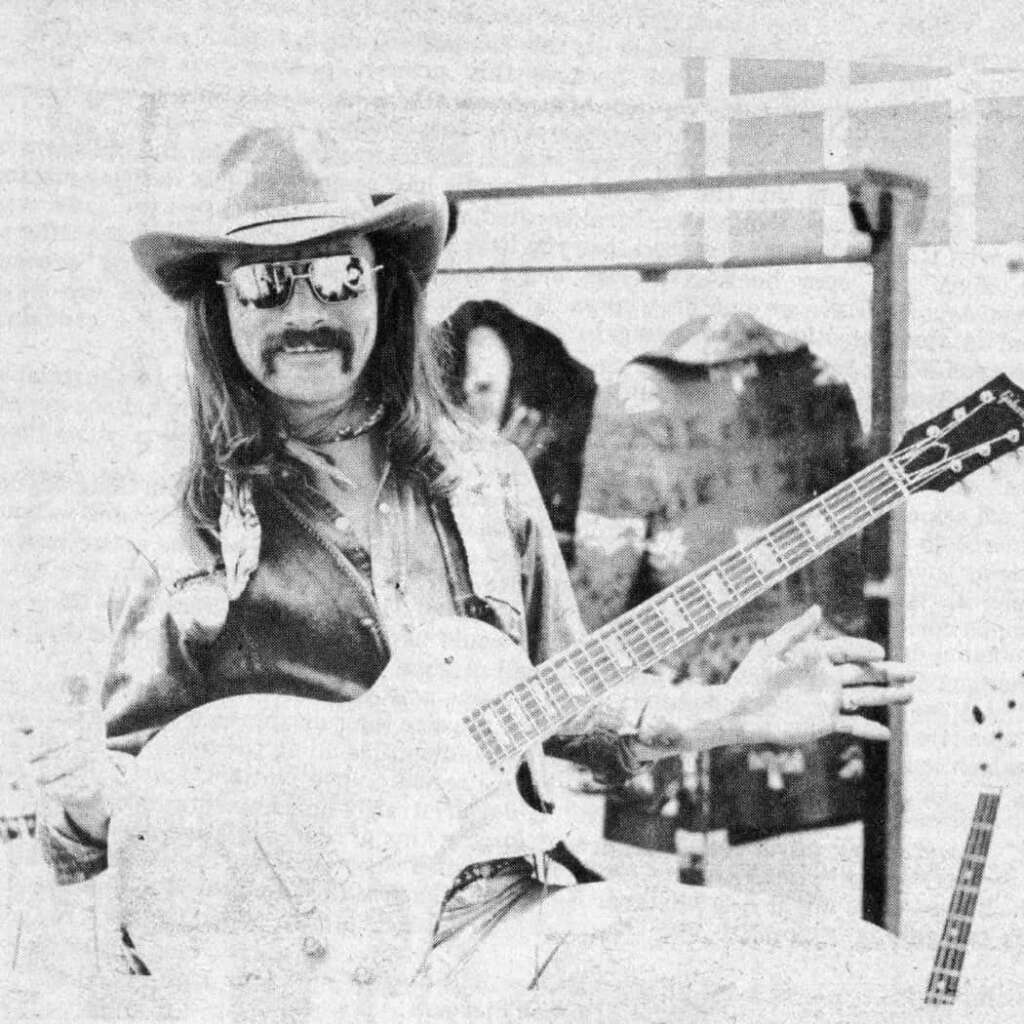
Forrest Richard Betts (December 12, 1943 – April 18, 2024) was an American guitarist, singer, songwriter, and composer best known as a founding member of the Allman Brothers Band.
Early in his career, he collaborated with Duane Allman,[1] introducing melodic twin guitar harmony and counterpoint which “rewrote the rules for how two rock guitarists can work together, completely scrapping the traditional rhythm/lead roles to stand toe to toe”.[2] Following Allman’s death in 1971, Betts assumed sole lead guitar duties during the peak of the group’s commercial success in the mid-1970s. Betts was the writer and singer on the Allmans’ hit single “Ramblin’ Man“. He also gained renown for composing instrumentals, with one appearing on most of the groups albums, including “In Memory of Elizabeth Reed” and “Jessica” (which was later used as the theme to Top Gear).
The band went through a hiatus in the late 1970s, during which time Betts, like many of the other band members, pursued a solo career and side projects under such names as Great Southern and The Dickey Betts Band. The Allman Brothers reformed in 1979, with Dan Toler taking the second guitar role alongside Betts. In 1982, they broke up a second time, during which time Betts formed the group Betts, Hall, Leavell and Trucks, which lasted until 1984. A third reformation occurred in 1989, with Warren Haynes now joining Betts on guitar. After Betts was ousted from the band in 2000 over a conflict regarding his continued drug and alcohol use; he never played with them again nor appeared with other former band members for reunions or side projects. With the death of Betts in April 2024, Jaimoe is the last living founder of the Allman Brothers Band.
He was inducted with the band into the Rock and Roll Hall of Fame in 1995[3] and also won a best rock performance Grammy Award with the band for “Jessica” in 1996.[4] Betts was ranked No. 58 on Rolling Stone‘s 100 Greatest Guitarists of All Time list in 2003, and No. 61 on the list published in 2011.[5][6]
Born in West Palm Beach on December 12, 1943, and raised in Bradenton, Florida,[7][8] Betts grew up in a musical family listening to traditional bluegrass, country music and Western swing. He started playing ukulele) at five and, as his hands got bigger, moved on to mandolin, banjo, and guitar. At sixteen and feeling the need for something “a little faster”, he played in a series of rock bands on the Florida circuit, up the East Coast and into the Midwest before forming Second Coming with Berry Oakley in 1967. According to Rick Derringer, the “group called the Jokers” referenced in “Rock and Roll, Hoochie Koo” was one of Betts’ early groups.[9]
In 1969, Duane Allman had parlayed success as a session player into a contract with Southern soul impresario Phil Walden, who planned to back a power trio featuring Allman. The ensuing Allman Brothers Band eventually grew to six members, including Duane’s brother Gregg, Betts, and Oakley.
After the death of Duane Allman in late 1971, Betts became the band’s sole guitarist and also took on a greater singing and leadership role. Betts, over the course of one night’s traveling, practiced slide guitar intensively in order to cover the majority of Duane’s parts. He went on to write “Jessica” and the Allmans’ biggest commercial hit, “Ramblin’ Man“.[citation needed] “Jessica” was inspired by his daughter of the same name.[10]
.jpg)
Betts’s first solo album, Highway Call, was released in 1974, and featured fiddle player Vassar Clements. After the Allman Brothers fell apart in 1976, Betts released more albums, starting with Dickey Betts & Great Southern in 1977, which included the song “Bougainvillea”, co-written with future Hollywood star Don Johnson. In 1978 he released an album, Atlanta’s Burning Down.[citation needed]
The Allman Brothers reformed in 1979 for the album Enlightened Rogues with two members of Great Southern replacing Allman Brothers members unwilling to participate in the reunion: guitar player Dan Toler (for pianist Chuck Leavell) and bassist David “Rook” Goldflies (for bassist Lamar Williams). Several albums would follow, with various personnel changes, until steadily declining record and concert ticket sales and tensions around management issues led the group to again disband in 1982.[citation needed]
Betts then formed Betts, Hall, Leavell and Trucks, where he was co-frontman along with former Wet Willie singer, saxophone, and harmonica player Jimmy Hall. Despite getting good notices, the group was unable to secure a recording contract and disbanded in 1984.[11] Betts then returned to his solo career, performing live at smaller venues and releasing the album Pattern Disruptive in 1989. When a one-off reunion tour was proposed in support of the Allman Brothers’ Dreams box set released in 1989 to commemorate the band’s 20th anniversary, Betts’s solo band again supplied the Allman Brothers’ other guitarist, slide guitarist Warren Haynes. The one-off tour’s success resulted in a permanent reunion which absorbed Betts’s energies for the remainder of the 1990s. This band lineup went on to release three acclaimed studio albums between 1990 and 1994.[citation needed]
Betts was replaced on numerous Allman Brothers tour dates throughout the mid-to-late 1990s, for what were reported in the media as “personal reasons”. While remaining active as a touring band, they failed to release an album of new studio material after 1994’s Where It All Begins until 2003’s Hittin’ the Note. Haynes and Allman Brothers bassist Allen Woody formed Gov’t Mule with former Dickey Betts Band drummer Matt Abts as a side project in 1994, and left the Allman Brothers for Gov’t Mule full-time in 1997. Betts’ last show with the Allman Brothers was at the Music Midtown Festival in Atlanta, Georgia, on May 7, 2000.[12]
Things reached a breaking point when the remaining original Allman Brothers members – Gregg Allman, Butch Trucks, and Jaimoe – suspended Betts (reportedly via fax) before the launch of the band’s Summer Campaign Tour 2000.[13] According to Betts, the band told him in the fax to get clean (presumably from alcohol and/or drugs). Betts was subsequently ordered out of the band after the dispute went to arbitration.[14]
Betts was temporarily replaced for the 2000 tour by Jimmy Herring, formerly of the Aquarium Rescue Unit. When Betts filed suit against the other three original Allmans, the separation turned into a permanent divorce. Although separated personally and as musical bandmates for over 15 years, Betts and Gregg Allman did reconcile before Allman’s death in 2017.[citation needed] Betts re-formed the Dickey Betts Band in 2000 and toured that summer. The band reassumed the name Dickey Betts & Great Southern and added Betts’ son Duane (named after Duane Allman) on lead guitar. In 2005, Betts released the DVD Live from the Rock and Roll Hall of Fame.[citation needed]
Betts’ final album release was Dickey Betts & Great Southern Official Bootleg Vol. 1 (2021), a two-CD live album of performances from the 2000s.[15]
Betts married his fifth wife, Donna, in 1989.[16] He had four children: Kimberly, Christy, Jessica, and Duane. Christy is married to Frank Hannon of the band Tesla. Duane, named for Betts’ former bandmate Duane Allman, is also a musician and performed and recorded with his father.[17]
Although he briefly resided in Georgia during the formative years of the Allman Brothers Band, he lived in Florida’s Sarasota metropolitan area for most of his life.[18]
In August 2018, Betts suffered a mild stroke and had to cancel upcoming tour dates with his Dickey Betts Band. He was in critical yet stable condition at a Florida hospital following an accident at his home in Osprey, Florida. An operation was planned for September 20, 2018.[19] He successfully underwent surgery to relieve swelling on his brain. In a statement posted on his website, Betts and his family said the “outpouring of support from all over the world has been overwhelming and amazing. We are so appreciative.”
Betts died from cancer and COPD at his home in Osprey, Florida, on April 18, 2024. He was 80.[20][21]
This song could not be more relevant today.

“American Tune” is a song by the American singer-songwriter Paul Simon. It was the third single from his third studio album, There Goes Rhymin’ Simon (1973), released on Columbia Records. The song, a meditation on the American experience, is based on the melody of the hymn “O Sacred Head, Now Wounded” and bears a striking resemblance to JS Bach’s “Erkenne mich, mein Hüter“. The song reached number 35 on the Billboard Hot 100.[2]
In an interview with Tom Moon in 2011, Paul Simon was asked about political references in his songs, and he said: “I don’t write overtly political songs, although ‘American Tune’ comes pretty close, as it was written just after Nixon was elected.”[3]
Billboard described it as a “discourse on inner security while being far from home.”[4] Cash Box called it a “gorgeous, haunting, highly lyrical track” and said that the “soft vocal performance is heightened by sweet string section.”[5] Record World said that it “should touch the hearts and ears of many Americans” with a “beautiful melody wrapped around meaningful lyrics.”[6]
It is ranked number 262 on Rolling Stone’s list of The 500 Greatest Songs of All Time.[7]
Years after the song’s release, the Los Angeles Times wrote “It does not ring with the loud anger that runs through our time. It is mournful, as if unspooling in the candlelight of a day’s end,” and praised the song for its tender, timeless nature, noting it as a “visceral [reminder] of our history.”[8]
The tune is based on the melody of the hymn “O Sacred Head, Now Wounded” (German: “O Haupt voll Blut und Wunden,” text by Paul Gerhardt). The common name for this hymn tune is “Passion Chorale.” The well-known hymn is itself a reworking of an earlier secular song, “Mein G’müt ist mir verwirret,” composed by Hans Leo Hassler.[9]
“American Tune” became a concert favorite, both for Simon and in reunion concerts with Simon’s former singing partner, Art Garfunkel. The song appears on several of Simon’s solo live albums and on Simon and Garfunkel‘s post-breakup live albums, most famously The Concert in Central Park. A live version with a string quartet appeared on Simon’s 1977 album Greatest Hits, Etc. Simon performed the song live on November 18, 2008, during the airing of The Colbert Report,[10] and on September 11, 2015, to close out the last show of the first week of The Late Show with Stephen Colbert.[11] In his surprise appearance at the 2022 Newport Folk Festival, Simon introduced Rhiannon Giddens to sing the song, with lyrics adjusted to include the lines, “We didn’t come here on the Mayflower / We came on a ship in a blood red moon”. Giddens backed the song with banjo, while Simon accompanied on guitar. [12]
The song has been covered by many artists, notably Rhiannon Giddens, Willie Nelson, Eva Cassidy, Ann Wilson, Shawn Colvin, Allen Toussaint, Gretchen Peters, Indigo Girls, Starland Vocal Band, Dave Matthews, Trey Anastasio, Keane, Glen Phillips, Jerry Douglas, Kurt Elling, Curtis Stigers, Darrell Scott, Storyhill, and Stacey Kent.[13] Mandy Patinkin also covers the song in Yiddish on his 1998 album Mamaloshen.
In 2017, Elvis Costello released a non-album single version under the pseudonym “The Imposter”. In 2020, Dave Matthews performed “American Tune” for Jimmy Kimmel Live! during the COVID-19 pandemic.
Simon’s own unfinished demo recording, with incomplete lyrics, was released as a bonus track on the 2004 CD reissue of There Goes Rhymin’ Simon.
The song has been featured in the television series The Wonder Years,[14] and used as the opening and closing song to Ken Burns’ documentary The Statue of Liberty.[15] A cover version by Crooked Still was used for the closing credits of the final episode of the 2022 series The English.[16]
Simon performed the song at the pre-inaugural concert for Jimmy Carter, held at the Kennedy Center in Washington on January 19, 1977, the evening before Carter’s swearing-in as president.[17]
In late October 2008, the progressive advocacy group Progressive Future produced a 60-second television ad featuring “American Tune” in support of Senator Barack Obama‘s presidential campaign. The “what’s gone wrong” line underscored a photo of President George W. Bush and Obama’s opponent John McCain standing close together.[18]
What was I thinking
when I pushed on that slide rule?
Was it the magic wand that led me here?
Ever since I was very small,
telescope in my hand,
That demon called my name
Through renewal in the fall,
watching the leaves blow
A little snow begins to swirl
Equations that mystify
hold all the worldly truths
Except how to fill the void.
Christmas comes and then it goes
HP made the slide rule obsolete
April, May, June,
Pomp and Circumstance
It’s suddenly not so clear.
All the aces in my squad
vied for the chance to get there first
No one had thought that honor would be mine
Out 100 million miles
and out of books to read.
What was I thinking?
Christmas comes and then it goes
AI lacks that gentle human touch
April, May, June Cognitive Decline
It’s suddenly very clear
Space exploration is the use of astronomy and space technology to explore outer space.[1] While the exploration of space is currently carried out mainly by astronomers with telescopes, its physical exploration is conducted both by uncrewed robotic space probes and human spaceflight. Space exploration, like its classical form astronomy, is one of the main sources for space science.
While the observation of objects in space, known as astronomy, predates reliable recorded history, it was the development of large and relatively efficient rockets during the mid-twentieth century that allowed physical space exploration to become a reality. Common rationales for exploring space include advancing scientific research, national prestige, uniting different nations, ensuring the future survival of humanity, and developing military and strategic advantages against other countries.[2]
The early era of space exploration was driven by a “Space Race” between the Soviet Union and the United States. A driving force of the start of space exploration was during the Cold War. After the ability to create nuclear weapons, the narrative of defense/offense left land and the power to control the air became the focus. Both the Soviet and the U.S. were fighting to prove their superiority in technology through exploring the unknown: space. In fact, the reason NASA was made was due to the response of Sputnik I.[3] The launch of the first human-made object to orbit Earth, the Soviet Union’s Sputnik 1, on 4 October 1957, and the first Moon landing by the American Apollo 11 mission on 20 July 1969 are often taken as landmarks for this initial period. The Soviet space program achieved many of the first milestones, including the first living being in orbit in 1957, the first human spaceflight (Yuri Gagarin aboard Vostok 1) in 1961, the first spacewalk (by Alexei Leonov) on 18 March 1965, the first automatic landing on another celestial body in 1966, and the launch of the first space station (Salyut 1) in 1971. After the first 20 years of exploration, focus shifted from one-off flights to renewable hardware, such as the Space Shuttle program, and from competition to cooperation as with the International Space Station (ISS).
With the substantial completion of the ISS[4] following STS-133 in March 2011, plans for space exploration by the U.S. remain in flux. Constellation, a Bush administration program for a return to the Moon by 2020[5] was judged inadequately funded and unrealistic by an expert review panel reporting in 2009.[6] The Obama administration proposed a revision of Constellation in 2010 to focus on the development of the capability for crewed missions beyond low Earth orbit (LEO), envisioning extending the operation of the ISS beyond 2020, transferring the development of launch vehicles for human crews from NASA to the private sector, and developing technology to enable missions to beyond LEO, such as Earth–Moon L1, the Moon, Earth–Sun L2, near-Earth asteroids, and Phobos or Mars orbit.[7]
In the 2000s, China initiated a successful crewed spaceflight program while India launched Chandraayan 1, while the European Union and Japan have also planned future crewed space missions. China, Russia, and Japan have advocated crewed missions to the Moon during the 21st century, while the European Union has advocated crewed missions to both the Moon and Mars during the 20th and 21st century.
See also: History of astronomy, Discovery and exploration of the Solar System, Timeline of space exploration, Timeline of first orbital launches by country, and Outer space § Discovery

The first telescope is said to have been invented in 1608 in the Netherlands by an eyeglass maker named Hans Lippershey, but their first recorded use in astronomy was by Galileo Galilei in 1609.[8] In 1668 Isaac Newton built his own reflecting telescope, the first fully functional telescope of this kind, and a landmark for future developments due to its superior features over the previous Galilean telescope.[9]
A string of discoveries in the Solar System (and beyond) followed, then and in the next centuries: the mountains of the Moon, the phases of Venus, the main satellites of Jupiter and Saturn, the rings of Saturn, many comets, the asteroids, the new planets Uranus and Neptune, and many more satellites.
The Orbiting Astronomical Observatory 2 was the first space telescope launched 1968,[10] but the launching of Hubble Space Telescope in 1990[11] set a milestone. As of 1 December 2022, there were 5,284 confirmed exoplanets discovered. The Milky Way is estimated to contain 100–400 billion stars[12] and more than 100 billion planets.[13] There are at least 2 trillion galaxies in the observable universe.[14][15] HD1 is the most distant known object from Earth, reported as 33.4 billion light-years away.[16][17][18][19][20][21]


MW 18014 was a German V-2 rocket test launch that took place on 20 June 1944, at the Peenemünde Army Research Center in Peenemünde. It was the first man-made object to reach outer space, attaining an apogee of 176 kilometers,[22] which is well above the Kármán line.[23] It was a vertical test launch. Although the rocket reached space, it did not reach orbital velocity, and therefore returned to Earth in an impact, becoming the first sub-orbital spaceflight.[24]
The first successful orbital launch was of the Soviet uncrewed Sputnik 1 (“Satellite 1”) mission on 4 October 1957. The satellite weighed about 83 kg (183 lb), and is believed to have orbited Earth at a height of about 250 km (160 mi). It had two radio transmitters (20 and 40 MHz), which emitted “beeps” that could be heard by radios around the globe. Analysis of the radio signals was used to gather information about the electron density of the ionosphere, while temperature and pressure data was encoded in the duration of radio beeps. The results indicated that the satellite was not punctured by a meteoroid. Sputnik 1 was launched by an R-7 rocket. It burned up upon re-entry on 3 January 1958.
The first successful human spaceflight was Vostok 1 (“East 1”), carrying the 27-year-old Russian cosmonaut, Yuri Gagarin, on 12 April 1961. The spacecraft completed one orbit around the globe, lasting about 1 hour and 48 minutes. Gagarin’s flight resonated around the world; it was a demonstration of the advanced Soviet space program and it opened an entirely new era in space exploration: human spaceflight.
The first artificial object to reach another celestial body was Luna 2 reaching the Moon in 1959.[25] The first soft landing on another celestial body was performed by Luna 9 landing on the Moon on 3 February 1966.[26] Luna 10 became the first artificial satellite of the Moon, entering in a lunar orbit on 3 April 1966.[27]
The first crewed landing on another celestial body was performed by Apollo 11 on 20 July 1969, landing on the Moon. There have been a total of six spacecraft with humans landing on the Moon starting from 1969 to the last human landing in 1972.
The first interplanetary flyby was the 1961 Venera 1 flyby of Venus, though the 1962 Mariner 2 was the first flyby of Venus to return data (closest approach 34,773 kilometers). Pioneer 6 was the first satellite to orbit the Sun, launched on 16 December 1965. The other planets were first flown by in 1965 for Mars by Mariner 4, 1973 for Jupiter by Pioneer 10, 1974 for Mercury by Mariner 10, 1979 for Saturn by Pioneer 11, 1986 for Uranus by Voyager 2, 1989 for Neptune by Voyager 2. In 2015, the dwarf planets Ceres and Pluto were orbited by Dawn and passed by New Horizons, respectively. This accounts for flybys of each of the eight planets in the Solar System, the Sun, the Moon, and Ceres and Pluto (two of the five recognized dwarf planets).
The first interplanetary surface mission to return at least limited surface data from another planet was the 1970 landing of Venera 7, which returned data to Earth for 23 minutes from Venus. In 1975 the Venera 9 was the first to return images from the surface of another planet, returning images from Venus. In 1971 the Mars 3 mission achieved the first soft landing on Mars returning data for almost 20 seconds. Later much longer duration surface missions were achieved, including over six years of Mars surface operation by Viking 1 from 1975 to 1982 and over two hours of transmission from the surface of Venus by Venera 13 in 1982, the longest ever Soviet planetary surface mission. Venus and Mars are the two planets outside of Earth on which humans have conducted surface missions with uncrewed robotic spacecraft.
Salyut 1 was the first space station of any kind, launched into low Earth orbit by the Soviet Union on 19 April 1971. The International Space Station is currently the largest and oldest of the 2 current fully functional space stations, inhabited continuously since the year 2000. The other, Tiangong space station built by China, is now fully crewed and operational.
Voyager 1 became the first human-made object to leave the Solar System into interstellar space on 25 August 2012. The probe passed the heliopause at 121 AU to enter interstellar space.[28]
The Apollo 13 flight passed the far side of the Moon at an altitude of 254 kilometers (158 miles; 137 nautical miles) above the lunar surface, and 400,171 km (248,655 mi) from Earth, marking the record for the farthest humans have ever traveled from Earth in 1970.
As of 26 November 2022 Voyager 1 was at a distance of 159 AU (23.8 billion km; 14.8 billion mi) from Earth.[29] It is the most distant human-made object from Earth.[30]
Starting in the mid-20th century probes and then human mission were sent into Earth orbit, and then on to the Moon. Also, probes were sent throughout the known Solar System, and into Solar orbit. Uncrewed spacecraft have been sent into orbit around Saturn, Jupiter, Mars, Venus, and Mercury by the 21st century, and the most distance active spacecraft, Voyager 1 and 2 traveled beyond 100 times the Earth-Sun distance. The instruments were enough though that it is thought they have left the Sun’s heliosphere, a sort of bubble of particles made in the Galaxy by the Sun’s solar wind.
The Sun is a major focus of space exploration. Being above the atmosphere in particular and Earth’s magnetic field gives access to the solar wind and infrared and ultraviolet radiations that cannot reach Earth’s surface. The Sun generates most space weather, which can affect power generation and transmission systems on Earth and interfere with, and even damage, satellites and space probes. Numerous spacecraft dedicated to observing the Sun, beginning with the Apollo Telescope Mount, have been launched and still others have had solar observation as a secondary objective. Parker Solar Probe, launched in 2018, will approach the Sun to within 1/9th the orbit of Mercury.
Main article: Exploration of Mercury

Mercury remains the least explored of the Terrestrial planets. As of May 2013, the Mariner 10 and MESSENGER missions have been the only missions that have made close observations of Mercury. MESSENGER entered orbit around Mercury in March 2011, to further investigate the observations made by Mariner 10 in 1975 (Munsell, 2006b). A third mission to Mercury, scheduled to arrive in 2025, BepiColombo is to include two probes. BepiColombo is a joint mission between Japan and the European Space Agency. MESSENGER and BepiColombo are intended to gather complementary data to help scientists understand many of the mysteries discovered by Mariner 10’s flybys.
Flights to other planets within the Solar System are accomplished at a cost in energy, which is described by the net change in velocity of the spacecraft, or delta-v. Due to the relatively high delta-v to reach Mercury and its proximity to the Sun, it is difficult to explore and orbits around it are rather unstable.
Main article: Observations and explorations of Venus
Venus was the first target of interplanetary flyby and lander missions and, despite one of the most hostile surface environments in the Solar System, has had more landers sent to it (nearly all from the Soviet Union) than any other planet in the Solar System. The first flyby was the 1961 Venera 1, though the 1962 Mariner 2 was the first flyby to successfully return data. Mariner 2 has been followed by several other flybys by multiple space agencies often as part of missions using a Venus flyby to provide a gravitational assist en route to other celestial bodies. In 1967 Venera 4 became the first probe to enter and directly examine the atmosphere of Venus. In 1970, Venera 7 became the first successful lander to reach the surface of Venus and by 1985 it had been followed by eight additional successful Soviet Venus landers which provided images and other direct surface data. Starting in 1975 with the Soviet orbiter Venera 9 some ten successful orbiter missions have been sent to Venus, including later missions which were able to map the surface of Venus using radar to pierce the obscuring atmosphere.
Main article: Earth observation satellite

Space exploration has been used as a tool to understand Earth as a celestial object. Orbital missions can provide data for Earth that can be difficult or impossible to obtain from a purely ground-based point of reference.
For example, the existence of the Van Allen radiation belts was unknown until their discovery by the United States’ first artificial satellite, Explorer 1. These belts contain radiation trapped by Earth’s magnetic fields, which currently renders construction of habitable space stations above 1000 km impractical. Following this early unexpected discovery, a large number of Earth observation satellites have been deployed specifically to explore Earth from a space-based perspective. These satellites have significantly contributed to the understanding of a variety of Earth-based phenomena. For instance, the hole in the ozone layer was found by an artificial satellite that was exploring Earth’s atmosphere, and satellites have allowed for the discovery of archeological sites or geological formations that were difficult or impossible to otherwise identify.
Main article: Exploration of the Moon

The Moon was the first celestial body to be the object of space exploration. It holds the distinctions of being the first remote celestial object to be flown by, orbited, and landed upon by spacecraft, and the only remote celestial object ever to be visited by humans.
In 1959 the Soviets obtained the first images of the far side of the Moon, never previously visible to humans. The U.S. exploration of the Moon began with the Ranger 4 impactor in 1962. Starting in 1966 the Soviets successfully deployed a number of landers to the Moon which were able to obtain data directly from the Moon’s surface; just four months later, Surveyor 1 marked the debut of a successful series of U.S. landers. The Soviet uncrewed missions culminated in the Lunokhod program in the early 1970s, which included the first uncrewed rovers and also successfully brought lunar soil samples to Earth for study. This marked the first (and to date the only) automated return of extraterrestrial soil samples to Earth. Uncrewed exploration of the Moon continues with various nations periodically deploying lunar orbiters, and in 2008 the Indian Moon Impact Probe and in 2023 the Chandrayaan-3 of India became the first spacecraft to land on the lunar south pole.
Crewed exploration of the Moon began in 1968 with the Apollo 8 mission that successfully orbited the Moon, the first time any extraterrestrial object was orbited by humans. In 1969, the Apollo 11 mission marked the first time humans set foot upon another world. Crewed exploration of the Moon did not continue for long. The Apollo 17 mission in 1972 marked the sixth landing and the most recent human visit. Artemis 2 is scheduled to complete a crewed flyby of the Moon in 2025, and Artemis 3 will perform the first lunar landing since Apollo 17 with it scheduled for launch no earlier than 2026. Robotic missions are still pursued vigorously.
Main article: Exploration of Mars

The exploration of Mars has been an important part of the space exploration programs of the Soviet Union (later Russia), the United States, Europe, Japan and India. Dozens of robotic spacecraft, including orbiters, landers, and rovers, have been launched toward Mars since the 1960s. These missions were aimed at gathering data about current conditions and answering questions about the history of Mars. The questions raised by the scientific community are expected to not only give a better appreciation of the Red Planet but also yield further insight into the past, and possible future, of Earth.
The exploration of Mars has come at a considerable financial cost with roughly two-thirds of all spacecraft destined for Mars failing before completing their missions, with some failing before they even began. Such a high failure rate can be attributed to the complexity and large number of variables involved in an interplanetary journey, and has led researchers to jokingly speak of The Great Galactic Ghoul[31] which subsists on a diet of Mars probes. This phenomenon is also informally known as the “Mars Curse“.[32] In contrast to overall high failure rates in the exploration of Mars, India has become the first country to achieve success of its maiden attempt. India’s Mars Orbiter Mission (MOM)[33][34][35] is one of the least expensive interplanetary missions ever undertaken with an approximate total cost of ₹ 450 Crore (US$73 million).[36][37] The first mission to Mars by any Arab country has been taken up by the United Arab Emirates. Called the Emirates Mars Mission, it was launched on 19 July 2020 and went into orbit around Mars on 9 February 2021. The uncrewed exploratory probe was named “Hope Probe” and was sent to Mars to study its atmosphere in detail.[38]
Main article: Exploration of Phobos
The Russian space mission Fobos-Grunt, which launched on 9 November 2011 experienced a failure leaving it stranded in low Earth orbit.[39] It was to begin exploration of the Phobos and Martian circumterrestrial orbit, and study whether the moons of Mars, or at least Phobos, could be a “trans-shipment point” for spaceships traveling to Mars.[40]
Main article: Exploration of the asteroids

Until the advent of space travel, objects in the asteroid belt were merely pinpricks of light in even the largest telescopes, their shapes and terrain remaining a mystery. Several asteroids have now been visited by probes, the first of which was Galileo, which flew past two: 951 Gaspra in 1991, followed by 243 Ida in 1993. Both of these lay near enough to Galileo’s planned trajectory to Jupiter that they could be visited at acceptable cost. The first landing on an asteroid was performed by the NEAR Shoemaker probe in 2000, following an orbital survey of the object, 433 Eros. The dwarf planet Ceres and the asteroid 4 Vesta, two of the three largest asteroids, were visited by NASA’s Dawn spacecraft, launched in 2007.
Hayabusa was a robotic spacecraft developed by the Japan Aerospace Exploration Agency to return a sample of material from the small near-Earth asteroid 25143 Itokawa to Earth for further analysis. Hayabusa was launched on 9 May 2003 and rendezvoused with Itokawa in mid-September 2005. After arriving at Itokawa, Hayabusa studied the asteroid’s shape, spin, topography, color, composition, density, and history. In November 2005, it landed on the asteroid twice to collect samples. The spacecraft returned to Earth on 13 June 2010.
Main article: Exploration of Jupiter

The exploration of Jupiter has consisted solely of a number of automated NASA spacecraft visiting the planet since 1973. A large majority of the missions have been “flybys”, in which detailed observations are taken without the probe landing or entering orbit; such as in Pioneer and Voyager programs. The Galileo and Juno spacecraft are the only spacecraft to have entered the planet’s orbit. As Jupiter is believed to have only a relatively small rocky core and no real solid surface, a landing mission is precluded.
Reaching Jupiter from Earth requires a delta-v of 9.2 km/s,[41] which is comparable to the 9.7 km/s delta-v needed to reach low Earth orbit.[42] Fortunately, gravity assists through planetary flybys can be used to reduce the energy required at launch to reach Jupiter, albeit at the cost of a significantly longer flight duration.[41]
Jupiter has 95 known moons, many of which have relatively little known information about them.
Main article: Exploration of Saturn
Saturn has been explored only through uncrewed spacecraft launched by NASA, including one mission (Cassini–Huygens) planned and executed in cooperation with other space agencies. These missions consist of flybys in 1979 by Pioneer 11, in 1980 by Voyager 1, in 1982 by Voyager 2 and an orbital mission by the Cassini spacecraft, which lasted from 2004 until 2017.
Saturn has at least 62 known moons, although the exact number is debatable since Saturn’s rings are made up of vast numbers of independently orbiting objects of varying sizes. The largest of the moons is Titan, which holds the distinction of being the only moon in the Solar System with an atmosphere denser and thicker than that of Earth. Titan holds the distinction of being the only object in the Outer Solar System that has been explored with a lander, the Huygens probe deployed by the Cassini spacecraft.
Main article: Exploration of Uranus
The exploration of Uranus has been entirely through the Voyager 2 spacecraft, with no other visits currently planned. Given its axial tilt of 97.77°, with its polar regions exposed to sunlight or darkness for long periods, scientists were not sure what to expect at Uranus. The closest approach to Uranus occurred on 24 January 1986. Voyager 2 studied the planet’s unique atmosphere and magnetosphere. Voyager 2 also examined its ring system and the moons of Uranus including all five of the previously known moons, while discovering an additional ten previously unknown moons.
Images of Uranus proved to have a very uniform appearance, with no evidence of the dramatic storms or atmospheric banding evident on Jupiter and Saturn. Great effort was required to even identify a few clouds in the images of the planet. The magnetosphere of Uranus, however, proved to be unique, being profoundly affected by the planet’s unusual axial tilt. In contrast to the bland appearance of Uranus itself, striking images were obtained of the Moons of Uranus, including evidence that Miranda had been unusually geologically active.
Main article: Exploration of Neptune
The exploration of Neptune began with 25 August 1989 Voyager 2 flyby, the sole visit to the system as of 2024. The possibility of a Neptune Orbiter has been discussed, but no other missions have been given serious thought.
Although the extremely uniform appearance of Uranus during Voyager 2‘s visit in 1986 had led to expectations that Neptune would also have few visible atmospheric phenomena, the spacecraft found that Neptune had obvious banding, visible clouds, auroras, and even a conspicuous anticyclone storm system rivaled in size only by Jupiter’s Great Red Spot. Neptune also proved to have the fastest winds of any planet in the Solar System, measured as high as 2,100 km/h.[43] Voyager 2 also examined Neptune’s ring and moon system. It discovered 900 complete rings and additional partial ring “arcs” around Neptune. In addition to examining Neptune’s three previously known moons, Voyager 2 also discovered five previously unknown moons, one of which, Proteus, proved to be the last largest moon in the system. Data from Voyager 2 supported the view that Neptune’s largest moon, Triton, is a captured Kuiper belt object.[44]
Main article: Pluto § Exploration
The dwarf planet Pluto presents significant challenges for spacecraft because of its great distance from Earth (requiring high velocity for reasonable trip times) and small mass (making capture into orbit very difficult at present). Voyager 1 could have visited Pluto, but controllers opted instead for a close flyby of Saturn’s moon Titan, resulting in a trajectory incompatible with a Pluto flyby. Voyager 2 never had a plausible trajectory for reaching Pluto.[45]
After an intense political battle, a mission to Pluto dubbed New Horizons was granted funding from the United States government in 2003.[46] New Horizons was launched successfully on 19 January 2006. In early 2007 the craft made use of a gravity assist from Jupiter. Its closest approach to Pluto was on 14 July 2015; scientific observations of Pluto began five months prior to closest approach and continued for 16 days after the encounter.
The New Horizons mission also did a flyby of the small planetesimal Arrokoth, in the Kuiper belt, in 2019. This was its first extended mission.[47]
Main article: List of missions to comets

Although many comets have been studied from Earth sometimes with centuries-worth of observations, only a few comets have been closely visited. In 1985, the International Cometary Explorer conducted the first comet fly-by (21P/Giacobini-Zinner) before joining the Halley Armada studying the famous comet. The Deep Impact probe smashed into 9P/Tempel to learn more about its structure and composition and the Stardust mission returned samples of another comet’s tail. The Philae lander successfully landed on Comet Churyumov–Gerasimenko in 2014 as part of the broader Rosetta mission.
Main article: Deep space exploration

Deep space exploration is the branch of astronomy, astronautics and space technology that is involved with the exploration of distant regions of outer space.[48] Physical exploration of space is conducted both by human spaceflights (deep-space astronautics) and by robotic spacecraft.
Some of the best candidates for future deep space engine technologies include anti-matter, nuclear power and beamed propulsion.[49] The latter, beamed propulsion, appears to be the best candidate for deep space exploration presently available, since it uses known physics and known technology that is being developed for other purposes.[50]
Main article: Future of space exploration


Main article: Breakthrough Starshot
Breakthrough Starshot is a research and engineering project by the Breakthrough Initiatives to develop a proof-of-concept fleet of light sail spacecraft named StarChip,[51] to be capable of making the journey to the Alpha Centauri star system 4.37 light-years away. It was founded in 2016 by Yuri Milner, Stephen Hawking, and Mark Zuckerberg.[52][53]
Main article: Exploration of the asteroids
An article in science magazine Nature suggested the use of asteroids as a gateway for space exploration, with the ultimate destination being Mars. In order to make such an approach viable, three requirements need to be fulfilled: first, “a thorough asteroid survey to find thousands of nearby bodies suitable for astronauts to visit”; second, “extending flight duration and distance capability to ever-increasing ranges out to Mars”; and finally, “developing better robotic vehicles and tools to enable astronauts to explore an asteroid regardless of its size, shape or spin”. Furthermore, using asteroids would provide astronauts with protection from galactic cosmic rays, with mission crews being able to land on them without great risk to radiation exposure.
Main article: James Webb Space Telescope
The James Webb Space Telescope (JWST or “Webb”) is a space telescope that is the successor to the Hubble Space Telescope.[54][55] The JWST will provide greatly improved resolution and sensitivity over the Hubble, and will enable a broad range of investigations across the fields of astronomy and cosmology, including observing some of the most distant events and objects in the universe, such as the formation of the first galaxies. Other goals include understanding the formation of stars and planets, and direct imaging of exoplanets and novas.[56]
The primary mirror of the JWST, the Optical Telescope Element, is composed of 18 hexagonal mirror segments made of gold-plated beryllium which combine to create a 6.5-meter (21 ft; 260 in) diameter mirror that is much larger than the Hubble’s 2.4-meter (7.9 ft; 94 in) mirror. Unlike the Hubble, which observes in the near ultraviolet, visible, and near infrared (0.1 to 1 μm) spectra, the JWST will observe in a lower frequency range, from long-wavelength visible light through mid-infrared (0.6 to 27 μm), which will allow it to observe high redshift objects that are too old and too distant for the Hubble to observe.[57] The telescope must be kept very cold in order to observe in the infrared without interference, so it will be deployed in space near the Earth–Sun L2 Lagrangian point, and a large sunshield made of silicon– and aluminum-coated Kapton will keep its mirror and instruments below 50 K (−220 °C; −370 °F).[58]
Main article: Artemis program
The Artemis program is an ongoing crewed spaceflight program carried out by NASA, U.S. commercial spaceflight companies, and international partners such as ESA,[59] with the goal of landing “the first woman and the next man” on the Moon, specifically at the lunar south pole region by 2024. Artemis would be the next step towards the long-term goal of establishing a sustainable presence on the Moon, laying the foundation for private companies to build a lunar economy, and eventually sending humans to Mars.
In 2017, the lunar campaign was authorized by Space Policy Directive 1, utilizing various ongoing spacecraft programs such as Orion, the Lunar Gateway, Commercial Lunar Payload Services, and adding an undeveloped crewed lander. The Space Launch System will serve as the primary launch vehicle for Orion, while commercial launch vehicles are planned for use to launch various other elements of the campaign.[60] NASA requested $1.6 billion in additional funding for Artemis for fiscal year 2020,[61] while the Senate Appropriations Committee requested from NASA a five-year budget profile[62] which is needed for evaluation and approval by Congress.[63][64]
Main article: Space advocacy

The research that is conducted by national space exploration agencies, such as NASA and Roscosmos, is one of the reasons supporters cite to justify government expenses. Economic analyses of the NASA programs often showed ongoing economic benefits (such as NASA spin-offs), generating many times the revenue of the cost of the program.[65] It is also argued that space exploration would lead to the extraction of resources on other planets and especially asteroids, which contain billions of dollars worth of minerals and metals. Such expeditions could generate a lot of revenue.[66] In addition, it has been argued that space exploration programs help inspire youth to study in science and engineering.[67] Space exploration also gives scientists the ability to perform experiments in other settings and expand humanity’s knowledge.[68]
Another claim is that space exploration is a necessity to mankind and that staying on Earth will lead to extinction. Some of the reasons are lack of natural resources, comets, nuclear war, and worldwide epidemic. Stephen Hawking, renowned British theoretical physicist, said that “I don’t think the human race will survive the next thousand years, unless we spread into space. There are too many accidents that can befall life on a single planet. But I’m an optimist. We will reach out to the stars.”[69] Arthur C. Clarke (1950) presented a summary of motivations for the human exploration of space in his non-fiction semi-technical monograph Interplanetary Flight.[70] He argued that humanity’s choice is essentially between expansion off Earth into space, versus cultural (and eventually biological) stagnation and death. These motivations could be attributed to one of the first rocket scientists in NASA, Wernher von Braun, and his vision of humans moving beyond Earth. The basis of this plan was to:
Develop multi-stage rockets capable of placing satellites, animals, and humans in space.
Development of large, winged reusable spacecraft capable of carrying humans and equipment into Earth orbit in a way that made space access routine and cost-effective.
Construction of a large, permanently occupied space station to be used as a platform both to observe Earth and from which to launch deep space expeditions.
Launching the first human flights around the Moon, leading to the first landings of humans on the Moon, with the intent of exploring that body and establishing permanent lunar bases.
Assembly and fueling of spaceships in Earth orbit for the purpose of sending humans to Mars with the intent of eventually colonizing that planet.[71]
Known as the Von Braun Paradigm, the plan was formulated to lead humans in the exploration of space. Von Braun’s vision of human space exploration served as the model for efforts in space exploration well into the twenty-first century, with NASA incorporating this approach into the majority of their projects.[71] The steps were followed out of order, as seen by the Apollo program reaching the moon before the space shuttle program was started, which in turn was used to complete the International Space Station. Von Braun’s Paradigm formed NASA’s drive for human exploration, in the hopes that humans discover the far reaches of the universe.
NASA has produced a series of public service announcement videos supporting the concept of space exploration.[72]
Overall, the public remains largely supportive of both crewed and uncrewed space exploration. According to an Associated Press Poll conducted in July 2003, 71% of U.S. citizens agreed with the statement that the space program is “a good investment”, compared to 21% who did not.[73]
Space advocacy and space policy[74] regularly invokes exploration as a human nature.[75]
Main articles: Space science and Human presence in space
Main articles: Spaceflight and Astronautics

Spaceflight is the use of space technology to achieve the flight of spacecraft into and through outer space.
Spaceflight is used in space exploration, and also in commercial activities like space tourism and satellite telecommunications. Additional non-commercial uses of spaceflight include space observatories, reconnaissance satellites and other Earth observation satellites.
A spaceflight typically begins with a rocket launch, which provides the initial thrust to overcome the force of gravity and propels the spacecraft from the surface of Earth. Once in space, the motion of a spacecraft—both when unpropelled and when under propulsion—is covered by the area of study called astrodynamics. Some spacecraft remain in space indefinitely, some disintegrate during atmospheric reentry, and others reach a planetary or lunar surface for landing or impact.
Main article: Satellite
Satellites are used for a large number of purposes. Common types include military (spy) and civilian Earth observation satellites, communication satellites, navigation satellites, weather satellites, and research satellites. Space stations and human spacecraft in orbit are also satellites.
Main article: Commercialization of space
The commercialization of space first started out with the launching of private satellites by NASA or other space agencies. Current examples of the commercial satellite use of space include satellite navigation systems, satellite television and satellite radio. The next step of commercialization of space was seen as human spaceflight. Flying humans safely to and from space had become routine to NASA.[76] Reusable spacecraft were an entirely new engineering challenge, something only seen in novels and films like Star Trek and War of the Worlds. Great names like Buzz Aldrin supported the use of making a reusable vehicle like the space shuttle. Aldrin held that reusable spacecraft were the key in making space travel affordable, stating that the use of “passenger space travel is a huge potential market big enough to justify the creation of reusable launch vehicles”.[77] How can the public go against the words of one of America’s best known heroes in space exploration? After all exploring space is the next great expedition, following the example of Lewis and Clark.Space tourism is the next step reusable vehicles in the commercialization of space. The purpose of this form of space travel is used by individuals for the purpose of personal pleasure.
Private spaceflight companies such as SpaceX and Blue Origin, and commercial space stations such as the Axiom Space and the Bigelow Commercial Space Station have dramatically changed the landscape of space exploration, and will continue to do so in the near future.
Main articles: Astrobiology and Extraterrestrial life
Astrobiology is the interdisciplinary study of life in the universe, combining aspects of astronomy, biology and geology.[78] It is focused primarily on the study of the origin, distribution and evolution of life. It is also known as exobiology (from Greek: έξω, exo, “outside”).[79][80][81] The term “Xenobiology” has been used as well, but this is technically incorrect because its terminology means “biology of the foreigners”.[82] Astrobiologists must also consider the possibility of life that is chemically entirely distinct from any life found on Earth.[83] In the Solar System some of the prime locations for current or past astrobiology are on Enceladus, Europa, Mars, and Titan.[84]
Main articles: Human spaceflight, Bioastronautics, Effect of spaceflight on the human body, Space medicine, Space architecture, Space station, Space habitat (facility), and Space habitat (settlement)

To date, the longest human occupation of space is the International Space Station which has been in continuous use for 23 years, 156 days. Valeri Polyakov‘s record single spaceflight of almost 438 days aboard the Mir space station has not been surpassed. The health effects of space have been well documented through years of research conducted in the field of aerospace medicine. Analog environments similar to those one may experience in space travel (like deep sea submarines) have been used in this research to further explore the relationship between isolation and extreme environments.[85] It is imperative that the health of the crew be maintained as any deviation from baseline may compromise the integrity of the mission as well as the safety of the crew, hence the reason why astronauts must endure rigorous medical screenings and tests prior to embarking on any missions. However, it does not take long for the environmental dynamics of spaceflight to commence its toll on the human body; for example, space motion sickness (SMS) – a condition which affects the neurovestibular system and culminates in mild to severe signs and symptoms such as vertigo, dizziness, fatigue, nausea, and disorientation – plagues almost all space travelers within their first few days in orbit.[85] Space travel can also have a profound impact on the psyche of the crew members as delineated in anecdotal writings composed after their retirement. Space travel can adversely affect the body’s natural biological clock (circadian rhythm); sleep patterns causing sleep deprivation and fatigue; and social interaction; consequently, residing in a Low Earth Orbit (LEO) environment for a prolonged amount of time can result in both mental and physical exhaustion.[85] Long-term stays in space reveal issues with bone and muscle loss in low gravity, immune system suppression, and radiation exposure. The lack of gravity causes fluid to rise upward which can cause pressure to build up in the eye, resulting in vision problems; the loss of bone minerals and densities; cardiovascular deconditioning; and decreased endurance and muscle mass.[86]
Radiation is an insidious health hazard to space travelers as it is invisible and can cause cancer. When above the Earth’s magnetic field spacecraft are no longer protected from the sun’s radiation; the danger of radiation is even more potent in deep space. The hazards of radiation can be ameliorated through protective shielding on the spacecraft, alerts, and dosimetry.[87]
Fortunately, with new and rapidly evolving technological advancements, those in Mission Control are able to monitor the health of their astronauts more closely utilizing telemedicine. One may not be able to completely evade the physiological effects of space flight, but they can be mitigated. For example, medical systems aboard space vessels such as the International Space Station (ISS) are well equipped and designed to counteract the effects of lack of gravity and weightlessness; on-board treadmills can help prevent muscle loss and reduce the risk of developing premature osteoporosis.[85][87] Additionally, a crew medical officer is appointed for each ISS mission and a flight surgeon is available 24/7 via the ISS Mission Control Center located in Houston, Texas.[87] Although the interactions are intended to take place in real time, communications between the space and terrestrial crew may become delayed – sometimes by as much as 20 minutes[87] – as their distance from each other increases when the spacecraft moves further out of LEO; because of this the crew are trained and need to be prepared to respond to any medical emergencies that may arise on the vessel as the ground crew are hundreds of miles away. As one can see, travelling and possibly living in space poses many challenges. Many past and current concepts for the continued exploration and colonization of space focus on a return to the Moon as a “stepping stone” to the other planets, especially Mars. At the end of 2006 NASA announced they were planning to build a permanent Moon base with continual presence by 2024.[88]
Beyond the technical factors that could make living in space more widespread, it has been suggested that the lack of private property, the inability or difficulty in establishing property rights in space, has been an impediment to the development of space for human habitation. Since the advent of space technology in the latter half of the twentieth century, the ownership of property in space has been murky, with strong arguments both for and against. In particular, the making of national territorial claims in outer space and on celestial bodies has been specifically proscribed by the Outer Space Treaty, which had been, as of 2012, ratified by all spacefaring nations.[89] Space colonization, also called space settlement and space humanization, would be the permanent autonomous (self-sufficient) human habitation of locations outside Earth, especially of natural satellites or planets such as the Moon or Mars, using significant amounts of in-situ resource utilization.
See also: Space law
Participation and representation of humanity in space is an issue ever since the first phase of space exploration.[90] Some rights of non-spacefaring countries have been mostly secured through international space law, declaring space the “province of all mankind“, understanding spaceflight as its resource, though sharing of space for all humanity is still criticized as imperialist and lacking.[90] Additionally to international inclusion, the inclusion of women and people of colour has also been lacking. To reach a more inclusive spaceflight some organizations like the Justspace Alliance[90] and IAU featured Inclusive Astronomy[91] have been formed in recent years.
Main article: Women in space
The first woman to go to space was Valentina Tereshkova. She flew in 1963 but it was not until the 1980s that another woman entered space again. All astronauts were required to be military test pilots at the time and women were not able to join this career, this is one reason for the delay in allowing women to join space crews.[citation needed] After the rule changed, Svetlana Savitskaya became the second woman to go to space, she was also from the Soviet Union. Sally Ride became the next woman in space and the first woman to fly to space through the United States program.
Since then, eleven other countries have allowed women astronauts. The first all-female space walk occurred in 2018, including Christina Koch and Jessica Meir. They had both previously participated in space walks with NASA. The first woman to go to the Moon is planned for 2024.
Despite these developments women are still underrepresented among astronauts and especially cosmonauts. Issues that block potential applicants from the programs, and limit the space missions they are able to go on, include:
See also: Space art § Art in space
Artistry in and from space ranges from signals, capturing and arranging material like Yuri Gagarin‘s selfie in space or the image The Blue Marble, over drawings like the first one in space by cosmonaut and artist Alexei Leonov, music videos like Chris Hadfield’s cover of Space Oddity on board the ISS, to permanent installations on celestial bodies like on the Moon.
I nixed the drums on this one and am much happier with it.

I used Horse Latitudes as a metaphor to signify the calm and stillness that comes when life slows down for whatever reason as age increases.
Horse Latitudes of life hold memories
Vignettes time will slowly carve away
Easels hold portraits of joy and sadness
As the winds of change abate
Jenny’s book club is at 7 tonight
Billy’s game is quarter to five
If I get out of my job by four
I can get him to the diamond on time.
There’s always something going on
There’s hardly time to sleep
But as the Sandman struggles
There’s a memory that keeps
Reminding me of a former life
Where every minute went on for much longer
Relativity theory is mysterious to me.
Sometimes I feel like a sailor at sea
Caught in the palm of a fierce tsunami
Tossing and turning I’m out of control
I’m the mythical person for whom the bell tolls
Horse Latitudes of life hold memories
Vignettes time will slowly carve away
Easels hold portraits of joy and sadness
As the winds of change abate
Jenny’s been gone for 7 long years.
Billy’s living out in LA.
Every year I get a nice Christmas card
And another one on my birthday.
Yesterday I found a diary
Hidden in a drawer
I think I saw her writing in it
Many years before.
The headline on page one announced
On Sunday morning two became three
The byline was a row of hearts
that brought me to my knees.
Sometimes I feel like a sailor at sea
Caught in the palm of a fierce tsunami
Tossing and turning I’m out of control
I’m the mythical person for whom the bell tolls
Horse Latitudes of life hold memories
Vignettes time will slowly carve away
Easels hold portraits of joy and sadness
As the winds of change abate
Horse Latitudes of life hold memories
Vignettes time will slowly carve away
Easels hold portraits of joy and sadness
As the winds of change abate
The horse latitudes are the latitudes about 30 degrees north and south of the Equator.[1] They are characterized by sunny skies, calm winds, and very little precipitation. They are also known as subtropical ridges or highs. It is a high-pressure area at the divergence of trade winds and the westerlies.
A likely and documented explanation is that the term is derived from the “dead horse” ritual of seamen (see Beating a dead horse). In this practice, the seaman paraded a straw-stuffed effigy of a horse around the deck before throwing it overboard. Seamen were paid partly in advance before a long voyage, and they frequently spent their pay all at once, resulting in a period of time without income. If they got advances from the ship’s paymaster, they would incur debt. This period was called the “dead horse” time, and it usually lasted a month or two. The seaman’s ceremony was to celebrate having worked off the “dead horse” debt. As west-bound shipping from Europe usually reached the subtropics at about the time the “dead horse” was worked off, the latitude became associated with the ceremony.[2]
An alternative theory, of sufficient popularity to serve as an example of folk etymology, is that the term horse latitudes originates from when the Spanish transported horses by ship to their colonies in the West Indies and Americas. Ships often became becalmed in mid-ocean in this latitude, thus severely prolonging the voyage; the resulting water shortages made it impossible for the crew to keep the horses alive, and they would throw the dead or dying animals overboard.[3]
A third explanation, which simultaneously explains both the northern and southern horse latitudes and does not depend on the length of the voyage or the port of departure, is based on maritime terminology: a ship was said to be ‘horsed’ when, although there was insufficient wind for sail, the vessel could make good progress by latching on to a strong current. This was suggested by Edward Taube in his article “The Sense of ‘Horse’ in the Horse Latitudes” (Journal of Geography, October 1967).[4] He argued the maritime use of ‘horsed’ described a ship that was being carried along by an ocean current or tide in the manner of a rider on horseback. The term had been in use since the end of the seventeenth century. Furthermore, The India Directory in its entry for Fernando de Noronha, an island off the coast of Brazil, mentions it had been visited frequently by ships “occasioned by the currents having horsed them to the westward”.[5]
The heating of the earth at the thermal equator leads to large amounts of convection along the Intertropical Convergence Zone. This air mass rises and then diverges, moving away from the equator in both northerly and southerly directions. As the air moves towards the mid-latitudes on both sides of the equator, it cools and sinks. This creates a ridge of high pressure near the 30th parallel in both hemispheres. At the surface level, the sinking air diverges again with some returning to the equator, creating the Hadley cell[6] which during summer is reinforced by other climatological mechanisms such as the Rodwell–Hoskins mechanism.[7][8] Many of the world’s deserts are caused by these climatological high-pressure areas.
The subtropical ridge moves poleward during the summer, reaching its highest latitude in early autumn, before moving back during the cold season. The El Niño–Southern Oscillation (ENSO) can displace the northern hemisphere subtropical ridge, with La Niña allowing for a more northerly axis for the ridge, while El Niños show flatter, more southerly ridges. The change of the ridge position during ENSO cycles changes the tracks of tropical cyclones that form around their equatorward and western peripheries. As the subtropical ridge varies in position and strength, it can enhance or depress monsoon regimes around their low-latitude periphery.
The horse latitudes are associated with the subtropical anticyclone. The belt in the Northern Hemisphere is sometimes called the “calms of Cancer” and that in the Southern Hemisphere the “calms of Capricorn“.
The consistently warm, dry, and sunny conditions of the horse latitudes are the main cause for the existence of the world’s major hot deserts, such as the Sahara Desert in Africa, the Arabian and Syrian deserts in the Middle East, the Mojave and Sonoran deserts in the southwestern United States and northern Mexico, all in the Northern Hemisphere; and the Atacama Desert, the Namib Desert, the Kalahari Desert, and the Australian Desert in the Southern Hemisphere.

The subtropical ridge starts migrating poleward in late spring reaching its zenith in early autumn before retreating equatorward during the late fall, winter, and early spring. The equatorward migration of the subtropical ridge during the cold season is due to increasing north-south temperature differences between the poles and tropics.[9] The latitudinal movement of the subtropical ridge is strongly correlated with the progression of the monsoon trough or Intertropical Convergence Zone.
Most tropical cyclones form on the side of the subtropical ridge closer to the equator, then move poleward past the ridge axis before recurving into the main belt of the Westerlies.[10] When the subtropical ridge shifts due to ENSO, so will the preferred tropical cyclone tracks. Areas west of Japan and Korea tend to experience far fewer September–November tropical cyclone impacts during El Niño and neutral years, while mainland China experiences much greater landfall frequency during La Niña years. During El Niño years, the break[clarification needed] in the subtropical ridge tends to lie near 130°E, which would favor the Japanese archipelago, while in La Niña years the formation of tropical cyclones, along with the subtropical ridge position, shift west, which increases the threat to China.[11] In the Atlantic basin, the subtropical ridge position tends to lie about 5 degrees farther south during El Niño years, which leads to a more southerly recurvature for tropical cyclones during those years.
When the Atlantic multidecadal oscillation‘s mode is favorable to tropical cyclone development (1995–present), it amplifies the subtropical ridge across the central and eastern Atlantic.[12]
See also: Air pollution
Main article: Monsoon

When the subtropical ridge in the northwest Pacific is stronger than normal, it leads to a wet monsoon season for Asia.[13] The subtropical ridge position is linked to how far northward monsoon moisture and thunderstorms extend into the United States. The subtropical ridge across North America typically migrates far enough northward to begin monsoon conditions across the Desert Southwest from July to September.[14] When the subtropical ridge is farther north than normal towards the Four Corners, monsoon thunderstorms can spread northward into Arizona. When the high pressure moves south, its circulation cuts off the moisture, and the hot, dry continental airmass returns from the northwest, and therefore the atmosphere dries out across the Desert Southwest, causing a break in the monsoon regime.[15]
In summer, On the subtropical ridge’s western edge (generally on the eastern coast of continents), the high-pressure cell pushes poleward a southerly flow (northerly in the southern hemisphere) of tropical air. In the United States, the subtropical ridge Bermuda High helps create the hot, sultry summers with daily thunderstorms with buoyant airmasses typical of the Gulf of Mexico and the East Coast of the United States. This flow pattern also occurs on the eastern coasts of continents in other subtropical climates such as South China, southern Japan, central-eastern South America Pampas, southern Queensland and, KwaZulu-Natal province in South Africa.[16]
When surface winds become light, the subsidence produced directly under the subtropical ridge can lead to a buildup of particulates in urban areas under the ridge, leading to widespread haze.[17] If the low-level relative humidity rises towards 100 percent overnight, fog can form.[18]
Newly mixed and mastered for 2024.
Italy, Germany, England and USA checking in! @sibviolin violins, @michelefortunato trombones, @azzronika vocals and myself to round it out. #beatles #rock #horns #violins #iinternationalcollab

“Martha My Dear” is a song by the English rock band the Beatles from their 1968 double album The Beatles (also known as the “White Album”). Credited to Lennon–McCartney, the song was written solely by Paul McCartney inspired in title only by his Old English Sheepdog, Martha. The song has been interpreted as a veiled reference to his break up with Jane Asher, particularly in the line “don’t forget me”. “Help yourself to a bit of what is all around you” refers to her alleged affair while away from McCartney with The Old Vic Theatre. [3][4] It has been covered by several artists, including Slade, Herb Alpert & The Tijuana Brass, Phish, World Party, and Les Boréades de Montréal.[5]
The song incorporates elements from pop rock music;[2] it also features a music hall-inspired piano line that recurs throughout the piece, as well as a brass section. The song modulates through several keys.[1]
The song is notated mainly in the key of E♭ major,[6] showing up embellished chords with jazzy sprinkled dissonances. The verse is a syncopated replicate of the first melodic section adding two extra beats, a technique similar to that used later by McCartney in “Two of Us“. Though the bridge is in the key of F major, the manner in which it abruptly sets in and exits makes it sound more out-of-the-way than it really is.[1]
According to Beatles biographers Ian MacDonald and Mark Lewisohn, “Martha My Dear” is one of the few songs by the band in which McCartney played all the instruments (except orchestral instruments played by session musicians). Such a scenario was increasingly common for him during the height of the tensions that marred the sessions for the album. Although George Harrison is known to have recorded a portion of the electric guitar on the final recording, he was not credited.[7]
The song was recorded over two days on 4 and 5 October 1968 at Trident Studios in London.[8] McCartney recorded the piano, drums and vocals on the first day. He was advised to have producer George Martin play the piano solo because it was believed that the solo was beyond McCartney’s competency, but McCartney persisted. Martin’s brass and string arrangements were overdubbed later that day. On 5 October, McCartney re-recorded his vocals, added handclaps, and overdubbed bass and guitar parts, completing the song that day.[8]
Coinciding with the 50th anniversary of its release, Jacob Stolworthy of The Independent listed “Martha My Dear” at number 20 in his ranking of the White Album’s 30 tracks. He called the song “one of the album’s most unfairly maligned tracks” and “irresistibly charming”.[9]
The Beatles
Additional musicians
Better mastering and production on this version
The effects of spaceflight on the human body are complex and largely harmful over both short and long term.[1] Significant adverse effects of long-term weightlessness include muscle atrophy and deterioration of the skeleton (spaceflight osteopenia).[2] Other significant effects include a slowing of cardiovascular system functions, decreased production of red blood cells (space anemia),[3] balance disorders, eyesight disorders and changes in the immune system.[4] Additional symptoms include fluid redistribution (causing the “moon-face” appearance typical in pictures of astronauts experiencing weightlessness),[5][6] loss of body mass, nasal congestion, sleep disturbance, and excess flatulence. Overall, NASA refers to the various deleterious effects of spaceflight on the human body by the acronym RIDGE (i.e., “space radiation, isolation and confinement, distance from Earth, gravity fields, and hostile and closed environments”).
The engineering problems associated with leaving Earth and developing space propulsion systems have been examined for over a century, and millions of hours of research have been spent on them. In recent years, there has been an increase in research on the issue of how humans can survive and work in space for extended and possibly indefinite periods of time. This question requires input from the physical and biological sciences and has now become the greatest challenge (other than funding) facing human space exploration. A fundamental step in overcoming this challenge is trying to understand the effects and impact of long-term space travel on the human body.
In October 2015, the NASA Office of Inspector General issued a health hazards report related to space exploration, including a human mission to Mars.[7][8]
On 12 April 2019, NASA reported medical results from the Astronaut Twin Study, where one astronaut twin spent a year in space on the International Space Station, while the other spent the year on Earth, which demonstrated several long-lasting changes, including those related to alterations in DNA and cognition, after the twins were compared.[9][10]
In November 2019, researchers reported that astronauts experienced serious blood flow and clot problems while on board the International Space Station, based on a six-month study of 11 healthy astronauts. The results may influence long-term spaceflight, including a mission to the planet Mars, according to the researchers.[11][12]
Many of the environmental conditions experienced by humans during spaceflight are very different from those in which humans evolved; however, technology such as that offered by a spaceship or spacesuit is able to shield people from the harshest conditions. The immediate needs for breathable air and drinkable water are addressed by a life support system, a group of devices that allow human beings to survive in outer space.[13] The life support system supplies air, water and food. It must also maintain temperature and pressure within acceptable limits and deal with the body’s waste products. Shielding against harmful external influences such as radiation and micro-meteorites is also necessary.
Some hazards are difficult to mitigate, such as weightlessness, also defined as a microgravity environment. Living in this type of environment impacts the body in three important ways: loss of proprioception, changes in fluid distribution, and deterioration of the musculoskeletal system.
On November 2, 2017, scientists reported that significant changes in the position and structure of the brain have been found in astronauts who have taken trips in space, based on MRI studies. Astronauts who took longer space trips were associated with greater brain changes.[14][15]
In October 2018, NASA-funded researchers found that lengthy journeys into outer space, including travel to the planet Mars, may substantially damage the gastrointestinal tissues of astronauts. The studies support earlier work that found such journeys could significantly damage the brains of astronauts, and age them prematurely.[16]
In March 2019, NASA reported that latent viruses in humans may be activated during space missions, adding possibly more risk to astronauts in future deep-space missions.[17]
Main article: Space medicine
Space medicine is a developing medical practice that studies the health of astronauts living in outer space. The main purpose of this academic pursuit is to discover how well and for how long people can survive the extreme conditions in space, and how fast they can re-adapt to the Earth’s environment after returning from space. Space medicine also seeks to develop preventive and palliative measures to ease the suffering caused by living in an environment to which humans are not well adapted.
See also: High-G training
During takeoff and re-entry, space travelers can experience several times normal gravity. An untrained person can usually withstand about 3g, but can black out at 4 to 6g. G-force in the vertical direction is more difficult to tolerate than a force perpendicular to the spine because blood flows away from the brain and eyes. First the person experiences a temporary loss of vision and then at higher g-forces loses consciousness. G-force training and a G-suit which constricts the body to keep more blood in the head can mitigate the effects. Most spacecraft are designed to keep g-forces within comfortable limits.
The environment of space is lethal without appropriate protection: the greatest threat in the vacuum of space derives from the lack of oxygen and pressure, although temperature and radiation also pose risks. The effects of space exposure can result in ebullism, hypoxia, hypocapnia, and decompression sickness. In addition to these, there is also cellular mutation and destruction from high energy photons and sub-atomic particles that are present in the surroundings.[18] Decompression is a serious concern during the extra-vehicular activities (EVAs) of astronauts.[19] Current Extravehicular Mobility Unit (EMU) designs take this and other issues into consideration, and have evolved over time.[20][21] A key challenge has been the competing interests of increasing astronaut mobility (which is reduced by high-pressure EMUs, analogous to the difficulty of deforming an inflated balloon relative to a deflated one) and minimising decompression risk. Investigators[22] have considered pressurizing a separate head unit to the regular 71 kPa (10.3 psi) cabin pressure as opposed to the current whole-EMU pressure of 29.6 kPa (4.3 psi).[21][23] In such a design, pressurization of the torso could be achieved mechanically, avoiding mobility reduction associated with pneumatic pressurization.[22]
See also: Uncontrolled decompression

Human physiology is adapted to living within the atmosphere of Earth, and a certain amount of oxygen is required in the air we breathe. If the body does not get enough oxygen, then the astronaut is at risk of becoming unconscious and dying from hypoxia. In the vacuum of space, gas exchange in the lungs continues but results in the removal of all gases, including oxygen, from the bloodstream. After 9 to 12 seconds, the deoxygenated blood reaches the brain, and it results in the loss of consciousness.[24] Exposure to vacuum for up to 30 seconds is unlikely to cause permanent physical damage.[25] Animal experiments show that rapid and complete recovery is normal for exposures shorter than 90 seconds, while longer full-body exposures are fatal and resuscitation has never been successful.[26][27] There is only a limited amount of data available from human accidents, but it is consistent with animal data. Limbs may be exposed for much longer if breathing is not impaired.[28]
In December 1966, aerospace engineer and test subject Jim LeBlanc of NASA was participating in a test to see how well a pressurized space suit prototype would perform in vacuum conditions. To simulate the effects of space, NASA constructed a massive vacuum chamber from which all air could be pumped.[29] At some point during the test, LeBlanc’s pressurization hose became detached from the space suit.[30] Even though this caused his suit pressure to drop from 3.8 psi (26.2 kPa) to 0.1 psi (0.7 kPa) in less than 10 seconds, LeBlanc remained conscious for about 14 seconds before losing consciousness due to hypoxia; the much lower pressure outside the body causes rapid de-oxygenation of the blood. “As I stumbled backwards, I could feel the saliva on my tongue starting to bubble just before I went unconscious and that’s the last thing I remember”, recalls LeBlanc.[31] A colleague entered the chamber within 25 seconds and gave LeBlanc oxygen. The chamber was repressurized in 1 minute instead of the normal 30 minutes. LeBlanc recovered almost immediately with just an earache and no permanent damage.[32]
Another effect from a vacuum is a condition called ebullism which results from the formation of bubbles in body fluids due to reduced ambient pressure. The steam may bloat the body up to twice its normal size and slow down circulation, but tissues are elastic and porous enough to prevent rupture.[33] Technically, ebullism is considered to begin at an elevation of around 19 kilometres (12 mi; 62,000 ft) or pressures less than 6.3 kPa (47 mm Hg),[34] known as the Armstrong limit.[18] Experiments with other animals have revealed an array of symptoms that could also apply to humans. The least severe of these is the freezing of bodily secretions due to evaporative cooling. Severe symptoms, such as loss of oxygen in tissue, followed by circulatory failure and flaccid paralysis would occur in about 30 seconds.[18] The lungs also collapse in this process, but will continue to release water vapour leading to cooling and ice formation in the respiratory tract.[18] A rough estimate is that a human will have about 90 seconds to be recompressed, after which death may be unavoidable.[33][35] Swelling from ebullism can be reduced by containment in a flight suit which are necessary to prevent ebullism above 19 km.[28] During the Space Shuttle program astronauts wore a fitted elastic garment called a Crew Altitude Protection Suit (CAPS) which prevented ebullism at pressures as low as 2 kPa (15 mm Hg).[36]
The only humans known to have died of exposure to vacuum in space are the three crew-members of the Soyuz 11 spacecraft; Vladislav Volkov, Georgi Dobrovolski, and Viktor Patsayev. During preparations for re-entry from orbit on June 30, 1971, a pressure-equalisation valve in the spacecraft’s descent module unexpectedly opened at an altitude of 168 kilometres (551,000 ft), causing rapid depressurisation and the subsequent death of the entire crew.[37][38]
In a vacuum, there is no medium for removing heat from the body by conduction or convection. Loss of heat is by radiation from the 310 K temperature of a person to the 3 K of outer space. This is a slow process, especially in a clothed person, so there is no danger of immediately freezing.[39] Rapid evaporative cooling of skin moisture in a vacuum may create frost, particularly in the mouth, but this is not a significant hazard.
Exposure to the intense radiation of direct, unfiltered sunlight would lead to local heating, though that would likely be well distributed by the body’s conductivity and blood circulation. Other solar radiation, particularly ultraviolet rays, however, may cause severe sunburn.
Main article: Health threat from cosmic rays

Without the protection of Earth’s atmosphere and magnetosphere astronauts are exposed to high levels of radiation. High levels of radiation damage lymphocytes, cells heavily involved in maintaining the immune system; this damage contributes to the lowered immunity experienced by astronauts. Radiation has also recently been linked to a higher incidence of cataracts in astronauts. Outside the protection of low Earth orbit, galactic cosmic rays present further challenges to human spaceflight,[43] as the health threat from cosmic rays significantly increases the chances of cancer over a decade or more of exposure.[44] A NASA-supported study reported that radiation may harm the brain of astronauts and accelerate the onset of Alzheimer’s disease.[45][46][47][48] Solar flare events (though rare) can give a fatal radiation dose in minutes. It is thought that protective shielding and protective drugs may ultimately lower the risks to an acceptable level.[49]
Crew living on the International Space Station (ISS) are partially protected from the space environment by Earth’s magnetic field, as the magnetosphere deflects solar wind around the Earth and the ISS. Nevertheless, solar flares are powerful enough to warp and penetrate the magnetic defences, and so are still a hazard to the crew. The crew of Expedition 10 took shelter as a precaution in 2005 in a more heavily shielded part of the station designed for this purpose.[50][51] However, beyond the limited protection of Earth’s magnetosphere, interplanetary human missions are much more vulnerable. Lawrence Townsend of the University of Tennessee and others have studied the most powerful solar flare ever recorded. Radiation doses astronauts would receive from a flare of this magnitude could cause acute radiation sickness and possibly even death.[52]Duration: 34 seconds.0:34A video made by the crew of the International Space Station showing the Aurora Australis, which is caused by high-energy particles in the space environment.
There is scientific concern that extended spaceflight might slow down the body’s ability to protect itself against diseases.[53] Radiation can penetrate living tissue and cause both short and long-term damage to the bone marrow stem cells which create the blood and immune systems. In particular, it causes ‘chromosomal aberrations’ in lymphocytes. As these cells are central to the immune system, any damage weakens the immune system, which means that in addition to increased vulnerability to new exposures, viruses already present in the body—which would normally be suppressed—become active. In space, T-cells (a form of lymphocyte) are less able to reproduce properly, and the T-cells that do reproduce are less able to fight off infection. Over time immunodeficiency results in the rapid spread of infection among crew members, especially in the confined areas of space flight systems.
On 31 May 2013, NASA scientists reported that a possible human mission to Mars[54] may involve a great radiation risk based on the amount of energetic particle radiation detected by the RAD on the Mars Science Laboratory while traveling from the Earth to Mars in 2011–2012.[40][41][42]
In September 2017, NASA reported radiation levels on the surface of the planet Mars were temporarily doubled, and were associated with an aurora 25-times brighter than any observed earlier, due to a massive, and unexpected, solar storm in the middle of the month.[55]

Following the advent of space stations that can be inhabited for long periods of time, exposure to weightlessness has been demonstrated to have some deleterious effects on human health. Humans are well-adapted to the physical conditions at the surface of the Earth, and so in response to weightlessness, various physiological systems begin to change, and in some cases, atrophy. Though these changes are usually temporary, some do have a long-term impact on human health.
Short-term exposure to microgravity causes space adaptation syndrome, self-limiting nausea caused by derangement of the vestibular system. Long-term exposure causes multiple health problems, one of the most significant being loss of bone and muscle mass. Over time these deconditioning effects can impair astronauts’ performance, increase their risk of injury, reduce their aerobic capacity, and slow down their cardiovascular system.[56] As the human body consists mostly of fluids, gravity tends to force them into the lower half of the body, and our bodies have many systems to balance this situation. When released from the pull of gravity, these systems continue to work, causing a general redistribution of fluids into the upper half of the body. This is the cause of the round-faced ‘puffiness’ seen in astronauts,[49][57] and may contribute to observations of altered speech motor control in astronauts.[58] Redistributing fluids around the body itself causes balance disorders, distorted vision, and a loss of taste and smell.
A 2006 Space Shuttle experiment found that Salmonella typhimurium, a bacterium that can cause food poisoning, became more virulent when cultivated in space.[59] On April 29, 2013, scientists in Rensselaer Polytechnic Institute, funded by NASA, reported that, during spaceflight on the International Space Station, microbes seem to adapt to the space environment in ways “not observed on Earth” and in ways that “can lead to increases in growth and virulence“.[60] In 2017, bacteria were found to be more resistant to antibiotics and to thrive in the near-weightlessness of space.[61] Microorganisms have been observed to survive the vacuum of outer space.[62][63]
Main article: Space adaptation syndrome

The most common problem experienced by humans in the initial hours of weightlessness is known as space adaptation syndrome or SAS, commonly referred to as space sickness. It is related to motion sickness, and arises as the vestibular system adapts to weightlessness.[64] Symptoms of SAS include nausea and vomiting, vertigo, headaches, lethargy, and overall malaise.[2] The first case of SAS was reported by cosmonaut Gherman Titov in 1961. Since then, roughly 45% of all people who have flown in space have suffered from this condition.
Main article: Spaceflight osteopenia

A major effect of long-term weightlessness involves the loss of bone and muscle mass. Without the effects of gravity, skeletal muscle is no longer required to maintain posture and the muscle groups used in moving around in a weightless environment differ from those required in terrestrial locomotion.[citation needed] In a weightless environment, astronauts put almost no weight on the back muscles or leg muscles used for standing up. Those muscles then start to weaken and eventually get smaller. Consequently, some muscles atrophy rapidly, and without regular exercise astronauts can lose up to 20% of their muscle mass in just 5 to 11 days.[65] The types of muscle fibre prominent in muscles also change. Slow-twitch endurance fibres used to maintain posture are replaced by fast-twitch rapidly contracting fibres that are insufficient for any heavy labour. Advances in research on exercise, hormone supplements, and medication may help maintain muscle and body mass.
Bone metabolism also changes. Normally, bone is laid down in the direction of mechanical stress. However, in a microgravity environment, there is very little mechanical stress. This results in a loss of bone tissue approximately 1.5% per month especially from the lower vertebrae, hip, and femur.[66] Due to microgravity and the decreased load on the bones, there is a rapid increase in bone loss, from 3% cortical bone loss per decade to about 1% every month the body is exposed to microgravity, for an otherwise healthy adult.[67] The rapid change in bone density is dramatic, making bones frail and resulting in symptoms that resemble those of osteoporosis. On Earth, the bones are constantly being shed and regenerated through a well-balanced system which involves signaling of osteoblasts and osteoclasts.[68] These systems are coupled, so that whenever bone is broken down, newly formed layers take its place—neither should happen without the other, in a healthy adult. In space, however, there is an increase in osteoclast activity due to microgravity. This is a problem because osteoclasts break down the bones into minerals that are reabsorbed by the body.[citation needed] Osteoblasts are not consecutively active with the osteoclasts, causing the bone to be constantly diminished with no recovery.[69] This increase in osteoclasts activity has been seen particularly in the pelvic region because this is the region that carries the biggest load with gravity present. A study demonstrated that in healthy mice, osteoclasts appearance increased by 197%, accompanied by a down-regulation of osteoblasts and growth factors that are known to help with the formation of new bone, after only sixteen days of exposure to microgravity. Elevated blood calcium levels from the lost bone result in dangerous calcification of soft tissues and potential kidney stone formation.[66] It is still unknown whether bone recovers completely. Unlike people with osteoporosis, astronauts eventually regain their bone density.[citation needed] After a 3–4 month trip into space, it takes about 2–3 years to regain lost bone density.[citation needed] New techniques are being developed to help astronauts recover faster. Research on diet, exercise, and medication may hold the potential to aid the process of growing new bone.
To prevent some of these adverse physiological effects, the ISS is equipped with two treadmills (including the COLBERT), and the aRED (advanced Resistive Exercise Device), which enable various weight-lifting exercises which add muscle but do nothing for bone density,[70] and a stationary bicycle; each astronaut spends at least two hours per day exercising on the equipment.[71][72] Astronauts use bungee cords to strap themselves to the treadmill.[73][74] Astronauts subject to long periods of weightlessness wear pants with elastic bands attached between waistband and cuffs to compress the leg bones and reduce osteopenia.[5]
Currently, NASA is using advanced computational tools to understand how to best counteract the bone and muscle atrophy experienced by astronauts in microgravity environments for prolonged periods of time.[75] The Human Research Program’s Human Health Countermeasures Element chartered the Digital Astronaut Project to investigate targeted questions about exercise countermeasure regimes.[76][77] NASA is focusing on integrating a model of the advanced Resistive Exercise Device (ARED) currently on board the International Space Station with OpenSim[78] musculoskeletal models of humans exercising with the device. The goal of this work is to use inverse dynamics to estimate joint torques and muscle forces resulting from using the ARED, and thus more accurately prescribe exercise regimens for the astronauts. These joint torques and muscle forces could be used in conjunction with more fundamental computational simulations of bone remodeling and muscle adaptation in order to more completely model the end effects of such countermeasures, and determine whether a proposed exercise regime would be sufficient to sustain astronaut musculoskeletal health.



In space, astronauts lose fluid volume—including up to 22% of their blood volume. Because it has less blood to pump, the heart will atrophy. A weakened heart results in low blood pressure and can produce a problem with “orthostatic tolerance”, or the body’s ability to send enough oxygen to the brain without the astronaut’s fainting or becoming dizzy. “Under the effects of the earth’s gravity, blood and other body fluids are pulled towards the lower body. When gravity is taken away or reduced during space exploration, the blood tends to collect in the upper body instead, resulting in facial edema and other unwelcome side effects. Upon return to Earth, the blood begins to pool in the lower extremities again, resulting in orthostatic hypotension.”[79]
In 2013 NASA published a study that found changes to the eyes and eyesight of monkeys with spaceflights longer than 6 months.[80] Noted changes included a flattening of the eyeball and changes to the retina.[80] Space traveler’s eyesight can become blurry after too much time in space.[81][82] Another effect is known as cosmic ray visual phenomena.
[a] NASA survey of 300 male and female astronauts, about 23 percent of short-flight and 49 percent of long-flight astronauts said they had experienced problems with both near and distance vision during their missions. Again, for some people vision problems persisted for years afterward.— NASA[80]
Since dust can not settle in zero gravity, small pieces of dead skin or metal can get in the eye, causing irritation and increasing the risk of infection.[83]
Long spaceflights can also alter a space traveler’s eye movements (particularly the vestibulo-ocular reflex).[84]
Main article: Visual impairment due to intracranial pressure
Because weightlessness increases the amount of fluid in the upper part of the body, astronauts experience increased intracranial pressure.[85] This appears to increase pressure on the backs of the eyeballs, affecting their shape and slightly crushing the optic nerve.[1][86][87][88][89][90] This effect was noticed in 2012 in a study using MRI scans of astronauts who had returned to Earth following at least one month in space.[91] Such eyesight problems could be a major concern for future deep space flight missions, including a crewed mission to the planet Mars.[54][86][87][88][89][92]
If indeed elevated intracranial pressure is the cause, artificial gravity might present one solution, as it would for many human health risks in space. However, such artificial gravitational systems have yet to be proven. More, even with sophisticated artificial gravity, a state of relative microgravity may remain, the risks of which remain unknown. [93]
One effect of weightlessness on humans is that some astronauts report a change in their sense of taste when in space.[94] Some astronauts find that their food is bland, others find that their favorite foods no longer taste as good (one who enjoyed coffee disliked the taste so much on a mission that he stopped drinking it after returning to Earth); some astronauts enjoy eating certain foods that they would not normally eat, and some experience no change whatsoever. Multiple tests have not identified the cause,[95] and several theories have been suggested, including food degradation, and psychological changes such as boredom. Astronauts often choose strong-tasting food to combat the loss of taste.
Within one month the human skeleton fully extends in weightlessness, causing height to increase by an inch.[57] After two months, calluses on the bottoms of feet molt and fall off from lack of use, leaving soft new skin. Tops of feet become, by contrast, raw and painfully sensitive, as they rub against the handrails feet are hooked into for stability.[96] Tears cannot be shed while crying, as they stick together into a ball.[97] In microgravity odors quickly permeate the environment, and NASA found in a test that the smell of cream sherry triggered the gag reflex.[95] Various other physical discomforts such as back and abdominal pain are common because of the readjustment to gravity, where in space there was no gravity and these muscles could freely stretch.[98] These may be part of the asthenization syndrome reported by cosmonauts living in space over an extended period of time, but regarded as anecdotal by astronauts.[99] Fatigue, listlessness, and psychosomatic worries are also part of the syndrome. The data is inconclusive; however, the syndrome does appear to exist as a manifestation of the internal and external stress crews in space must face.[100]
See also: Psychological and sociological effects of spaceflight

The psychological effects of living in space have not been clearly analyzed but analogies on Earth do exist, such as Arctic research stations and submarines. The enormous stress on the crew, coupled with the body adapting to other environmental changes, can result in anxiety, insomnia and depression.[101]
There has been considerable evidence that psychosocial stressors are among the most important impediments to optimal crew morale and performance.[102] Cosmonaut Valery Ryumin, twice Hero of the Soviet Union, quotes this passage from “The Handbook of Hymen” by O. Henry in his autobiographical book about the Salyut 6 mission: “If you want to instigate the art of manslaughter just shut two men up in an eighteen by twenty-foot cabin for a month. Human nature won’t stand it.”[103]
NASA’s interest in psychological stress caused by space travel, initially studied when their crewed missions began, was rekindled when astronauts joined cosmonauts on the Russian space station Mir. Common sources of stress in early American missions included maintaining high performance while under public scrutiny, as well as isolation from peers and family. On the ISS, the latter is still often a cause of stress, such as when NASA Astronaut Daniel Tani‘s mother died in a car accident, and when Michael Fincke was forced to miss the birth of his second child.[100]
Main article: Sleep in space
The amount and quality of sleep experienced in space is poor due to highly variable light and dark cycles on flight decks and poor illumination during daytime hours in the spacecraft. Even the habit of looking out of the window before retiring can send the wrong messages to the brain, resulting in poor sleep patterns. These disturbances in circadian rhythm have profound effects on the neurobehavioural responses of the crew and aggravate the psychological stresses they already experience. Sleep is disturbed on the ISS regularly due to mission demands, such as the scheduling of incoming or departing space vehicles. Sound levels in the station are unavoidably high because the atmosphere is unable to thermosiphon; fans are required at all times to allow processing of the atmosphere, which would stagnate in the freefall (zero-g) environment. Fifty percent of Space Shuttle astronauts took sleeping pills and still got 2 hours less sleep each night in space than they did on the ground. NASA is researching two areas which may provide the keys to a better night’s sleep, as improved sleep decreases fatigue and increases daytime productivity. A variety of methods for combating this phenomenon are constantly under discussion.[104]
A study of the longest spaceflight concluded that the first three weeks represent a critical period where attention is adversely affected because of the demand to adjust to the extreme change of environment.[105] While Skylab’s three crews remained in space 1, 2, and 3 months respectively, long-term crews on Salyut 6, Salyut 7, and the ISS remain about 5–6 months, while MIR expeditions often lasted longer. The ISS working environment includes further stress caused by living and working in cramped conditions with people from very different cultures who speak different languages. First-generation space stations had crews who spoke a single language, while 2nd and 3rd generation stations have crews from many cultures who speak many languages. The ISS is unique because visitors are not classed automatically into ‘host’ or ‘guest’ categories as with previous stations and spacecraft, and may not suffer from feelings of isolation in the same way.

The sum of human experience has resulted in the accumulation of 58 solar years in space and a much better understanding of how the human body adapts. In the future, industrialisation of space and exploration of inner and outer planets will require humans to endure longer and longer periods in space. The majority of current data comes from missions of short duration and so some of the long-term physiological effects of living in space are still unknown. A round trip to Mars[54] with current technology is estimated to involve at least 18 months in transit alone. Knowing how the human body reacts to such time periods in space is a vital part of the preparation for such journeys. On-board medical facilities need to be adequate for coping with any type of trauma or emergency as well as contain a huge variety of diagnostic and medical instruments in order to keep a crew healthy over a long period of time, as these will be the only facilities available on board a spacecraft for coping not only with trauma but also with the adaptive responses of the human body in space.
At the moment only rigorously tested humans have experienced the conditions of space. If off-world colonization someday begins, many types of people will be exposed to these dangers, and the effects on the very young are completely unknown. On October 29, 1998, John Glenn, one of the original Mercury 7, returned to space at the age of 77. His space flight, which lasted 9 days, provided NASA with important information about the effects of space flight on older people. Factors such as nutritional requirements and physical environments which have so far not been examined will become important. Overall, there is little data on the manifold effects of living in space, and this makes attempts toward mitigating the risks during a lengthy space habitation difficult. Testbeds such as the ISS are currently being utilized to research some of these risks.
The environment of space is still largely unknown, and there will likely be as-yet-unknown hazards. Meanwhile, future technologies such as artificial gravity and more complex bioregenerative life support systems may someday be capable of mitigating some risks.
Boston impresario Joe Viglione asked me to record and produce this song he wrote. Here it is.

This is a cover of a cover!

“East St. Louis Toodle-Oo” (also “Toodle-O” and “Todolo“) is a composition written by Duke Ellington and Bubber Miley and recorded several times by Ellington for various labels from 1926–1930 under various titles.[1] This song was the first charting single for Duke Ellington in 1927 and was one of the main examples of his early “jungle music”.[2] This composition (which entered the public domain on January 1, 2023[3]) was covered by Steely Dan on their 1974 album Pretzel Logic.
Ellington first recorded “Toodle-Oo” in November 1926 for Vocalion Records, which was released as Vo (1064). He recorded the composition twice more in early 1927 for Brunswick Records; the first version was not released at the time, but the second was released as Br (3480).[1] He recorded his hit version in March 1927 for Columbia Records, under the name “the Washingtonians”. Along with recording “Toodle-Oo”, two other compositions were recorded at the same session, “Hop Head” and “Down in Our Alley Blues”, the former of which would be released as the B-side of Columbia 953-D.[4]
“East St. Louis Toodle-Oo” features a growling plunger-muted trumpet part played by co-composer Bubber Miley, one of the first jazz trumpeters to utilize the style.[4] This style was carried on by later Ellington trumpeters Cootie Williams (1937 recording),[5] and Ray Nance (1956 recording).
For Steely Dan‘s 1974 cover of the song, Walter Becker played the melody with a wah-wah pedal to imitate Miley’s trumpet style, while Jeff “Skunk” Baxter used a pedal steel guitar for the trombone part.[6]
I used some new tools on this remix/master. Produced at Baselines Designs Studio.

Here’s the second song that will be on this year’s album, to be released later in 2024.

I am right here
Waiting for you to come back
It’s been a while since you’ve been
seen around here
Everyone is very concerned
We hope that you haven’t gone south
But who could blame you if you did
There’s only so much drizzle that a
sol can take.
Come and break the spell…
And melt away my shell
Power up —
Power up my soul
With your stunning warmth
Window panes weep their dusty tears,
Empty chairs hold echoes of your bright smile
Conversations stutter, ice falls on the sill
Aching for warmth, your tender touch.
Here’s a new song for January 2024. It’s a song about temptation.

Temptation is a desire to engage in short-term urges for enjoyment that threatens long-term goals.[1] In the context of some religions, temptation is the inclination to sin. Temptation also describes the coaxing or inducing a person into committing such an act, by manipulation or otherwise of curiosity, desire or fear of loss something important to a person.
In the context of self-control and ego depletion, temptation is described as an immediate, pleasurable urge and/or impulse that disrupts an individual’s ability to wait for the long-term goals, in which that individual hopes to attain.[1]
More informally, temptation may be used to mean “the state of being attracted and enticed” without anything to do with moral, ethical, or ideological valuation; for example, one may say that a piece of food looks “tempting” even though eating it would result in no negative consequences.
Research suggests that there are paradoxical effects associated with temptation.[1] Implicit in all the forms in which temptation can present itself there is a set of options that may facilitate high moral standards in decision-making.
Temptations can have effects on long-term goal attainment, it has been found that individuals who experienced temptation and the effects of it found there were benefits to their experiences.[1]
A research article was written by Vanchai Ariyabuddhiphongs, a professor at Bangkok University, about the motivational and persuasive negative effects of such temptations such as money, that can push one to disregard religious beliefs whether it be Buddhism, Christianity etc.. He says that when given an opportunity at a large amount of money we have a greater chance of harming, stealing, partaking in sexual misconduct, or abusing substances. This idea of money as a negative persuasion tactic in regards to the religions mentioned above, is psychologically proven to affect our cognitive ability to make decisions. Vanchai’s article talked solely on Buddhist practices but it is believed that it could be broadened to all beliefs. Our religious beliefs may define who we are as spiritual people, but this article described how an outside source can push those thoughts away and look to benefit us in a way that may include disregarding religion .[2]
In the Eastern Orthodox Christian tradition, temptation is broken down into 6 distinct steps or stages: provocation, momentary disturbance of the intellect, coupling, assent, prepossession, and passion.[3]
Temptation is usually used in a loose sense to describe actions which indicate a lack of self-control. Temptation is something that allures, excites, and seduces someone. Successful endeavors of goal-driven activity is threatened by the tempting nature of immediate pleasure [1] Infatuation can also lead to temptation as someone might do something for love in spite of one’s better judgement.
In advertising, temptation is a theme common to many of the marketing and advertising techniques used to make products more attractive.
Temptation is measured through indirect and implicit methods.[1] Temptation could be measured using experimental constructs of undesirable situations or through a ‘self-report’ outcome measure of problem behaviors, which leads to the full extent and process of the underlying conflict and the implications that are oftentimes overlooked.[1]
Research has found that components of an assessment that would allow for an individual to precisely understand the influence of self-control and other potential or protective variables on the process, experience, and resolution of temptation.[1]
Generally individuals experience temptations in both positive and negative terms. For example, there is an individual who may experience temptation in the form of fearing the potential negative implications and consequences that can arise, whether it is in the context of standards or accountability related to the self, society, and/or the transcendent, including condemnation from one’s conception of deity, higher power, or sense of responsibility to the universe or nature.[1]
Another example, an individual may view their experience of temptation as an opportunity for growth, it could be intrapersonal growth, interpersonal growth, and/or transcendent growth, which includes recognizing constructive and/or collaborative interactions with the transcendent.[1]
In regards to Spiritual struggle, research argues that the struggle can be looked upon as a gift, as an opportunity for growth, and as a means to improve one’s life.[1]
There are valenced effects on a variety of outcomes from temptation. Such as the health and well-being of an individual. There is also the relief of stress that an individual may be experiencing.[1] For example, undesirable, “illicit, and/or transcendent conflicts underlying the successful or failed resolution of the experience of temptation will likely have facilitative or debilitative effects on myriad aspects of physical health, mental health, and well-being”.[1] An individual’s experience with temptation may influence a person’s future experiences, predict future possibilities, and outcomes.[1]
When an individual is attempting to address or resolve a complex experience of temptation, including transcendent levels and potential negative and positive expressions.[1] For example, “mindfulness, humility, prayer, meditation, reframing, resoluteness, determination,other spiritual and/or positive psychological variables may be facilitators, or perhaps alternatives to, self-control as the primary arbiter of temptation”.[1]
Main article: Self-control
See also: Delayed gratification and Ego depletion
Self-control is commonly used by an individual to resist temptation. B. F. Skinner stated 9 methods for achieving this.[4] Self-control is considered by some to be a limited resource, which is depleted by use.[5][1] Some believe that self-control can be replenished and thus that the immediate effects of an individual’s depleted self-control can be overcome, and that an individual must be able to identify the presence of a temptation (i.e., short-term desire) before self-control can affect an outcome.[1]
Dave Overland (@eipi) writes solid rock songs with cogent lyrics. The boys in Without Focus really know how to play. It adds up to a solid performance with a message that is more important today than ever. Produced at Baselines Designs Studio.

Produced at Baselines Designs Studio, @kiwichrys on the vocals.

“Always Remember Us This Way” is a song from the 2018 film A Star Is Born and its soundtrack of the same name, performed by the film’s star Lady Gaga. It was released as soundtrack’s second single in Italy and France in January 2019. The song was written by Lady Gaga, Natalie Hemby, Hillary Lindsey, and Lori McKenna, and produced by Dave Cobb and Lady Gaga.
The song has received widespread critical acclaim and has reached the top of the record chart in Iceland and the top ten in Belgium (both Flanders and Wallonia), Hungary, Ireland, Norway, Portugal, Scotland, Sweden and Switzerland, the digital charts of Luxembourg, Slovakia and the combined European chart. The track has also reached the top twenty in Denmark, Estonia, France, Malaysia, and on the digital chart of Czech Republic. It reached the top twenty of the Australian and New Zealand charts, while achieving triple platinum certification from the former governing body.
“Always Remember Us This Way” received a nomination for Song of the Year at the 62nd Grammy Awards, the second nomination from the album in this category after “Shallow“, which was nominated for the year before. Gaga performed the song live during her 2022 stadium tour, The Chromatica Ball.

.jpg)

Natalie Hemby, Lori McKenna, and Hillary Lindsey (left to right) co-wrote the song with Lady Gaga.
“Always Remember Us This Way” was written by Lady Gaga, Natalie Hemby, Hillary Lindsey, and Lori McKenna, and produced by Dave Cobb and Gaga.[1][2] It also features background vocals from Hemby, Lindsey and McKenna.[3] Bradley Cooper had approached Cobb for crafting the sound of the album, after listening to the latter’s work. Cobb flew out to Los Angeles and met Gaga and Cooper for a writing session. He played the track “Maybe It’s Time” (written by singer-songwriter Jason Isbell), which impressed Gaga and Cooper and set the tone for the soundtrack. They asked Hemby, Lindsey and McKenna to come down to Los Angeles and start composing tracks.[4]
“Always Remember Us This Way” was released to Italian radios on January 4, 2019, followed by release in French radios two weeks later.[5][6] A music video for the song was released previously, showing the sequence from the film when Gaga sings the track after being introduced by Jackson onstage, who sweetly tells her, “I love you, I’ll always remember us this way”. A vertical-shaped version of the clip was released to Spotify.[7] Brooke Bajgrowicz from Billboard explained that the “reflective video” showed Ally and Jackson “falling in love with each other”, while interspersed with scenes of the couple going on a motorbike ride, kissing in a parking lot and performing music together. The clip ends with the crowd chanting Ally’s name, and Jackson walks over to embrace her.[8]

“Always Remember Us This Way” was recorded immediately after the songwriters finished composing it. They also provided backing vocals as Gaga recorded her vocals in the studio. Cobb said, “It was pure magic when that went down and you can hear it in the film—the energy and the excitement that was happening. It’s amazing to hear that kind of voice come through headphones.” Lindsey, who had previously collaborated with Gaga on her fifth studio album, Joanne (2016), recalled that the singer had imbibed in the character of Ally she was playing in the film completely. “She was living in the hurt and ache of Ally losing the love of her life. We all just wanted to hug her. She was so broken up and in so much raw pain,” Lindsey added.[4] McKenna described the songwriting as a powerful moment because the lyrics made them all tearful, and they decided that if “Maybe It’s Time” was Cooper’s character Jackson’s song, then “Always Remember Us This Way” belonged with Ally.[9]
According to Cobb it was magical when “[Gaga] got in the vocal booth on the microphone and the writers were in the control room. I was playing with the band, and it just happened. Her voice was as big as the house. All of us had goosebumps. That happens very seldomly.”[9] The song is a piano-driven country ballad,[10][11] which is “pushed along” by Gaga’s raw, powerful vocals.[8] Following the first verse being on piano, the guitars and drums kick in from the second verse and Gaga’s vocals build up to the final chorus uttering the lines, “When the sun goes down/ And the band won’t play/ I’ll always remember us this way”.[12] The song is composed in the time signature of common time and is performed in the key of A minor with a slow tempo of 65 beats per minute. It follows a chord progression of Am–F–C–G, and the vocals span from G3 to E5.[13]
The song received widespread critical acclaim upon release. Jon Pareles of The New York Times described the song as a “hushed-to-heroic”, Elton John-inspired “showstopper”.[14] Rolling Stone‘s Brittany Spanos and The Washington Post‘s Emily Yahr called the song “explosive” and “haunting”, respectively.[2][15] USA Today‘s Patrick Ryan said the song “ranks up there with 2009’s “Speechless” and 2013’s “Dope” as one of Gaga’s best ballads”.[10] Natalie Walker of Vulture thought that “this song really illuminates what a virtuosic vocal chameleon Gaga is”, and compared aspects of the track to Lorde‘s “Liability” and the songs of Adele.[16] Maureen Lee Lenker of Entertainment Weekly picked “Always Remember Us This Way” as the best track of the soundtrack. She opined that the song is “a poem in its own right, evocative and elegiac” with its lyrics, while also serving as a “showcase for Gaga’s powerhouse voice, as it moves from the whisperings of its opening lines, soft and invoking love as an act of prayer, to the heroic belt of the chorus.”[17]
Maeve McDermott of the Chicago Sun-Times wrote that “Always Remember Us This Way” was the soundtrack’s “most intriguing entry”.[3] Carl Wilson of Slate praised Gaga’s performance in the track, thinking that “this is the song she was searching for on Joanne “, and writing that “like a fearless vocal assassin, she annihilates anyone who remembers only the meat dress and puts herself about as close to Streisand’s plane (though not Garland‘s, sorry) as any current pop singer could.”[18] Jeremy Winogard of Slant Magazine thought that the song “allow[s] Gaga to flex her pipes.”[19] Writing for Pitchfork, Larry Fitzmaurice listed “Always Remember Us This Way” as one of the album’s best, and called it “unabashedly sentimental”.[20] The Plain Dealer‘s Joey Morona wrote, “Her considerable vocal prowess and control are … on full display on the heartfelt slow jam”.[21] Adam White of The Independent felt that due to its “gorgeous melodies” it is a song which is “easy to return to over and over again”.[22] The Daily Telegraph‘s Neil McCormick picked “I’ll Never Love Again” and “Always Remember Us This Way” Gaga’s best solo tracks from the album, saying: “They may be clichéd, sentimental and old-fashioned, but they are powered by enough conviction and vocal drama to suggest that Lady Gaga has the star power to go supernova in any musical era.”[23]
Following the soundtrack’s release, “Always Remember Us This Way” debuted at number-two on the US Digital Songs chart.[24] The song consecutively debuted at number 41 on the Billboard Hot 100 along with four other tracks from the album charting.[25] It was present on the chart for a total of nine weeks.[26] As of February 2019, the track has sold 248,000 copies in the United States and accumulated 71 million streams.[27] The track debuted at number 32 on the Canadian Hot 100 while entering their Digital Songs chart at number-two.[28][29] In Australia, the song entered the ARIA Singles Chart at number 18, and by next week reached a peak of number 12.[30] The Australian Recording Industry Association (ARIA) certified it triple platinum for selling over 210,000 units in the country.[31] Similarly in New Zealand, the song entered the singles at number 39, and after a few weeks reached a peak of number 14.[32] The Recorded Music NZ (RMNZ) certified it Platinum for selling over 30,000 units in the country.[33]
“Always Remember Us This Way” entered the UK Singles Chart at number 39 with sales of 11,029 units on the chart dated October 12, 2018.[34] By its third week on the chart, the track had moved up to reach a peak of number 25 while selling 16,815 units, being present within the top 100 for eleven weeks.[35][36] As of July 2022, the song has sold 982,000 copies in the UK with 118 million streams[37] and is certified double platinum by the British Phonographic Industry (BPI).[38]
In Ireland the song reached number three on the chart in its third week. That same week first single “Shallow” held the top-spot on the Irish Singles Chart while album track “I’ll Never Love Again” also reached the top-ten.
[39][40] “Always Remember Us This Way” also reached the top-ten of the charts in Scotland, Sweden and Switzerland (number-one in the French-speaking part of Romandie), in the latter two in the same week.
“Always Remember Us This Way” is the most streamed female non-single song on Spotify. [41][42][43]
_(cropped).jpg)
In 2022, Gaga performed “Always Remember Us This Way” at The Chromatica Ball stadium tour while playing on the piano, which was set inside a sculpture of thorns.[44][45] The performance was called “beautiful” and “gorgeus” by Lauren O’Neill from i and The Guardian‘s Michael Cragg, respectively.[46][47] While reviewing the concert, Bob Gendron of the Chicago Tribune opined that the “balladic renditions of ‘Always Remember Us This Way’ and ‘The Edge of Glory‘ exposed another facet of Gaga: that of a gospel singer in hiding”.[48]
During the tour’s stop at East Rutherford, New Jersey, Gaga dedicated “Always Remember Us This Way” to friend/frequent collaborator Tony Bennett, and also interjected a reminder to be “kind to those dealing with mental health” toward the end of the song.[49] In Houston’s Minute Maid Park, she dedicated the song to her Houston-born friend Sonja Durham, who passed away years earlier due to cancer.[50]
Credits adapted from the liner notes of A Star Is Born.[51]
| Weekly charts[edit]Chart (2018–2019)Peak positionAustralia (ARIA)[30]12Austria (Ö3 Austria Top 40)[52]25Belgium (Ultratop 50 Flanders)[53]10Belgium (Ultratop 50 Wallonia)[54]5Canada (Canadian Hot 100)[28]26Czech Republic (Rádio – Top 100)[55]20Czech Republic (Singles Digitál Top 100)[56]17Denmark (Tracklisten)[57]13Estonia (IFPI)[58]19Euro Digital Songs (Billboard)[59]5Finland Airplay (Radiosoittolista)[60]7France (SNEP)[61]18Germany (Official German Charts)[62]84Greece Digital Songs (IFPI Greece)[63]21Hungary (Rádiós Top 40)[64]25Hungary (Single Top 40)[65]2Hungary (Stream Top 40)[66]18Iceland (Tonlist)[67]1Ireland (IRMA)[39]3Italy (FIMI)[68]41Lithuania (AGATA)[69]11Luxembourg Digital Songs (Billboard)[70]2Malaysia (RIM)[71]16Netherlands (Dutch Top 40)[72]16Netherlands (Single Top 100)[73]30New Zealand (Recorded Music NZ)[32]14Norway (VG-lista)[74]7Portugal (AFP)[75]10Scotland (OCC)[41]4Singapore (RIAS)[76]29Slovakia (Rádio Top 100)[77]8Slovakia (Singles Digitál Top 100)[78]4South Korea International Digital (Gaon)[79]52Spain (PROMUSICAE)[80]91Sweden (Sverigetopplistan)[42]10Switzerland (Schweizer Hitparade)[43]7Switzerland (Media Control Romandy)[81]1UK Singles (OCC)[36]25US Billboard Hot 100[26]41 | Year-end charts[edit]Chart (2018)PositionHungary (Single Top 40)[82]36Chart (2019)PositionAustralia (ARIA)[83]98Belgium (Ultratop Flanders)[84]20Belgium (Ultratop Wallonia)[85]13Denmark (Tracklisten)[86]32France (SNEP)[87]32Hungary (Single Top 40)[88]12Iceland (Plötutíðindi)[89]4Netherlands (Dutch Top 40)[90]56Netherlands (Single Top 100)[91]76New Zealand (Recorded Music NZ)[92]36Norway (VG-lista)[93]12Portugal (AFP)[94]60Sweden (Sverigetopplistan)[95]25Switzerland (Schweizer Hitparade)[96]12US Digital Song Sales (Billboard)[97]32 |
| Region | Certification | Certified units/sales |
|---|---|---|
| Australia (ARIA)[31] | 3× Platinum | 210,000‡ |
| Belgium (BEA)[98] | Platinum | 40,000‡ |
| Denmark (IFPI Danmark)[99] | 2× Platinum | 180,000‡ |
| France (SNEP)[100] | Diamond | 333,333‡ |
| Germany (BVMI)[101] | Gold | 200,000‡ |
| Italy (FIMI)[102] | 2× Platinum | 200,000‡ |
| New Zealand (RMNZ)[33] | Platinum | 30,000‡ |
| Norway (IFPI Norway)[103] | 4× Platinum | 240,000‡ |
| Poland (ZPAV)[104] | 4× Platinum | 200,000‡ |
| Portugal (AFP)[105] | 2× Platinum | 20,000‡ |
| Switzerland (IFPI Switzerland)[106] | Gold | 10,000‡ |
| United Kingdom (BPI)[38] | 2× Platinum | 1,200,000‡ |
| United States (RIAA)[107] | Platinum | 1,000,000‡ / 248,000[27] |
| Streaming | ||
| Sweden (GLF)[108] | 3× Platinum | 24,000,000† |
| ‡ Sales+streaming figures based on certification alone. † Streaming-only figures based on certification alone. | ||
| Region | Date | Format | Label | Ref. |
|---|---|---|---|---|
| Italy | January 4, 2019 | Radio airplay | Universal | [5] |
| France | January 18, 2019 | [6] |
Walter is a musician/producer from the Netherlands. Check him out here: https://www.walterdoes.com/.
I play bass and electric lead guitar on this one. For more information, check out Walter’s site.

Written and performed by Fiona Lunney – Enjoy your Christmas 2023!!

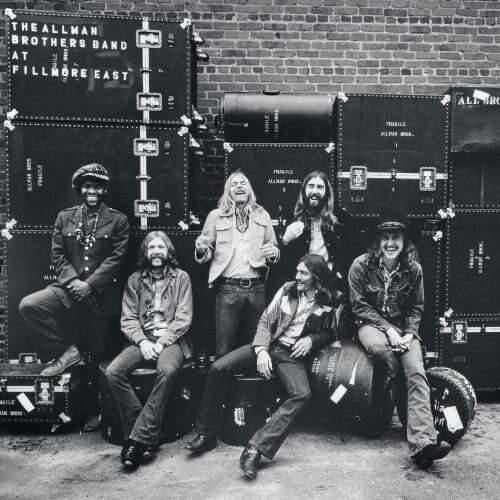
“Blue Sky” is a song by the American rock band The Allman Brothers Band from their third studio album, Eat a Peach (1972), released on Capricorn Records. The song was written and sung by guitarist Dickey Betts, who penned it about his girlfriend (and later wife), Sandy “Bluesky” Wabegijig. The track is also notable as one of guitarist Duane Allman‘s final recorded performances with the group. The band’s two guitarists, Duane Allman and Dickey Betts, alternate playing the song’s lead: Allman’s solo beginning 1:07 in, Betts joining in a shared melody line at 2:28, followed by Betts’s solo at 2:37. The song is notably more country-inspired than many songs in the band’s catalogue.
His debut as a vocalist for the band, Dickey Betts composed “Blue Sky” about his Indigenous Canadian girlfriend, Sandy “Bluesky” Wabegijig, whom he would later marry. The lyrics leave out any references to gender to make it nonspecific: “Once I got into the song I realized how nice it would be to keep the vernaculars—he and she—out and make it like you’re thinking of the spirit, like I was giving thanks for a beautiful day. I think that made it broader and more relatable to anyone and everyone,” he later said.[3] Betts initially wanted the band’s lead vocalist, Gregg Allman, to sing the song, but guitarist Duane Allman encouraged him to sing it himself: “Man, this is your song and it sounds like you and you need to sing it.”[3] An embryonic version of the song can be found on the fan bootleg, The Gatlinburg Tapes, a recording of the band jamming in April 1971 in Gatlinburg, Tennessee.[4]
The song was one of Duane Allman’s last recorded performances with the band. “As I mixed songs like “Blue Sky,” I knew, of course, that I was listening to the last things that Duane ever played and there was just such a mix of beauty and sadness, knowing there’s not going to be any more from him,” said Johnny Sandlin.[5]
While Duane Allman died before Eat a Peach’s release, the Band played the song live several times before and after the album’s studio version was recorded. Only one of these performances, recorded live during a September 19, 1971, concert at S.U.N.Y. Stonybrook, has been released by the band; several bootleg recordings from other shows circulate. Two versions of “Blue Sky” were being performed as of 2012: An Allman Brothers take on the SUNY Stony Brook/Eat a Peach original (with Warren Haynes on lead vocals, though Gregg Allman does them sometimes), and an arrangement which evolved between 1973 and 2001 played by Dickey Betts and his band Great Southern.
In 2018 singer and guitarist Frank Hannon released a cover of “Blue Sky” featuring Dickey Betts‘ son Duane Betts on guitar. Frank Hannon is the son-in-law of Dickey Betts. The cover album titled “From one place…to Another! Vol.1” reached #27 on Billboards Folk / Americana charts.
“Blue Sky” has been covered several times in the past including by Joan Baez on her 1975 album Diamonds & Rust, also released as a single.
This song is called ‘You Gotta Be Quick’. Private Lightning was previously known as ‘Quick’ – This was done in Triton Studios in Boston around 1976 or so.
The picture below predates the folks that are on this cut. 4 members here appear – 2nd, 3rd, 4th from left and 6th on the left…plus David Rosenberg on drums and Adam Sherman on vocals. First on the left, Carl Smith was the original vocalist and 4th from left is Gary Snyder, our first drummer. This photo was taken at Gordon College in Beverly Mass. where we used to practice.

Written by Dave Overland from England. Dave sings the male part and Rachel Bettney sings the female part. Rabbit is on keys. Smoky Toobs on Lead acoustic. Produced at Baselines Designs Studio in Boston.

Dave Overland on vocals. Produced at Baselines Designs Studio in Boston.
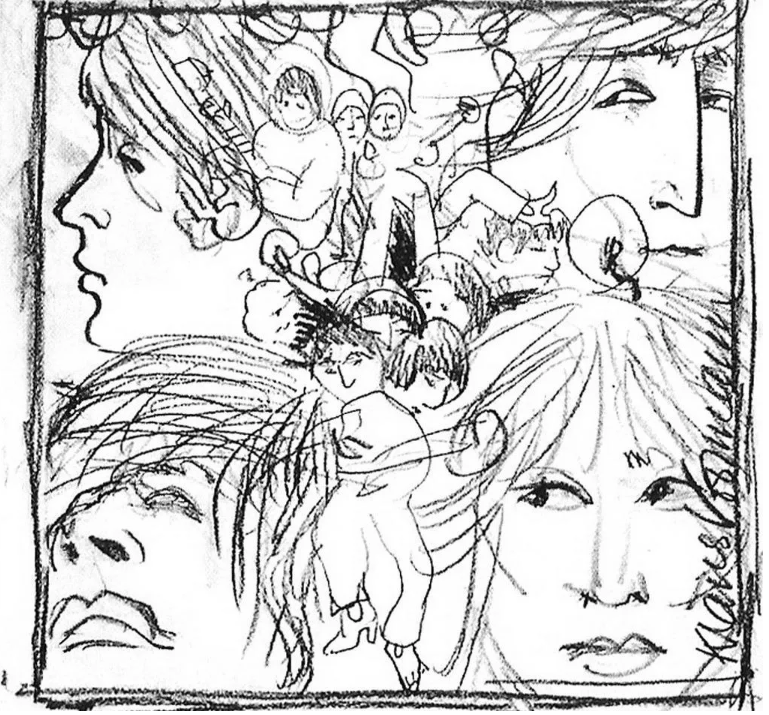
“For No One” is a song by the English rock band the Beatles from their 1966 album Revolver. It was written by Paul McCartney, and credited to Lennon–McCartney. An early example of baroque pop[1][2][3] drawing on both baroque music and nineteenth-century art song,[4] it describes the end of a romantic relationship. Mostly performed by the composer, the track is distinguished by its French horn line performed by Alan Civil, played first as a solo and then as counterpoint in the final verse. It was considered one of McCartney’s most mature compositions to date on its release.[5]
McCartney recalls writing “For No One” in the bathroom of a ski resort in the Swiss Alps[6] while on holiday with his then girlfriend Jane Asher; “I suspect it was about another argument,” he later recalled.[7] The lyrics end enigmatically with the line “A love that should have lasted years”. The song’s working title was “Why Did It Die?”[8] The composition is built on a descending scale progression in B major with a refrain that modulates to C-sharp minor.[4]
The song was recorded on 9, 16 and 19 May 1966. McCartney sang and played clavichord (rented from George Martin‘s AIR company), piano and bass guitar, while Ringo Starr played drums, tambourine and maracas.[9][10] Neither John Lennon nor George Harrison contributed to the recording.[11]
The French horn solo was by Alan Civil, a British horn player described by recording engineer Geoff Emerick as the “best horn player in London”.[12] During the session, McCartney pushed Civil to play a note that was beyond the usual range of the instrument. According to Emerick, the result was the “performance of his life”.[12] Civil said that the song was “recorded in rather bad musical style, in that it was ‘in the cracks’ [not in concert pitch], neither B-flat nor B-major. This posed a certain difficulty in tuning my instrument.”[13] Civil is one of the few session musicians to receive credit on a Beatles album.[14]
In her contemporaneous review of Revolver, for The Evening Standard, Maureen Cleave highlighted “For No One” among McCartney’s contributions and deemed it “as moving as ‘Yesterday‘”.[15]
Thomas Ward of AllMusic describes “For No One” as “one of Paul McCartney’s great ballads with the Beatles”, adding that it is “a simply beautiful song, full of idiosyncratic McCartney touches yet undeniably inspired”.[16] Ward praises McCartney’s vocal performance and calls the song’s melody “one of the most inspired of the singer’s whole career”.[16] Ward also admires the bass line and French horn solo, and concludes his review by calling the song “one of the most delicate and fine ballads of the Beatles’ entire canon”.[16]
Rob Sheffield of Rolling Stone writes that McCartney’s songs on Revolver “[had] a new caustic realism”.[5] He calls “For No One” the “ultimate ‘you stay home, she goes out’ break-up song”.[5] Lennon called the song “one of [his] favourites of [McCartney’s]” and “a nice piece of work.”[17]
Elvis Costello named it his favourite Beatles song, stating in an interview, “‘For No One’ is everything that’s great about Paul McCartney in one song … It’s a really beautiful melody. He’s like a fantastic movie actor who doesn’t do anything. He doesn’t over-dramatize.” Costello went on to call it McCartney’s best lyric and lauded the song’s arrangement, concluding, “It’s about as perfect a record as you could make.”[18]
According to Ian MacDonald,[19] except where noted:
The Beatles
Additional musician
Produced at Baselines Designs Studio, this song was written and sung by Dave Overland (@eipi on Bandla) from Great Britain. Keys are by @rabbitwithmachine gun (Bandlab)

Produced at baselines Designs Studio

The Red Road Flats were a mid-twentieth-century high-rise housing complex located between the districts of Balornock and Barmulloch in the northeast of the city of Glasgow, Scotland. The estate originally consisted of eight multi-storey blocks of steel frame construction. All were demolished by 2015. Two were “slabs”, much wider in cross-section than they are deep. Six were “points”, more of a traditional tower block shape. The slabs had 28 floors (26 occupiable and 2 mechanical), the point blocks 31 (30 occupiable and 1 mechanical), and taken together, they were designed for a population of 4,700 people. The point blocks were among the tallest buildings in Glasgow at 89 metres (292 ft), second in overall height behind the former Bluevale and Whitevale Towers in Camlachie. The 30th floor of the point blocks were the highest inhabitable floor level of any building in Glasgow.
Views from the upper floors drew the eye along the Campsie Fells to Ben Lomond and the Arrochar Alps, then west past the Erskine Bridge and out to Goat Fell on the Isle of Arran continuing south over Glasgow and East towards Edinburgh. On a clear day, the buildings were visible on the Glasgow skyline from up to 10 miles (16 kilometres) away. The 31st floor of the point blocks and the corresponding 28th floor of the slabs were reserved as a communal drying area.
Among the best-known of Glasgow’s highrise housing developments of the 1960s, the buildings were formally condemned in July 2008 after a long period of decline, with their phased demolition taking place in three stages between 2010 and 2015.
After the publication of the Bruce Report in 1946, Glasgow Corporation identified Comprehensive Development Areas (CDAs), which were largely inner-urban districts (such as the Gorbals, Anderston and Townhead), with a high proportion of overcrowded slum housing. These areas would see the mass demolition of overcrowded and insanitary tenement slum housing, and their replacement with lower density housing schemes to create space for modern developments. The dispersed population would be relocated to new estates built on green belt land on the outer periphery of the city’s metropolitan area, with others moved out to the New Towns of Cumbernauld and East Kilbride. These initiatives began to be implemented in the late 1950s.
Barlornock was a green belt area that had undergone little development before the construction of the Red Road estate. The original plan for Red Road was far more modest than the eventual high-rise scheme – it called for a complex of maisonettes no taller than 4 storeys. What emerged was Glasgow Corporation architect Sam Bunton’s scheme to house a population of 4,700 people in 28- and 31-storey tower blocks which were at the time the highest in Europe,[1] although they were quickly surpassed when Birmingham City Housing Department opened The Sentinels, two 32 storey council blocks in 1971 (these were themselves surpassed by the 42-storey Barbican Estate in the City of London completed in 1973).
Contemporary critics of the scheme accused Bunton – who was close to retirement at the time – of championing the development as a personal vanity project;[2] he was well known within Glasgow Corporation as a strong proponent of high-rise housing; his practice having designed other similar multi-storey estates around the city. Bunton was said to have dreamt of “building a Manhattan-style skyscraper” in Glasgow, hence the use of the steel frame construction system in place of the “system-built” pre-fabricated concrete panel method which had been used for all other tower blocks built in the city up until that point. This would create one of the estate’s most significant legacies – steel construction had to be fire-proofed, which meant the use of asbestos, a legacy which would blight the estate in the coming years. Bunton argued for the steel frame in numerous letters to the Glasgow Herald in February 1963, claiming “it is the best material available in the construction field since it brings into active participation an array of steel erectors, and the resources of an industry which is at present only working at one-third of its capacity”,[3] thus suggesting that local politics (primarily lobbying from Glasgow’s underworked steel fabrication industries) had shaped the design of the buildings in other ways.
The first three towers were formally opened on 28 October 1966, by the then Scottish Secretary, Willie Ross. For most of the early residents, living in the flats meant a considerable and welcome rise in their living conditions, since most had previously lived in much worse housing, often severely overcrowded, either nearby or elsewhere in the city. From the time they were built until recent years, they were owned by the local council.
_(col_balance_%26_levels)_(crop).jpg)
During the original construction, large amounts of asbestos were used to ensure the structural integrity of the buildings’ steel frames in the event of a fire.[4] Despite contemporary concerns over the suitability of the nature of the fire proofing solution used in the buildings, Bunton vehemently defended it, stating in an article to the International Asbestos Cement Review in 1966; “steel and asbestos in partnership with social others operate as the collective that stabilises Red Road and holds it together, albeit provisionally, as a viable, safe housing solution”.[5]
Two decades later it became widely known that the use of this material caused illnesses and deaths, and whilst some of it was removed over the course of the life of the buildings – between 1979 and 1982 the buildings were fitted with coloured metal overcladding to cover the exterior asbestos walls, whilst the slab blocks had additional external fire escapes built in the late 1980s[6] – asbestos was integral to their structure and could not be fully removed until the buildings were demolished.[7]


By the 1970s the estate had gained a reputation for anti-social crime, ranging from disaffected youths throwing objects from the roofs to frequent burglaries. Such problems were less severe than those evident in parts of the city such as the nearby low-rise Blackhill estate, long dominated by ruthless crime gangs. But they were able to strike a nerve in the perceptions of non-residents, owing partly to the “looming” ambience of the blocks which in some ways might be called emblematic. The slab blocks, for example, were not only 25 storeys high but also almost 100 metres (300′) wide.
A major turning point came in August 1977, when a fire started by vandals in an empty flat on the 23rd floor of 10 Red Road Court, caused serious structural damage to the building, resulting in the death of a 12-year-old boy and a large number of tenants being evacuated. Many refused to return to their ruined homes, since the fire had brought to the fore the issues surrounding the asbestos lining used in the buildings, and prompted the outer refurbishment of the towers. As a mark of respect, the flat on Floor 23 of 10 Red Road Court was never let out again for rent, and instead was refurbished as a drop-in “community flat” with social amenities for the whole estate. Around 1980 the authorities declared two of the blocks (10 Red Road Court and 33 Petershill Drive) unfit as family accommodation and transferred them for use by students and the YMCA respectively. These happened to be the blocks closest to the front of the complex when approached from the city centre. Being nearest the bus stop, they were also easiest to locate for the YMCA guests and university students.

By the time the 1980s had dawned, it had become clear that the optimism that had surrounded the policy of high rise housing had waned in less than two decades, and despite attempts to regenerate the estate, drug dealing, muggings and other serious crime continued, and the towers also became a frequent spot for suicides. Along with the equally controversial and derided Hutchesontown C estate in the Gorbals, Red Road became increasingly looked upon as a monument to the errors of Glasgow’s ambitious post-war housing renewal policy.[8][9]
Measures were introduced in the 1980s which gave residents increased protection. These included the control of access through the communal entrance doors by means of RFID keys and intercoms, and the installation of round-the-clock concierge facilities. Crime fell dramatically.
By the 1990s, residents included refugees from the Kosovo War. Later residents included people who had fled from countries in Africa, Asia, and elsewhere in Europe.[10]
The position changed dramatically in 2003 when the flats were transferred, after a ballot, to a housing association in the shape of the Glasgow Housing Association Ltd. The practice of transferring housing stock from public to private ownership had initially been launched in the 1970s as a flagship policy promoted by the Conservative Party. At that time, the recipients were individual tenants who opted to buy their homes, or long-term leases thereon. Twenty years later the policy was continued by the Labour Party led council, which transferred its entire housing stock to a single company set up for the purpose.

.jpg)
Soon the new landlords as well as the council insisted that repairs were costing more than receipts in rent, and that big changes therefore had to be made. In 2005 Glasgow Housing Association announced its intention to demolish one of the tallest blocks as part of a regeneration of the area.[11][12]
Defend Council Housing, a pro-council housing campaign group,[13] set up a local campaign against the demolition, seeking to ensure the scheme’s continued existence.[14] However, all the eight buildings were planned for phased demolition beginning in the spring of 2010 and expected to be accomplished within a decade.[15][16]
On 7 March 2010, the Serykh family, three asylum seekers, jumped to their deaths from one of the towers.[17] These deaths galvanised much in the way of action in and around the Red Road. Various projects now exist to document the end of the flats positively, with the hope that everyone with memories of the flats will contribute actively to the projects as best they can.
The first block, the 28-floor slab block, was demolished by controlled explosion on 10 June 2012.[18] The steel structured tower took just six seconds to fall after a series of carefully timed explosions, using 275 kilograms (606 pounds) of explosive, ripped along the building around the sixth to eighth floors. The second block, the 31-floor point block on Birnie Court was demolished on 5 May 2013,[19] at 11:46 a.m., taking about four seconds to fall.
In April 2014, it was announced that five of the remaining towers would be given a dramatic explosive demolition as part of the 2014 Commonwealth Games opening ceremony.[20] The spectacle would have the five towers simultaneously felled by controlled explosion, with the footage being broadcast live to large screens in Celtic Park.
Former MSP Carolyn Leckie criticised the demolition plans and called for the five flats to be “demolished with dignity, not for entertainment”. She has said “the image of tower blocks coming down is not a positive international spectacle” and suggests it also conveys disregard for the asylum seekers living in the sixth tower, which would remain standing.[21] The demolition plan for the Commonwealth Games was cancelled for safety reasons,[22] but the flats were demolished the following year.
In August 2015, Glasgow Housing Association announced that all six remaining high-rise blocks would be brought down in a one-off demolition later in 2015.[23] The six remaining towers were demolished on 11 October 2015, after Sheriff Court interdicts (the Scottish law equivalent of an injunction) were obtained against a group of residents who refused to leave their nearby homes during the explosions.[24] Two of the six blocks failed to completely collapse and remained partially standing.[25][26] The contractors, Safedem carried out a review to determine the best way of completing the demolition[27] and the partial remains of the two flats were eventually demolished using a high reach excavator.
A classical sounding song about the eternal struggle between the Islamic Hatfield and McCoys.
The history of the Israeli–Palestinian conflict traces back to the late 19th century when Zionists sought to establish a homeland for the Jewish people in Ottoman-controlled Palestine. The Balfour Declaration of 1917, issued by the British government, endorsed the idea of a Jewish homeland in Palestine, which led to an influx of Jewish immigrants to the region. Following World War II and the Holocaust, international pressure mounted for the establishment of a Jewish state in Palestine, leading to the creation of Israel in 1948.
The establishment of Israel, and the war that followed and preceded it, led to the displacement of hundreds of thousands of Palestinians who became refugees, sparking a decades-long conflict between Israel and the Palestinian people.[1] The Palestinians seek to establish their own independent state in at least a part of historic Palestine. Israeli defense of its own borders, control over the West Bank, the Egyptian-Israeli blockade of the Gaza Strip, and Palestinian internal politics currently make this goal out of reach.
Numerous peace negotiations have taken place over the years, but a lasting peace agreement has remained elusive. The conflict has been marked by violence, including terrorist attacks by Palestinian militants and military operations by Israel. The United States and other countries have played a key role in attempting to broker peace, but many obstacles remain, including the issue of Israeli settlements in the West Bank, the status of Jerusalem, and the ultimate fate of Palestinian refugees.
Further information: History of the Jews and Judaism in the Land of Israel and Islam in Palestine
See also: Zionism, Arab nationalism, and Palestinian nationalism
Before World War I, the Middle East region, including the Ottoman Syria (the southern part of which are regarded as Palestine), was under the control of the Ottoman Empire for nearly 400 years.[2] Towards the end of the 19th century, Palestine, which was divided between the Mutasarrifate of Jerusalem, Syria Vilayet and Beirut Vilayet, was inhabited predominantly by Arab Muslims, both farmers and Bedouin (principally in the Negev and Jordan Valley), with smaller numbers of Christians (mostly Arabs), Druze, Circassians and Jews (predominantly Sephardic).[3] At that time most of the Jews worldwide lived outside Palestine, predominantly in eastern and central Europe,[4] with significant communities in the Mediterranean, the Middle East and the Americas.

The roots of the conflict can be traced to the late 19th century, with the rise of national movements, including Zionism and Arab nationalism. Though the Jewish aspiration to return to Zion had been part of Jewish religious thought for more than a millennium, the Jewish population of Europe and to some degree Middle East began to more actively discuss immigration back to the Land of Israel, and the re-establishment of the Jewish Nation, only between 1859 and the 1880s, largely as a solution to the widespread persecution of Jews, and antisemitism in Russia and Europe.[citation needed] As a result, the Zionist movement, the modern movement for the creation of a homeland for the Jewish people, was established as a political movement in 1897.
The Zionist movement called for the establishment of a nation state for the Jewish people in Palestine, which would serve as a haven for the Jews of the world and in which they would have the right for self-determination.[5] Zionists increasingly came to hold that this state should be in their historic homeland, which they referred to as the Land of Israel.[6] The World Zionist Organization and the Jewish National Fund encouraged immigration and funded purchase of land, both under Ottoman rule and under British rule, in the region of Palestine[7] while Arab nationalism, at least in an early form, and Syrian nationalism were the dominant tendencies, along with continued loyalty to the Ottoman state, in the area.
According to Benny Morris, among the first recorded violent incidents between Arabs and the newly immigrated Jews in Palestine was the accidental shooting death of an Arab man in Safed, during a wedding in December 1882, by a Jewish guard of the newly formed Rosh Pinna.[8] In response, about 200 Arabs descended on the Jewish settlement throwing stones and vandalizing property.[9] Another incident happened in Petah Tikva, where in early 1886 the Jewish settlers demanded that their tenants vacate the disputed land and started encroaching on it. On March 28, a Jewish settler crossing this land was attacked and robbed of his horse by Yahudiya Arabs, while the settlers confiscated nine mules found grazing in their fields, though it is not clear which incident came first and which was the retaliation. The Jewish settlers refused to return the mules, a decision viewed as a provocation. The following day, when most of the settlement’s men folk were away, fifty or sixty Arab villagers attacked Petach Tikva, vandalizing houses and fields and carrying off much of the livestock. Four Jews were injured and a fifth, an elderly woman with a heart condition, died four days later.[10]
By 1908, thirteen Jews had been killed by Arabs, with four of them killed in what Benny Morris calls “nationalist circumstances”, the others in the course of robberies and other crimes. In the next five years twelve Jewish settlement guards were killed by Arabs. Settlers began to speak more and more of Arab “hatred” and “nationalism” lurking behind the increasing depredations, rather than mere “banditry”.[10]
Zionist ambitions were increasingly identified as a threat by the Arab leaders in Palestine region.[11] Certain developments, such as the acquisition of lands from Arab owners for Jewish settlements, which led to the eviction of the fellaheen from the lands which they cultivated as tenant farmers, aggravated the tension between the parties and caused the Arab population in the region of Palestine to feel dispossessed of their lands.[12] Ottoman land-purchase regulations were invoked following local complaints in opposition to increasing immigration. Ottoman policy makers in the late 19th century were apprehensive of the increased Russian and European influence in the region, partly as a result of a large immigration wave from the Russian Empire. The Ottoman authorities feared the loyalty of the new immigrants not so much because of their Jewishness but because of concern that their loyalty was primarily to their country of origin, Russia, with whom the Ottoman Empire had a long history of conflicts: immigrant loyalty to Russia might ultimately undermine Turkish control in the region of Palestine. This concern was fomented by the example seen in the dismantling of Ottoman authority in the Balkan region. European immigration was also considered by local residents to be a threat to the cultural make-up of the region.[13] The regional significance of the anti-Jewish riots (pogroms) in Russia in the late 19th and early 20th centuries and anti-immigration legislation being enacted in Europe was that Jewish immigration waves began arriving in Palestine (see First Aliyah and Second Aliyah).[14] As a result of the extent of the various Zionist enterprises which started becoming apparent,[13] the Arab population in the Palestine region began protesting against the acquisition of lands by the Jewish population. As a result, in 1892 the Ottoman authorities banned land sales to foreigners. By 1914 the Jewish population in Palestine had risen to over 60,000, with around 33,000 of these being recent settlers.[15]
Further information: Occupied Enemy Territory Administration
Main articles: Balfour Declaration and McMahon–Hussein Correspondence


As a result of a mutual defense treaty that the Ottoman Empire made with Germany, during World War I the Ottoman Empire joined the Central Powers opposed to Great Britain and France. The possibility of releasing Palestine from the control of the Ottoman Empire led the new Jewish population and the Arab population in Palestine to support the alignment of the United Kingdom, France, and Russia during World War I. In 1915, the McMahon–Hussein Correspondence was formed as an agreement with Arab leaders to grant sovereignty to Arab lands under Ottoman control to form an Arab state in exchange for the Great Arab Revolt against the Ottomans. However, the Balfour Declaration in 1917 proposed to “favour the establishment in Palestine of a national home for the Jewish people, but that nothing should be done to prejudice the civil and religious rights of the existing non-Jewish communities in Palestine.” In 1916, the Anglo-French Sykes–Picot Agreement allocated to the British Empire the area of present-day Jordan, Israel, the Palestinian territories, and the area of present-day Iraq. The Balfour Declaration was seen by Jewish nationalists as the cornerstone of a future Jewish homeland on both sides of the Jordan River, but increased the concerns of the Arab population in the Palestine region.
In 1917, the British succeeded in defeating the Ottoman Turkish forces and occupied the Palestine region. The land remained under British military administration for the remainder of the war.
On January 3, 1919, future president of the World Zionist Organization Chaim Weizmann and the future King Faisal I of Iraq signed the Faisal-Weizmann Agreement in which Faisal provisionally accepted the Balfour Declaration conditional on the fulfillment of British wartime promises of Palestine being included in the area of Arab independence.
At the 1919 Paris Peace Conference and Treaty of Versailles, Turkey’s loss of its Middle East Empire was formalized.
Main article: Timeline of intercommunal violence in Mandatory Palestine
See also: Palestinian nationalism, Zionism, and Mandatory Palestine
After World War I and the collapse of the Ottoman Empire, in April 1920 the Allied Supreme Council meeting at San Remo granted to Britain the mandates for Palestine and Transjordan (the territories that include the area of present-day Israel, Jordan, West Bank and the Gaza Strip), endorsing the terms of the Balfour Declaration.[16] In August 1920, this was officially acknowledged in the Treaty of Sèvres. Both Zionist and Arab representatives attended the conference, where they met and signed an agreement[17] to cooperate. The agreement was never implemented. The borders and terms under which the mandate was to be held were not finalized until September 1922. Article 25 of the mandate specified that the eastern area (then known as Transjordan or Transjordania) did not have to be subject to all parts of the Mandate, notably the provisions regarding a Jewish national home. This was used by the British as one rationale to establish an autonomous Arab state under the mandate, which it saw as at least partially fulfilling the undertakings in the Hussein-McMahon Correspondence. On April 11, 1921, the British passed administration of the eastern region of the British Mandate to the Hashemite Arab dynasty from the Hejaz region (a region located in present-day Saudi Arabia) and on May 15, 1923 recognized it as an autonomous state, thereby eliminating Jewish national aspirations on that part of the Mandatory Palestine. The mandate over Transjordan ended on May 22, 1946, when the Hashemite Kingdom of Transjordan (later Jordan) gained independence.
Palestinian nationalism was marked by a reaction to the Zionist movement and to Jewish settlement in Palestine as well as by a desire for self-determination by the Arab population in the region.[18] Jewish immigration to Palestine continued to grow significantly during the period of the British Mandate in Palestine, mainly due to the growth of anti-Semitism in Europe. Between 1919 and 1926, 90,000 immigrants arrived in Palestine because of the anti-Semitic manifestations, such as the pogroms in Ukraine in which 100,000 Jews were killed.[19] Some of these immigrants were absorbed in Jewish communities established on lands purchased legally by Zionist agencies from absentee landlords. In some cases, a large acquisition of lands, from absentee landlords, led to the replacement of the fellahin tenant farmers with European Jewish settlers, causing Palestinian Arabs to feel dispossessed. Jewish immigration to Palestine was especially significant after the rise of the Nazis to power in Germany, following which the Jewish population in Palestine doubled.

The Arab population in Palestine opposed the increase of the Jewish population because the new immigrants refused to lease or sell land to Palestinians, or hire them.[20] During the 1920s relations between the Jewish and Arab populations deteriorated and the hostility between the two groups intensified.
From 1920, the Grand Mufti of Jerusalem Haj Mohammad Amin al-Husayni became the leader of the Palestinian Arab movement and played a key role in inciting religious riots against the Jewish population in Palestine.[21] The Mufti stirred religious passions against Jews by alleging that Jews were seeking to rebuild the Jewish Temple on the site of the Dome of the Rock and Jami Al-Aqsa.[21]
The first major riots against the Jewish population in Palestine were the Jaffa riots in 1921. As a result of the Jaffa riots, the Haganah was founded as a defense force for the Jewish population of the British Mandate for Palestine. Religious tension over the Kotel and the escalation of the tensions between the Arab and Jewish populations led to the 1929 Palestine riots. In these religious-nationalist riots, Jews were massacred in Hebron. Devastation also took place in Safed and Jerusalem. In 1936, as Europe was preparing for war, the Supreme Muslim Council in Palestine, led by Amin al-Husayni, instigated the 1936–39 Arab revolt in Palestine in which Palestinian Arabs rioted and murdered Jews in various cities.[22] In 1937 Amin al-Husayni, who was wanted by the British, fled Palestine and took refuge successively in Lebanon, Iraq, Italy and finally Nazi Germany.
The British responded to the outbreaks of violence with the Haycraft Commission of Inquiry (1921), the Shaw Report (1930), the Peel Commission of 1936–1937, the Woodhead Commission (1938) and the White Paper of 1939.
The Peel Commission of 1937 was the first to propose a two-state solution to the conflict, whereby Palestine would be divided into two states: one Arab state and one Jewish state. The Jewish state would include the coastal plain, Jezreel Valley, Beit She’an and the Galilee, while the Arab state would include Transjordan, Judea and Samaria, the Jordan Valley, and the Negev. The 2 main Jewish leaders, Chaim Weizmann and David Ben-Gurion had convinced the Zionist Congress to approve equivocally the Peel recommendations as a basis for more negotiation.[23][24][25] The Arab leadership in Palestine rejected the conclusions and refused to share any land in Palestine with the Jewish population. The rejection of the Peel Commission’s proposal by The Arabs led to the establishment of the Woodhead Commission. The Woodhead Commission considered three different plans, one of which was based on the Peel plan. Reporting in 1938, the Commission rejected the Peel plan primarily on the grounds that it could not be implemented without a massive forced transfer of Arabs (an option that the British government had already ruled out).[26] With dissent from some of its members, the Commission instead recommended a plan that would leave the Galilee under British mandate, but emphasised serious problems with it that included a lack of financial self-sufficiency of the proposed Arab State.[26] The British Government accompanied the publication of the Woodhead Report by a statement of policy rejecting partition as impracticable due to “political, administrative and financial difficulties”.[27]
In May 1939 the British government released a new policy paper which sought to implement a one-state solution in Palestine, significantly reduced the number of Jewish immigrants allowed to enter Palestine by establishing a quota for Jewish immigration which was set by the British government in the short-term and which would be set by the Arab leadership in the long-term. The quota also placed restrictions on the rights of Jews to buy land from Arabs, in an attempt to limit the socio-political damage. These restrictions remained until the end of the mandate period, a period which occurred in parallel with World War II and the Holocaust, during which many Jewish refugees tried to escape from Europe.[28] As a result, during the 1930s and 1940s the leadership of the Yishuv arranged a couple of illegal immigration waves of Jews to the British Mandate of Palestine (see also Aliyah Bet), which caused even more tensions in the region.
Ben-Gurion said he wanted to “concentrate the masses of our people in this country [Palestine] and its environs.”[29] When he proposed accepting the Peel proposals in 1937, which included a Jewish state in part of Palestine, Ben-Gurion told the twentieth Zionist Congress, “The Jewish state now being offered to us is not the Zionist objective. […] But it can serve as a decisive stage along the path to greater Zionist implementation. It will consolidate in Palestine, within the shortest possible time, the real Jewish force, which will lead us to our historic goal”.[30] In a discussion in the Jewish Agency he said that he wanted a Jewish-Arab agreement “on the assumption that after we become a strong force, as a result of the creation of the state, we shall abolish partition and expand to the whole of Palestine.”[31]

During the 1936–39 Arab revolt in Palestine, ties were made between the Arab leadership in Palestine and the Nazi movement in Germany.[32] These connections led to cooperation between the Palestinian national movement and the Axis powers later on during World War II.[32] In May 1941 Amin al-Husayni issued a fatwa for a holy war against Britain. In 1941 during a meeting with Adolf Hitler Amin al-Husayni asked Germany to oppose, as part of the Arab struggle for independence, the establishment of a Jewish national home in Palestine.[33] He received a promise from Hitler that Germany would eliminate the existing Jewish foundations in Palestine after the Germans had gained victory in the war.[34] During the war Amin al-Husayni joined the Nazis, serving with the Waffen SS in Bosnia and Yugoslavia.[21] In addition, during the war a joint Palestinian-Nazi military operation was held in the region of Palestine. These factors caused a deterioration in the relations between the Palestinian leadership and the British, which turned to collaborate with the Yeshuv during the period known as the 200 days of dread.
After World War II, as a result of the British policies, the Jewish resistance organizations united and established the Jewish Resistance Movement which coordinated armed attacks against the British military which took place between 1945 and 1946. Following the King David Hotel bombing (in which the Irgun blew up the King David Hotel in Jerusalem, the headquarters of the British administration), which shocked the public because of the deaths of many innocent civilians, the Jewish Resistance Movement was disassembled in 1946.[35] The leadership of the Yishuv decided instead to concentrate their efforts on the illegal immigration and began to organize a massive immigration of European Jewish refugees to Palestine using small boats operating in secrecy, many of which were captured at sea by the British and imprisoned in camps on Cyprus. About 70,000 Jews were brought to Palestine in this way in 1946 and 1947. Details of the Holocaust had a major effect on the situation in Palestine and propelled large support for the Zionist movement.

Palestinian Arab fighters, 1947

Haganah fighters, 1947
On May 15, 1947, the General Assembly of the newly formed United Nations resolved that a committee, (United Nations Special Committee on Palestine), be created “to prepare for consideration at the next regular session of the Assembly a report on the question of Palestine”. The Committee was to consist of the representatives of Australia, Canada, Czechoslovakia, Guatemala, India, Iran, Netherlands, Peru, Sweden, Uruguay and Yugoslavia.[36]
In Chapter VI of the report of September 3, 1947, the majority of the Committee proposed recommendations for consideration by the General Assembly that “Palestine within its present borders, following a transitional period of two years from September 1, 1947, shall be constituted into an independent Arab State, an independent Jewish State, and the City of Jerusalem”.[37] The Arab state was supposed to comprise roughly 4,300 square miles (11,000 km2) and would contain a tiny Jewish population. The Jewish State was supposed to be roughly 5,700 square miles (15,000 km2) in size and was supposed to contain a sizable Arab minority population. Neither state would be contiguous. Jerusalem and Bethlehem were to be put under the control of the United Nations.[19] Neither side was satisfied with the Partition Plan. The Jews disliked losing Jerusalem—which had a majority Jewish population at that time—and worried about the tenability of a noncontiguous state. However, most of the Jews in Palestine accepted the plan, and the Jewish Agency (the de facto government of the Yishuv) campaigned fervently for its approval. The more extreme Jewish groups, such as the Irgun, rejected the plan. The Arab leadership argued that it violated the rights of the majority of the people in Palestine, which at the time was 67% non-Jewish (1,237,000) and 33% Jewish (608,000).[38] Arab leaders also argued a large number of Arabs would be trapped in the Jewish State. Every major Arab leader objected in principle to the right of the Jews to an independent state in Palestine, reflecting the policies of the Arab League.
On November 29, 1947, the General Assembly adopted a resolution recommending “to the United Kingdom, as the mandatory Power for Palestine, and to all other Members of the United Nations the adoption and implementation, with regard to the future government of Palestine, of the Plan of Partition with Economic Union“, (a slightly amended version of the plan in Chapter VI of the report of September 3, 1947), as Resolution 181(II)). Thirty-three states voted in favor of the resolution, while 13 countries opposed it. Ten countries abstained from the vote.[39] The Yishuv accepted the plan, but the Arabs in Palestine and the surrounding Arab states rejected the plan. The Arab countries (all of which had opposed the plan) proposed to query the International Court of Justice on the competence of the General Assembly to partition a country against the wishes of the majority of its inhabitants, but were again defeated.[citation needed]
The Plan (PART I A., Clause 3.) provided that “Independent Arab and Jewish States and the Special International Regime for the City of Jerusalem, should come into existence in Palestine two months after the evacuation of the armed forces of the mandatory Power has been completed but in any case not later than October 1, 1948 ….”

The approval of the plan sparked attacks carried out by Arab irregulars against the Jewish population in Palestine.[40][41] Fighting began almost as soon as the Resolution of November 29, 1947 was approved. Shooting, stoning, and rioting continued apace in the following days. The consulates of Poland and Sweden, both of whose governments had voted for partition, were attacked. Bombs were thrown into cafes, Molotov cocktails were hurled at shops, and a synagogue was set on fire.[40] Arab gunmen attacked Jewish cars and trucks, snipers in Jaffa began firing at passers-by in Tel Aviv and Jaffa Arabs attacked close Tel Aviv neighborhood.[41]
As the British evacuation from the region progressed, the violence became more prevalent. Murders, reprisals, and counter-reprisals came fast on each other’s heels, resulting in dozens of victims killed on both sides in the process. The Deir Yassin massacre took place on April 9, 1948, when around 120 fighters from the Irgun Zevai Leumi and the Israeli Stern Gang Zionist paramilitary groups attacked Deir Yassin near Jerusalem, a Palestinian Arab village of roughly 600 people. The sanguinary impasse persisted as no force intervened to put a stop to the escalating cycles of violence. During the first two months of the war, about 1,000 people were killed and 2,000 injured.[42] By the end of March, the figure had risen to 2,000 dead and 4,000 wounded.[43]

On May 14, 1948, one day before the British Mandate expired, Ben-Gurion declared “the establishment of a Jewish State in Eretz-Israel, to be known as the State of Israel“. The declaration was stated to be “by virtue of our natural and historic right and on the strength of the resolution of the United Nations General Assembly”. The Declaration stated that the State of Israel would “ensure complete equality of social and political rights to all its inhabitants irrespective of religion, race or sex; it will guarantee freedom of religion, conscience, language, education and culture; it will safeguard the Holy Places of all religions; and it will be faithful to the principles of the Charter of the United Nations“.[44]
For a chronological guide, see Timeline of the Israeli–Palestinian conflict.
See also: 1948 Arab–Israeli War, Israeli Declaration of Independence, All-Palestine Government, Occupation of the Gaza Strip by Egypt, and Jordanian annexation of the West Bank

The termination of the British mandate over Palestine and the Israeli Declaration of Independence sparked a full-scale war (1948 Arab–Israeli War) which erupted after May 14, 1948. On 15–16 May, the four armies of Jordan, Syria, Egypt and Iraq[45] invaded/intervened in what had been the area of the British Mandate[16] followed not long after by units from[45] Lebanon.[16]
In the introduction to the[46] cablegram from the Secretary-General of the League of Arab States to the UN Secretary-General on May 15, 1948, the Arab League gave reasons for its “intervention”, “On the occasion of the intervention of Arab States in Palestine to restore law and order and to prevent disturbances prevailing in Palestine from spreading into their territories and to check further bloodshed”. Clause 10.(a) of the Cablegram provided:”10. Now that the Mandate over Palestine has come to an end, leaving no legally constituted authority behind in order to administer law and order in the country and afford the necessary and adequate protection to life and property, the Arab States declare as follows:”(a) The right to set up a Government in Palestine pertains to its inhabitants under the principles of self-determination recognized by the Covenant of the League of Nations as well as the United Nations Charter”.


While Arab commanders ordered villagers to evacuate for military purposes in isolated areas,[47] there is no evidence that the Arab leadership made a blanket call for evacuation and in fact most urged Palestinians to stay in their homes.[48] Assaults by the Haganah on major Arab population centers like Jaffa and Haifa as well as expulsions carried out by groups like the Irgun and Lehi such as at Deir Yassin and Lydda led to the exodus of large portions of the Arab masses.[49] Factors such as the earlier flight by the Palestinian elite and the psychological effects of Jewish atrocities (stories which both sides propagated) also played important roles in the Palestinian flight.
The war resulted in an Israeli victory, with Israel annexing territory beyond the partition borders for a proposed Jewish state and into the borders for a proposed Palestinian Arab state.[50] Jordan, Syria, Lebanon, and Egypt signed the 1949 Armistice Agreements with Israel. The remaining territories, the Gaza Strip and the West Bank, were occupied by Egypt and Transjordan, respectively. Jordan also annexed[51] East Jerusalem while Israel administered West Jerusalem. In 1950, the West Bank was unilaterally incorporated into Jordan.[52]
Between 700,000 and 750,000 Palestinian Arabs fled or were expelled from the area that became Israel and became what is known today as the Palestinian refugees.[53] The Palestinian refugees were not allowed to return to Israel and most of the neighboring Arab states, with the exception of Transjordan, denied granting them—or their descendants—citizenship. In 1949, Israel offered to allow some members of families that had been separated during the war to return, to release refugee accounts frozen in Israeli banks, and to repatriate 100,000 refugees.[16] The Arab states[16] rejected this compromise, at least in part because they were unwilling to take any action that might be construed as recognition of Israel. As of today, most of them still live in refugee camps and the question of how their situation should be resolved remains one of the main issues of the Israeli–Palestinian conflict.
Due to the 1948 Arab–Israeli war, about 856,000 Jews fled or were expelled from their homes in Arab countries and most were forced to abandon their property.[54] Jews from Libya, Iraq, Yemen, Syria, Lebanon and North Africa left due to physical and political insecurity, with the majority being forced to abandon their properties.[54] 260,000 reached Israel in 1948–1951, 600,000 by 1972.[54][55][56]
While most of the Palestinian Arab population that remained in Israel after the war was granted an Israeli citizenship, Arab Israelis were subject to martial law up to 1966. A variety of legal measures facilitated the transfer of land abandoned by Arabs to state ownership. In 1966, security restrictions placed on Arab citizens of Israel were lifted completely, the government set about dismantling most of the discriminatory laws, and Arab citizens of Israel were granted the same rights as Jewish citizens.
After the 1948 war, some of the Palestinian refugees who lived in camps in the West Bank within Jordanian controlled territory, the Gaza Strip Egyptian controlled territory and Syria tried to return by infiltration into Israeli territory, and some of those Palestinians who had remained in Israel were declared infiltrators by Israel and were deported. Ben-Gurion emphatically rejected the return of refugees in the Israeli Cabinet decision of June 1948 reiterated in a letter to the UN of August 2, 1949 containing the text of a statement made by Moshe Sharett on August 1, 1948 where the basic attitude of the Israeli Government was that a solution must be sought, not through the return of the refugees to Israel, but through the resettlement of the Palestinian Arab refugee population in other states.[57]
See also: List of attacks against Israeli civilians before 1967 and Six-Day War
Violence was ongoing during almost the entire period from 1950 through 1967. It includes attacks on civilians in Israel carried out by the Jordanian Army, such as the Ramat Rachel archaeologists shooting attack, mass-casualty attacks on Israeli civilians carried out by Palestinian militants then usually called fedayeen, include the Yehud attack, the Ma’ale Akrabim massacre, the Beit Oved attack, the Shafir shooting attack, the 1956 Eilat bus ambush, the Ein Ofarim killings, and the Negev desert road ambush; major Israeli attacks include the Beit Jalla, the Qibya massacre, the Nahalin reprisal raid, and the Rantis and Falameh reprisal raids. The Lavon Affair led to a deeper distrust of Jews in Egypt, from whose community key agents in the operation had been recruited, and as a result Egypt retaliated against its Jewish community.[citation needed] After Israel’s raid on an Egyptian military outpost in Gaza in February 1955 killed 37 Egyptian soldiers the Egyptian government began to actively sponsor, train, and arm the Palestinian volunteers from Gaza as fedayeen units which committed raids into Israel.[58]
In 1967, after years of Egyptian-aided Palestinian fedayeen attacks stemming from the Gaza Strip, the Egyptian expulsion of UNEF, Egypt’s amassing of an increased number of troops in the Sinai Peninsula, and several other threatening gestures from other neighboring Arab nations, Israel launched a preemptive strike against Egypt. The strike and the operations that followed became known as the Six-Day War. At the end of the Six-Day War, Israel had captured, among other territories, the Gaza Strip from Egypt and the West Bank from Jordan (including East Jerusalem). Shortly after Israel seized control over Jerusalem, Israel asserted sovereignty over the entire city of Jerusalem and the Palestinian residents of East Jerusalem were given a permanent resident status in Israel. The status of the city as Israel’s capital and the occupation of the West Bank and Gaza Strip created a new set of contentious issues in the conflict. This meant that Israel controlled the entire former British mandate of Palestine that under the Balfour Declaration was supposed to allow a Jewish state within its borders. Following the Six-Day War, the United Nations Security Council issued a resolution with a clause affirming “the necessity … for achieving a just settlement of the refugee problem,” referring to the Palestinian refugee problem.[59]
At the end of August 1967, Arab leaders met in Khartoum in response to the war, to discuss the Arab position toward Israel. They reached consensus that there should be no recognition, no peace, and no negotiations with the State of Israel, the so-called “three no’s”. [56]
Following years of attacks by the Palestinian fedayeen, the Palestine Liberation Organization (PLO) was established in 1964. Its goal was the liberation of Palestine through armed struggle.[60] The original PLO Charter stated the desire for a Palestinian state established within the entirety of the borders of the British mandate prior to the 1948 war (i.e. the current boundaries of the State of Israel) and said it is a “national duty … to purge the Zionist presence from Palestine.”[61] It also called for a right of return and self-determination for Palestinians.
See also: Battle of Karameh, Yom Kippur War, Palestinian insurgency in South Lebanon, 1982 Lebanon War, and First Intifada

The defeat of the Arab countries in the Six-Day War prompted fractured Palestinian political and militant groups to give up any remaining hope they had placed in pan-Arabism. In July 1968 armed, non-state actors such as Fatah and the Popular Front for the Liberation of Palestine achieved the majority of the Palestinian National Council votes, and on February 3, 1969, at the Palestinian National Council in Cairo, the leader of the Fatah, Yasser Arafat was elected as the chairman of the PLO. From the start, the organization used armed violence against civilian and military targets in the conflict with Israel. The PLO tried to take over the population of the West Bank, but the Israel Defense Forces (IDF) deported them into Jordan, where they began to act against the Jordanian rule (Palestinians in Jordan comprised about 70% of the total population, which mostly consisted of refugees) and from there attacked Israel numerous times, using the infiltration of terrorists and shooting Katyusha rockets. This led to retaliations from Israel.
In the late 1960s, tensions between Palestinians and the Jordanian government increased greatly. In September 1970 a bloody military struggle was held between Jordan and the Palestinian armed organizations. King Hussein of Jordan was able to quell the Palestinian revolt. During the armed conflict, thousands of people were killed, the vast majority of whom were Palestinians. The fighting continued until July 1971 with the expulsion of the PLO to Lebanon. A large number of Palestinians immigrated to Lebanon after Black September and joined the tens of thousands of Palestinian refugees already there. The center of PLO activity then shifted to Lebanon, where they established bases to stage attacks on Israel and launch an international terror campaign, largely aimed at abducting airplanes. The 1969 Cairo agreement gave the Palestinians autonomy within the south of the country, increasing the Palestinian control of the area. The area controlled by the PLO became known by the international press and locals as “Fatahland“, which created tensions with local Lebanese and contributed to the 1975–1990 Lebanese Civil War.
The PLO took advantage of its control of southern Lebanon in order to launch Katyusha rocket attacks at Galilee villages and execute terror attacks on the northern border. At the beginning of the 1970s the Palestinian terror organizations, headed by the PLO and the Popular Front for the Liberation of Palestine waged an international terror campaign against Israelis, primarily in Europe. In an attempt to publicize the Palestinian cause, frustrated Palestinian guerrilla groups in Lebanon attacked Israeli civilian ‘targets’ like schools, buses and apartment blocks, with occasional attacks abroad—for example, at embassies or airports—and with the hijacking of airliners. The peak of the Palestinian terrorism wave against Israelis occurred in 1972 and took form in several acts of terrorism, most prominently the Sabena Flight 572 hijacking, the Lod Airport massacre and the Munich massacre.
On March 15, 1972 King Hussein of Jordan unveiled his plan for a “United Arab Kingdom“, which would have been a federation consisting of the Hashemite Kingdom of Jordan and a federal district in the West Bank which was formerly under Jordan’s control. According to King Hussein’s proposal each state would have its own parliament and would be united under one monarch. Hussein conditioned the establishment of the UAK on a treaty between Jordan and Israel in which Israel would concede the control of East Jerusalem to the Jordanian-Palestinian federation so that it would become the capital of the Palestinian Arab federal district. The plan was eventually ruled out after the PLO and other Arab states strongly opposed the plan and after Israel rejected the notion of transferring the control of East Jerusalem to such a federation.[62][63][64]
The 1972 also saw increasing Soviet involvement. Defector Ion Mihai Pacepa claimed that the KGB and Securitate organized trainings on covert bombing and plane hijacking for PLO and published propaganda (such as The Protocols of the Elders of Zion) in Arabic language to further fuel the conflict.[65][66]

The Munich massacre was perpetrated during the 1972 Summer Olympics in Munich. 11 members of the Israeli team were taken hostage by Palestinian terrorists. A botched German rescue attempt led to the death of all 11 Israeli athletes and coaches. Five of the terrorists were shot and three survived unharmed. The three surviving Palestinians were released without charge by the German authorities a month later. The Israeli government responded with an assassination campaign against the organizers and a raid on the PLO headquarters in Lebanon. Other notable events include the hijacking of several civilian airliners, the Savoy Hotel attack, the Zion Square explosive refrigerator and the Coastal Road massacre. During the 1970s and the early 1980s, Israel suffered attacks from PLO bases in Lebanon, such as the Avivim school bus massacre in 1970 and the Ma’alot massacre in 1974 in which Palestinians attacked a school in Ma’alot killing twenty-two children.
In 1973 The Syrian and Egyptian armies launched the Yom Kippur War, a well-planned surprise attack against Israel. The Egyptians and Syrians advanced during the first 24–48 hours, after which momentum began to swing in Israel’s favor. Eventually a Disengagement of Forces agreement was signed between the parties and a ceasefire took effect that ended the war. The Yom Kippur War paved the way for the Camp David Accords in 1978, which set a precedent for future peace negotiations.
In 1974 the PLO adopted the Ten Point Program, which called for the establishment of a national authority “over every part of Palestinian territory that is liberated” with the aim of “completing the liberation of all Palestinian territory”. The program implied that the liberation of Palestine may be partial (at least, at some stage), and though it emphasized armed struggle, it did not exclude other means. This allowed the PLO to engage in diplomatic channels, and provided validation for future compromises made by the Palestinian leadership.
In the mid-1970s many attempts were made by Gush Emunim movement to establish outposts or resettle former Jewish areas in the West Bank and Gaza Strip. Initially the Israeli government forcibly disbanded these settlements. However, in the absence of peace talks to determine the future of these and other occupied territories, Israel ceased enforcement of the original ban on settlement, which led to the founding of the first settlements in these regions.

In July 1976, an Air France plane carrying 260 people was hijacked by Palestinian and German terrorists and flown to Uganda. There, the Germans separated the Jewish passengers from the Non-Jewish passengers, releasing the non-Jews. The hijackers threatened to kill the remaining 100-odd Jewish passengers (and the French crew who had refused to leave). Israel responded with a rescue operation in which the kidnapped Jews were freed.
The rise of the Likud party to the government in 1977 led to the establishment of a large number of Israeli settlements in the West Bank.
On March 11, 1978, a force of nearly a dozen armed Palestinian terrorists landed their boats near a major coastal road in Israel. There they hijacked a bus and sprayed gunfire inside and at passing vehicles, killing thirty-seven civilians. In response, the IDF launched Operation Litani three days later, with the goal of taking control of Southern Lebanon up to the Litani River. The IDF achieved this goal, and the PLO withdrew to the north into Beirut. After Israel withdrew from Lebanon, Fatah forces resumed firing rockets into the Galilee region of Israel. During the years following operation Litani, many diplomatic efforts were made which tried to end the war on the Israeli–Lebanese border, including the effort of Philip Habib, the emissary of Ronald Reagan who in the summer of 1981 managed to arrange a lasting cease-fire between Israel and the PLO which lasted about a year.
Israel ended the ceasefire after an assassination attempt on the Israeli Ambassador in Britain, Shlomo Argov, in mid-1982 (which was made by Abu Nidal’s organization that was ostracized from the PLO). This led Israel to invade Lebanon in the 1982 Lebanon War on June 6, 1982 with the aim to protect the North of Israel from terrorist attacks. IDF invaded Lebanon and even occupied Beirut. To end the siege, the US and European governments brokered an agreement guaranteeing safe passage for Arafat and Fatah—guarded by a multinational force—to exile in Tunis. During the war, Israeli allied Phalangist Christian Arab militias carried out the bloody Sabra and Shatila Massacre in which 700–3,500 unarmed Palestinians were killed by the Phalangist militias while the Israeli troops surrounded the camps with tanks and checkpoints, monitoring entrances and exits. For its involvement in the Lebanese war and its indirect responsibility for the Sabra and Shatila Massacre, Israel was heavily criticized, including from within. An Israeli Commission of Inquiry found that Israeli military personnel, among them defense minister and future prime minister Ariel Sharon, had several times become aware that a massacre was in progress without taking serious steps to stop it, leading to his resignation as Israel’s Defense Minister. In June 1985, Israel withdrew most of its troops from Lebanon, leaving a residual Israeli force and an Israeli-supported militia in southern Lebanon as a “security zone” and buffer against attacks on its northern territory.
Meanwhile, the PLO led an international diplomatic front against Israel in Tunis. Following the wave of terror attacks including the murder on MS Achille Lauro in October 1985, Israel bombed the PLO commandership in Tunis during Operation Wooden Leg.
According to information obtained from the Israeli Department of Defense, Israel revoked the residency status of more than 100,000 residents of the Gaza Strip and of around 140,000 residents of the West Bank during the 27 years between Israel’s occupation of the West Bank and Gaza Strip in 1967 and the establishment of the Palestinian Authority in 1994.[67] Working in secret, the Israeli government revoked the residency status of Palestinians who studied or lived abroad for longer than a period of time and the revocations have barred nearly a quarter of a million Palestinians and their descendants from returning to Israel/Palestine. Israel is now employing a similar residency right revocation procedure for Palestinian residents of East Jerusalem.[67]
The first Palestinian Intifada (uprising) erupted in December 1987 and lasted until the Madrid Conference of 1991, despite Israeli attempts to suppress it. It was a partially spontaneous uprising, but by January 1988, it was already under the direction from the PLO headquarters in Tunis, which carried out ongoing terrorist attacks targeting Israeli civilians. The riots escalated daily throughout the territories and were especially severe in the Gaza Strip. The Intifada was renowned for its stone-throwing demonstrations by youth against the heavily armed Israeli Defense Forces.[68] Over the course of the First Intifada, a total 1,551 Palestinians and 422 Israelis were killed.[citation needed] In 1987, Ahmed Yassin co-founded Hamas with Abdel Aziz al-Rantissi. Since then, Hamas has been involved in what it calls “armed resistance” against Israel, which includes mainly terrorist acts against Israeli civilian population.
On November 15, 1988, a year after the outbreak of the first intifada, the PLO declared the establishment of the Palestinian state from Algiers, Algeria. The proclaimed “State of Palestine” is not and has never actually been an independent state, as it has never had sovereignty over any territory in history. The declaration is generally interpreted to have recognized Israel within its pre-1967 boundaries, and its right to exist. Following this declaration, the United States and many other countries recognized the PLO.[69]
During the Gulf War in 1990–91, Arafat supported Saddam Hussein‘s invasion of Kuwait and opposed the US-led coalition attack on Iraq. After the Gulf War, Kuwaiti authorities forcibly pressured nearly 200,000 Palestinians to leave Kuwait.[70] The policy which partly led to this exodus was a response to the alignment of PLO leader Yasser Arafat with Saddam Hussein. Arafat’s decision also severed relations with Egypt and many of the oil-producing Arab states that supported the US-led coalition. Many in the US also used Arafat’s position as a reason to disregard his claims to being a partner for peace. After the end of hostilities, many Arab states that backed the coalition cut off funds to the PLO which brought the PLO to the brink of crisis.[71]
In the aftermath of the 1991 Gulf War, the coalition’s victory in the Gulf War opened a new opportunity to advance the peace process. The U.S launched a diplomatic initiative in cooperation with Russia which resulted in the October 1991 Madrid peace conference. The conference was hosted by the government of Spain and co-sponsored by the US and the USSR. The Madrid peace conference was an early attempt by the international community to start a peace process through negotiations involving Israel and the Palestinians, as well as Arab countries including Syria, Lebanon, and Jordan. The Palestinian team due to Israeli objections, was initially formally a part of a joint Palestinian-Jordanian delegation and consisted of Palestinians from the West Bank and Gaza without open PLO associations.[72]
Main article: Oslo Accords

In January 1993, Israeli and Palestine Liberation Organization (PLO) negotiators began secret negotiations in Oslo, Norway. On September 9, 1993, Yasser Arafat sent a letter to Israeli Prime Minister Yitzhak Rabin, stating that the PLO officially recognized Israel’s right to exist and officially renouncing terrorism.[73] On September 13, Arafat and Rabin signed a Declaration of Principles in Washington, D.C., on the basis of the negotiations between Israeli and Palestinian teams in Oslo, Norway. The declaration was a major conceptual breakthrough achieved outside of the Madrid framework, which specifically barred foreign-residing PLO leaders from the negotiation process. After this, a long process of negotiation known as the “Oslo peace process” began. One of the main features of the Oslo Peace Process was the establishment of the autonomous governmental authority, the Palestinian Authority and its associated governing institutions to administer Palestinian communities in the Gaza Strip and the West Bank.[74]
In February 1994, Baruch Goldstein, a follower of the Kach party, murdered 29 Palestinians and wounded 125 at the Cave of the Patriarchs in Hebron, which became known as the Cave of the Patriarchs massacre. As an act of revenge to the massacre, in April 1994, Hamas launched suicide attacks targeting the Israeli civilian population in many locations throughout Israel, however, once the Hamas started to use these means it became a regular pattern of action against Israel.
On September 28, 1995, Prime Minister Yitzhak Rabin and PLO chairman Yasser Arafat signed the Israeli-Palestinian Interim Agreement on the West Bank and the Gaza Strip in Washington. The agreement marked the conclusion of the first stage of negotiations between Israel and the PLO. The agreement allowed the PLO leadership to relocate to the occupied territories and granted autonomy to the Palestinians with talks to follow regarding final status. In return the Palestinians recognized Israel’s right to exist and promised to abstain from use of terror.
Tensions in Israel, arising from the continuation of terrorism and anger at loss of territory, led to the assassination of Prime Minister Rabin by a right-wing Jewish radical on November 4, 1995. Upon Rabin’s assassination, the Israeli prime minister’s post was filled by Shimon Peres. Peres continued Rabin’s policies in supporting the peace process.
In 1996, increasing Israeli doubts about the peace process, led to Benjamin Netanyahu of the Likud Party winning the election, mainly due to his promise to use a more rigid line in the negotiations with the Palestinian Authority. Netanyahu raised many questions about many central premises of the Oslo process. One of his main points was disagreement with the Oslo premise that the negotiations should proceed in stages, meaning that concessions should be made to Palestinians before any resolution was reached on major issues, such as the status of Jerusalem, and the amending of the Palestinian National Charter. Oslo supporters had claimed that the multi-stage approach would build goodwill among Palestinians and would propel them to seek reconciliation when these major issues were raised in later stages. Netanyahu said that these concessions only gave encouragement to extremist elements, without receiving any tangible gestures in return. He called for tangible gestures of Palestinian goodwill in return for Israeli concessions.
.png)
In January 1996, Israel assassinated the chief bombmaker of Hamas, Yahya Ayyash. In reaction to this, Hamas carried out a wave of suicide attacks in Israel. Following these attacks, the Palestinian Authority began to act against the Hamas and oppress their activity.
In January 1997, Netanyahu signed the Hebron Protocol with the Palestinian Authority, resulting in the redeployment of Israeli forces in Hebron and the turnover of civilian authority in much of the area to the Palestinian Authority.
In 1997, after two deadly suicide attacks in Jerusalem by Hamas, Israeli secret agents were sent to Jordan to eliminate the political head of the Department of Hamas, Khaled Mashal, using a special poison. The operation failed and the secret agents were captured. In return for their release Israel sent over the medicine which saved his life and freed a dozen Palestinian prisoners including Sheikh Ahmad Yassin. This release and the increase of the security forces of the Palestinian Authority led to a cease-fire in the suicide attacks until the outbreak of the Second Intifada.
Eventually, the lack of progress of the peace process led to new negotiations, which produced the Wye River Memorandum, which detailed the steps to be taken by the Israeli government and Palestinian Authority to implement the earlier Interim Agreement of 1995. It was signed by Israeli Prime Minister Benjamin Netanyahu and PLO chairman Yasser Arafat, and on November 17, 1998, Israel’s 120 member parliament, the Knesset, approved the Wye River Memorandum by a vote of 75–19.

In 1999, Ehud Barak was elected prime minister. Barak continued Rabin’s policies in supporting the peace process. In 2000, 18 years after Israel occupied Southern Lebanon in the 1982 Lebanon War, the occupation ended as Israel unilaterally withdrew its remaining forces from the “security zone” in southern Lebanon.
As the violence increased with little hope for diplomacy, in July 2000 the Camp David 2000 Summit was held which was aimed at reaching a “final status” agreement. The summit collapsed after Yasser Arafat would not accept a proposal drafted by American and Israeli negotiators. Barak was prepared to offer the entire Gaza Strip, a Palestinian capital in a part of East Jerusalem, 73% of the West Bank (excluding eastern Jerusalem) raising to 90–94% after 10–25 years, and financial reparations for Palestinian refugees for peace. Arafat turned down the offer without making a counter-offer.[75]
See also: Second Intifada, Israel’s unilateral disengagement plan, and Israeli West Bank barrier


After the failure of the 2000 Camp David Summit, which was expected to reach a final agreement on the Israeli–Palestinian peace process in July 2000,[76] the Second Intifada, a major Palestinian uprising against Israel, erupted. The outbreaks of violence began in September 2000, after Ariel Sharon, then the Israeli opposition leader, made a provocative visit to the Al-Aqsa compound on the Temple Mount in Jerusalem.[76]
After the collapse of Barak’s government, Ariel Sharon was elected Prime Minister on February 6, 2001. Sharon invited the Israeli Labor Party into the coalition to shore up support for the disengagement plan. Due to the deterioration of the political situation, he refused to continue negotiations with the Palestinian Authority at the Taba Summit, or under any aspect of the Oslo Accords.
At the Beirut Summit in 2002, the Arab League proposed an alternative political plan aimed at ending the Israeli–Palestinian conflict. Later on the proposal was formulated as a political plan widely accepted by all Arab states as well as the Arab League. As part of this plan all Arab states would normalize their relations with Israel and bring to an end to the Arab–Israeli conflict in exchange for a full Israeli withdrawal from the Golan Heights, the Gaza Strip and West Bank (including East Jerusalem). In addition, the plan required Israel to allow the establishment of an independent Palestinian state and, what the plan describes as a “just solution” for the Palestinian refugees in accordance with UN General Assembly Resolution 194. Israel rejected the wording of the initiative, but official spokespersons expressed gladness about an Arab initiative for peace and Israel’s normalization in the region.[citation needed]
Following a period of relative restraint on the part of Israel, after a lethal suicide attack in the Park Hotel in Netanya which happened on March 27, 2002, in which 30 Jews were murdered, Sharon ordered Operation Defensive Shield, a large-scale military operation carried out by the Israel Defense Forces between March 29 until May 10, 2002 in Palestinian cities in the West Bank. The operation contributed significantly to the reduction of Palestinian terror attacks in Israel.
As part of the efforts to fight Palestinian terrorism, in June 2002, Israel began construction of the West Bank barrier. After the barrier went up, Palestinian suicide bombings and other attacks across Israel dropped by 90%.[77] However, this barrier became a major issue of contention between the two sides as 85% of the wall is within territory that is Palestinian according to the 1948 Green Line.[78]
Following the severe economic and security situation in Israel, the Likud Party headed by Ariel Sharon won the Israeli elections in January 2003 in an overwhelming victory. The elections led to a temporary truce between Israel and the Palestinians and to the Aquba summit in the May 2003 in which Sharon endorsed the Road map for peace put forth by the United States, European Union, and Russia, which opened a dialogue with Mahmoud Abbas, and announced his commitment to the creation of a Palestinian state in the future. Following the endorsing of the Road Map, the Quartet on the Middle East was established, consisting of representatives from the United States, Russia, EU and UN as an intermediary body of the Israeli–Palestinian conflict.
On March 19, 2003, Arafat appointed Mahmoud Abbas as the Prime Minister. The rest of Abbas’s term as prime minister continued to be characterized by numerous conflicts between him and Arafat over the distribution of power between the two. The United States and Israel accused Arafat of constantly undermining Abbas and his government. Continuing violence and Israeli “target killings” of known terrorists[citation needed] forced Abbas to pledge a crackdown in order to uphold the Palestinian Authority’s side of the Road map for peace. This led to a power struggle with Arafat over control of the Palestinian security services; Arafat refused to release control to Abbas, thus preventing him from using them in a crackdown on militants. Abbas resigned from the post of Prime Minister in October 2003, citing lack of support from Israel and the United States as well as “internal incitement” against his government.[79]
In the end of 2003, Sharon embarked on a course of unilateral withdrawal from the Gaza Strip, while maintaining control of its coastline and airspace. Sharon’s plan has been welcomed by both the Palestinian Authority and Israel’s left wing as a step towards a final peace settlement. However, it has been greeted with opposition from within his own Likud party and from other right-wing Israelis,[who?] on national security, military, and religious grounds. In January 2005, Sharon formed a national unity government that included representatives of Likud, Labor, and Meimad and Degel HaTorah as “out-of-government” supporters without any seats in the government (United Torah Judaism parties usually reject having ministerial offices as a policy). Between August 16 and 30, 2005, Sharon controversially expelled 9,480 Jewish settlers from 21 settlements in Gaza and four settlements in the northern West Bank. The disengagement plan was implemented in September 2005. Following the withdrawal, the Israeli town of Sderot and other Israeli communities near the Gaza strip became subject to constant shelling and mortar bomb attacks from Gaza with only minimal[clarification needed] Israeli response.

Following the November 2004 death of long-time Fatah party PLO leader Palestinian Authority chairman Yasser Arafat, Fatah member Mahmoud Abbas was elected President of the Palestinian National Authority in January 2005.
In 2006 Palestinian legislative elections Hamas won a majority in the Palestinian Legislative Council, prompting the United States and many European countries to cut off all funds to the Hamas and the Palestinian Authority[80] insisting that the Hamas must recognize Israel, renounce violence and accept previous peace pacts.[81] Israel refused to negotiate with Hamas, since Hamas never renounced its beliefs that Israel has no right to exist and that the entire State of Israel is an illegal occupation which must be wiped out. EU countries and the United States threatened an economic boycott if Hamas will not recognize Israel’s existence, not renounce terrorism and shall support the peace agreements signed between the PLO and Israel in the past. Hamas officials have openly stated that the organization does not recognize Israel’s right to exist, even though the organization expressed openness to hold a long-term truce. Hamas is considered by Israel and 12 other countries[82] to be a terrorist organization and therefore not entitled to participate in formal peace negotiations.1:54Footage of a rocket attack in Southern Israel, March 2009
In June 2006 during a well-planned operation, Hamas managed to cross the border from Gaza, attack an Israeli tank, kill two IDF soldiers and kidnap wounded Israeli soldier Gilad Shalit back into the Gaza Strip. Following the incident and in response to numerous rocket firings by Hamas from the Gaza Strip into southern Israel, fighting broke out between Hamas and Israel in the Gaza Strip (see 2006 Israel-Gaza conflict).
In the summer of 2007 a Fatah–Hamas conflict broke out, which eventually led Hamas taking control of the Gaza strip, which in practice divided the Palestinian Authority into two. Various forces affiliated with Fatah engaged in combat with Hamas, in numerous gun battles. Most Fatah leaders escaped to Egypt and the West Bank, while some were captured and killed. Fatah remained in control of the West Bank, and President Abbas formed a new governing coalition, which some critics of Fatah said subverts the Palestinian Constitution and excludes the majority government of Hamas.

In November 2007, the Annapolis Conference was held. The conference marked the first time a two-state solution was articulated as the mutually agreed-upon outline for addressing the Israeli–Palestinian conflict. The conference ended with the issuing of a joint statement from all parties.
A fragile six-month truce between Hamas and Israel expired on December 19, 2008.[83] Hamas and Israel could not agree on conditions to extend the truce.[84] Hamas blamed Israel for not lifting the Gaza Strip blockade, and for an Israeli raid on a purported tunnel, crossing the border into the Gaza Strip from Israel on November 4,[85] which it held constituted a serious breach of the truce.[86] Israel accuses Hamas of violating the truce citing the frequent rocket and mortar attacks on Israeli cities.[87]

The Israeli operation began with an intense bombardment of the Gaza Strip,[88] targeting Hamas bases, police training camps,[89] police headquarters and offices.[90] Civilian infrastructure, including mosques, houses, medical facilities and schools, were also attacked. Israel has said many of these buildings were used by combatants, and as storage spaces for weapons and rockets.[91] Hamas intensified its rocket and mortar attacks against targets in Israel throughout the conflict, hitting previously untargeted cities such as Beersheba and Ashdod.[92] On January 3, 2009, the Israeli ground invasion began.[93][94] The operation resulted in the deaths of more than 1,300 Palestinians.[citation needed] The IDF released a report stating that the vast majority of the dead were Hamas militants.[95] The Palestinian Centre for Human Rights reported that 926 of the 1,417 dead had been civilians and non-combatants.[96]
From 2009 onwards, the Obama administration repeatedly pressured the Israeli government led by Prime Minister Benjamin Netanyahu to freeze the growth of Israeli settlements in the West Bank and reignite the peace process between Israel and the Palestinian people.[97] During President Obama’s Cairo speech on June 4, 2009 in which Obama addressed the Muslim world Obama stated, among other things, that “The United States does not accept the legitimacy of continued Israeli settlements”. “This construction violates previous agreements and undermines efforts to achieve peace. It is time for these settlements to stop.” Following Obama’s Cairo speech Netanyahu immediately called a special government meeting. On June 14, ten days after Obama’s Cairo speech, Netanyahu gave a speech at Bar-Ilan University in which he endorsed, for the first time, a “Demilitarized Palestinian State”, after two months of refusing to commit to anything other than a self-ruling autonomy when coming into office. The speech was widely seen as a response to Obama’s speech.[98] Netanyahu stated that he would accept a Palestinian state if Jerusalem were to remain the united capital of Israel, the Palestinians would have no army, and the Palestinians would give up their demand for a right of return. He also claimed the right for a “natural growth” in the existing Jewish settlements in the West Bank while their permanent status is up to further negotiation. In general, the address represented a complete turnaround for his previously hawkish positions against the Israeli–Palestinian peace process.[99] The overture was quickly rejected by Palestinian leaders such as Hamas spokesman Sami Abu Zuhri, who called the speech “racist”.[98]
On November 25, 2009, Israel imposed a 10-month construction freeze on all of its settlements in the West Bank. Israel’s decision was widely seen as due to pressure from the Obama administration, which urged the sides to seize the opportunity to resume talks. In his announcement Netanyahu called the move “a painful step that will encourage the peace process” and urged the Palestinians to respond.[100] On September 2, United States launched direct negotiations between Israel and the Palestinian Authority in Washington.
During September 2011 the Palestinian Authority led a diplomatic campaign aimed at getting recognition of the State of Palestine within the 1967 borders, with East Jerusalem as its capital, by the Sixty-sixth session of the United Nations General Assembly.[101] On September 23 President Mahmoud Abbas submitted a request to recognize the State of Palestine as the 194th UN member to the Secretary-General Ban Ki-moon. The Security Council has yet to vote on it. The decision was labeled by the Israeli government as a unilateral step.[102]

In 2012, the Palestinian Authority applied for admission as a United Nations non-member state, which requires only a majority vote by the United Nations General Assembly. Hamas also backed the motion.[103] The draft resolution was passed on November 29, 2012 by a vote of 138 to 9, with 41 abstentions.[104][105] Regardless of the UN recognition, as of this writing, no Palestinian state exists except on a symbolic level. Israel indicated that an actual, real-world Palestinian state can only come into existence if Palestinians succeed in negotiating peace with Israel.[106]
On November 14, 2012 Israel began Operation Pillar of Defense in the Gaza Strip with the stated aims being to halt the indiscriminate rocket attacks originating from the Gaza Strip[107][108] and to disrupt the capabilities of militant organizations.[109] The operation began with the targeted killing of Ahmed Jabari, chief of Hamas military wing. The IDF stated it targeted more than 1,500 military sites in Gaza Strip, including rocket launching pads, smuggling tunnels, command centers, weapons manufacturing, and storage buildings.[110] According to Palestinians sources civilian houses were hit and[111] Gaza Health officials state that 167 Palestinians had been killed in the conflict by November 23. The Palestinian militant groups fired over 1,456[112] Iranian Fajr-5, Russian Grad rockets, Qassams and mortars into Rishon LeZion, Beersheba, Ashdod, Ashkelon and other population centers; Tel Aviv was hit for the first time since the 1991 Gulf War, and rockets were aimed at Jerusalem.[113] The rockets killed four Israeli civilians—three of them in a direct hit on a home in Kiryat Malachi—two Israeli soldiers, and a number of Palestinian civilians. By November 19, over 252 Israelis were physically injured in rocket attacks.[114] Israel’s Iron Dome missile defense system intercepted about 421 rockets, another 142 rockets fell on Gaza itself, 875 rockets fell in open areas, and 58 rockets hit urban areas in Israel.[110][112][115] A bomb attack against a Tel Aviv bus that wounded over 20 civilians received the “blessing” of Hamas.[116] On November 21 a ceasefire was announced after days of negotiations between Hamas and Israel mediated by Egypt.

In October 2011, a deal was reached between Israel and Hamas, by which the captured Israeli soldier Gilad Shalit would be released in exchange for 1,027 Palestinians and Arab-Israeli prisoners, 280 of whom had been sentenced to life in prison for planning and perpetrating various terror attacks against Israeli targets.[117][118] The military Hamas leader Ahmed Jabari was quoted later as confirming that the prisoners released as part of the deal were collectively responsible for the killing of 569 Israeli civilians.[119][120]
In 2014, another war between Israel and Gaza occurred resulting in over 70 Israeli casualties and over 2000 Palestinians casualties.
Main articles: 2021 Israel–Palestine crisis, July 2023 Jenin incursion, and 2023 Israel–Hamas war
In 2021, yet another war between Israel and Gaza occurred resulting in over 250 casualties.[121] As the war went on, violent conflict was ignited within Israel as well.[122] Policy analysts believe that the war decreased the chances of Israeli-Palestinian bilateral talks.[123]
In November 2022, with the election of the 37th government of Israel, a coalition government led by Benjamin Netanyahu and notable for its inclusion of far-right politicians,[124] violence in the conflict has increased, with a rise in military actions such as the July 2023 Jenin incursion and Palestinian political violence producing the highest death toll in the conflict since 2005.[125]
On October 7, 2023 Hamas launched an large-scale offensive against Israel, during which Hamas initially fired at least 2,200 rockets at Israel from the Gaza Strip, while at the same time hundreds of Palestinian militants broke through the border and entered Israel by foot and with motor vehicles, as they engaged in gun battles with the Israeli security forces, murdered Israeli civilians, took over Israeli towns and military bases, as well as kidnapped Israeli civilians and soldiers.
Data is from the United Nations Office for the Coordination of Humanitarian Affairs.[126]


Dave Overland wrote this song and play acoustic guitar and sings. Mike (Smokey Tubez) on electric guitar, Robert (@rabbitwithmachinegun) on keys, and me on Bass, Drums and production. Produced at Baselines Designs Studio.

This is a song written by England’s own Dave Overland, performed by the band Without Focus. Appearing in this song along with Dave are @rabbitwithmachinegun on keys and myself on lead guitars, bass and drums. Recorded and produced at Baselines Designs Studio in Boston.